
Please enjoy a voice of calm and reason, a momentary relief from the daily insanity. Then we all get to work. November is coming. https://joebiden.com/

State Senator Rob Hogg
From our inbox: A note from Senator Rob Hogg
Dear Friends:
I hope you are safe and healthy during the COVD-19 pandemic. Below, I share a list of candidates for office as you get ready to vote (hopefully by mail) in the June 2 primary. But first, let me share a few thoughts about the COVID-19 pandemic.
This is a moment of survival for ourselves personally and for people across our state and around the world. Too many Iowans and Americans have already lost their lives. As I write this, 43 Iowans have died from COVID-19, and over 23,000 Americans.
I want us to survive so that we can build a safe, healthy, peaceful, prosperous, diverse, and sustainable future for all . . . after we survive the pandemic. Right now, survival is the priority.
Thank you to all the health care workers, child care providers, food service workers, correctional staff and other public safety workers, and others who must work with the public and are keeping us safe and healthy during the worst public health emergency of our times.
Thank you to all the volunteers who are stepping up to help with food assistance, personal protection equipment, and housing for vulnerable Iowans.
Thank you to the Iowans who are staying at home to slow down and stop the spread of COVID-19 and reduce the burdens on our health care and public safety workers.
Like many of you, I wish Governor Reynolds was doing more to combat this pandemic. While she took action in mid-March – by working with legislative leaders to suspend the legislative session, by closing all schools, by canceling large events, and by closing bars and restaurants except for carry out – her actions the last few weeks have not been enough to protect Iowans and will prolong the pandemic.
To address the pandemic, we need four things: (1) a strong shelter in place order, for at least two to three weeks; (2) more screening and testing; (3) more contact tracing; and (4) more medical capacity including staff and equipment. The Governor’s leadership is critical to achieve all four. You can share your views with her office at 515-281-5211 or at this web site:
https://governor.iowa.gov/contact
You can also share your views through an online petition from the nonprofit advocacy organization, Progress Iowa. To sign on, please visit this link:
http://act.progressiowa.org/sign/demand-governor-reynolds-issue-shelter-place-order/
In the absence of stronger leadership from the Governor, it is up to all of us to do more to keep ourselves and our community safe from this dangerous and highly contagious disease.
Together, we can save lives, support our health care workers, and end this pandemic sooner.
50 DAYS TO THE IOWA DEMOCRATIC PRIMARY
Today, Monday, April 13, marks 50 days to the Iowa Democratic Primary on Tuesday, June 2, 2020. Please get to know all the candidates and make your plans now to vote by mail. While the state may still allow in-person voting, it is a public health imperative – for ourselves and for our election workers – to vote in this election by mail. Here are the candidates:
US SENATE
Five Democrats are on the ballot for the U.S. Senate:
Michael Franken
Kimberly Graham
Theresa Greenfield
Eddie Mauro
Cal Woods
US HOUSE
In addition to Abby Finkenauer (First District) and Cindy Axne (Third District) running for re-election, Democrats have Rita Hart seeking to replace Dave Loebsack in the Second District and J.D. Scholten seeking to replace Steve King in the Fourth District. We have no contested primaries for U.S. House.
STATE SENATE
In addition to Democratic incumbents running for re-election, we have these Democratic candidates in open seats or challenging an incumbent Republican:
District 6 – C.J. Petersen of Breda
District 8 – Steve Gorman of Council Bluffs
District 10 – Warren Varley of Stuart
District 12 – Joey Norris of Red Oak
District 20 – Rhonda Martin of Johnston
District 22 – Primary: Sarah Trone Garriott of Windsor Heights, Tricia Gavin of Clive, and Michael Libbie of West Des Moines
District 24 – Primary: Cynthia Oppedal Paschen of Ames and Keith Puntenney of Boone
District 28 – Matt Tapscott of Decorah
District 32 – Pam Egli of Waverly
District 36 – Dave Degner of Traer
District 38 – Primary: Alvin Aragon of Vinton and Ivy Schuster of Searsboro
District 40 – Lance Roorda of Leighton
District 44 – Primary: Tom Courtney of Burlington, Rex Troute of Burlington, and Kevin Warth of West Burlington
District 46: Chris Brase of Muscatine
We can also still nominate candidates at conventions in Districts 2 (replace Randy Feenstra), 4 (against Dennis Guth), 14 (against Amy Sinclair), 26 (against Waylon Brown), and 48 (against Dan Zumbach).
STATE HOUSE
In addition to Democratic incumbents running for re-election, we have these Democratic candidates in open seats or challenging an incumbent Republican:
District 4 – Bjorn Johnson of Ireton
District 7 – Debra Jensen of Forest City
District 8 – Glenn Kiss of Forest City
District 11 – Primary: Sara Huddleston of Storm Lake and James Eliason of Storm Lake
District 12 – Sam Muhr of Exira
District 14 – Steve Hansen of Sioux City
District 16 – Jen Pellant of Council Bluffs
District 17 – Jan Creasman of Woodbine
District 18 – Damon Hopkins of Dunlap
District 19 – Nick Miller of Polk City
District 20 – Ryan Morrison of Stuart
District 22 – Shawna Anderson of Oakland
District 24 – Chris Adcock of Essex
District 25 – Primary: Caleb Short of Norwalk and Ryan Marquardt of Winterset
District 27 – Cody Dilliner of Allerton
District 30 – Lori Slings of Altoona
District 37 – Andrea Phillips of Ankeny
District 47 – Shelly Stotts of Boone
District 48 – Jack Friend of Ames
District 49 – Selden Spencer of Huxley
District 50 – Dennis Evans of Reinbeck
District 51 – Jane Podgorniak of Northwood
District 54 – Primary: Karen Koenig of Hampton and Kai Trevor Brost of Clarksville
District 55 – Kayla Koether of Decorah
District 56 – Angela Reed of Guttenburg
District 63 – Carissa Froyum of Denver
District 67 – Eric Gjerde of Cedar Rapids
District 71 – Sue Cahill of Marshalltown
District 72 – Primary: Christina Blackcloud of Tama and John Anderson of Tama
District 73 – Lonny Pulkrabek of Iowa City
District 75 – Ruby Bodeker of Vinton
District 76 – Sarah Smith of Grinnell
District 78 – Kimberly Davis of Washington
District 82 – Phil Miller of Fairfield
District 84 – Jeff Fager of Mount Pleasant
District 88 – Sandy Dockendorff of Danville
District 91 – Kelcey Brackett of Muscatine
District 92 – Jennifer Kakert of Blue Grass
District 94 – Marie Gleason of Pleasant Valley
District 95 – Christian Andrews of Mount Vernon
District 96 – Everett Chase of Monticello
District 97 – Ryan Zeskey of Le Claire
We can also still nominate candidates at conventions in these 13 districts which currently have only Republican candidates: Districts 1, 2, 3, 5, 6, 9, 10, 21, 23, 28, 57, 79, and 80.
Please research these candidates and find the ones that you would like to support with you volunteer time, your monetary contributions, and your vote.
To see the complete list of candidates, including Democratic legislative incumbents running for re-election, please visit:
https://sos.iowa.gov/elections/pdf/Candidates/primarycandidatelist.pdf
I hope this information is helpful. Please let me know if you have any questions or suggestions.
Take care and stay safe. After we survive the pandemic, together, we can build a safe, healthy, peaceful, prosperous, diverse and sustainable future for all.
Rob
Senator Rob Hogg
Cedar Rapids
Telephone: (319) 247-0223
Email: SenatorRobHogg@gmail.com
Twitter: @SenatorRobHogg
Facebook: https://www.facebook.com/hoggforsenate/
Live on Zoom
Mike Owen and Peter Fisher will dig in on the data and transparency issues surrounding the state’s reporting on Covid-19 testing and the metrics Gov. Reynold is using before she will issue a shelter-in-place order.
Then we’ll do a deep dive on the unemployment numbers – with an analysis of whether our state can handle it – all from Colin Gordon.
And we’ll take a little time to talk with each other about what we can do in this time to care for each other, fight for each other, and expand what is winnable for people and planet. RSVP here.
Take action!
Add your name to these action alerts:
Help us connect!
We’re trying to connect with as many people as we can – just like how we connected with you today! Can you help make 15-20 calls? Email Abby at abigail@iowacci.org for information on our upcoming phone bank shifts.
Thanks for all you do to fight for a better Iowa,
Iowa CCI Family
P.S. Do you need support with unemployment applications, legal aid, childcare, or other issues? Here is a website with some great resources that might help during this time.

Among the other blogs I try to keep up with is iowastartingline.com. Throughout the lead up to the caucuses they covered the Iowa caucuses thoroughly. Since the caucuses they have been doing top notch work covering Iowa’s politics and the Covid-19 outbreak in Iowa.
Their Thursday newsletter contained a little blurb that raised an eyebrow. They noted that Iowa’s corona virus infection rate was nearing that of neighboring Minnesota:
|
Minnesota’s population is about 2.5 million higher than Iowa’s. Minnesota also has the Twin Cities with a metropolitan population in the 4 million range. Densely packed cities seem to be one of the worst factors for spreading the virus. Yet the much less populated Iowa is coming close to matching the nearly twice as large Minnesota. Also noted in the paragraph above is that Minnesota has done more that twice as many tests.
Minnesota’s Governor Tim Walz has been much more aggressive in shutting down non-essential activities. While not issuing a total lockdown, Walz issued an original stay at home order a couple of weeks ago:
“Buckle it up for a few more weeks,” the governor said. The order takes effect Saturday and lasts through April 10.
Walz said it’s impossible to lessen the number of Minnesotans who will become infected with COVID-19, but the stay-home order is intended to push out the time of peak infections so there are intensive care unit beds available for those who need it.
“The thing that Minnesota is going to do is ensure if you need an ICU, it’s there,” Walz told the state in a livestreamed address Wednesday.
Minnesota had 235 ICU beds available as of Tuesday, Walz said, adding that about 15 percent of COVID-19 cases will require hospitalization and 5 percent will need intensive care. The remaining 80 percent of infections are expected to be mild.”
In contrast in Iowa, Governor Kim Reynolds has been extremely reluctant to shut down anything. Reynolds just extended the shut down for Iowa schools through April earlier this week. She also finally ordered shut downs for shopping malls and other places where crowds gather:
Iowa Gov. Kim Reynolds on Monday expanded business closures to include malls, bowling alleys and playgrounds and instructed police to enforce her order prohibiting gatherings of more than 10 people as the coronavirus pandemic intensified across the state.
Public health officials reported 78 new positive cases Monday, bringing the state total to 946 known cases across 75 of Iowa’s 99 counties. Three additional deaths related to COVID-19 increased the state total to 25.
<< snip >>
Iowa Gov. Kim Reynolds on Monday expanded business closures to include malls, bowling alleys and playgrounds and instructed police to enforce her order prohibiting gatherings of more than 10 people as the coronavirus pandemic intensified across the state.
Public health officials reported 78 new positive cases Monday, bringing the state total to 946 known cases across 75 of Iowa’s 99 counties. Three additional deaths related to COVID-19 increased the state total to 25.”
Time and preparedness are critical in this pandemic. Reynolds has failed in both areas. Her 12 point metrics system has been a mystery to Iowans who see cases and deaths go up daily, yet according to Reynolds metrics not bad enough to do serious action.
While Reynolds has been slow to respond to the crisis, we fear that she will be too quick to lift restrictions as the crisis wanes. Letting up on restrictions too early could easily cause a rebound in infections and be self-defeating.
Meanwhile in Minnesota, Governor Walz proceeds with great caution in opening things back up:
Gov. Tim Walz is extending the state’s stay at home executive order to May 4.
Walz says this next round is not like “flipping a light switch.” It’s a way to piece-by-piece turn on parts of the economy in a way that does not jeopardize the progress Minnesotans have made by physical distancing.
“We cannot rest easy,” Walz said.
Look who is here to brighten our Easter!
There is a bit of fear in these parts that many people have not been out to the grocery store for a spell. When that Easter Bunny comes hopping around he might look like a tasty meal. Please do not eat the Easter Bunny folks! The kids will never understand.
Back to a bit of reality. We will include some Easter questions today.
Over 14,000 people who were alive 2 months ago, are now dead because Trump did nothing 3 months ago. #TrumpLiedPeopleDied – irishrygirl
Answers:
Two minutes of some adorable cats with Easter eggs

Creates false impression that Covid-19 is better controlled in Iowa
During the Kim Reynolds daily Covid-19 press conference Friday I noticed that the Reynolds map for applying her “metrics” to decide the need for further action to shutdown activities put Linn County in one region and Johnson County in another. According to the guidelines set by her office – that a region must hit a score of 10 out of 12 to call for a further upgrade of actions – neither region scores above a nine.
However, if the arbitrarily assigned regional line were moved to include Linn County in with Johnson County’s region there is no doubt that the region would far exceed guidelines for further action.
In the Covid-19 county map for Friday the highest number of cases is clustered in Eastern Iowa in the upper portion of region 5. This would include Johnson(185 cases), Washington(70), Louisa(56), Muscatine(80) and Scott(99) counties. We would add in Cedar County(20 cases) which is nearly surrounded by the aforementioned counties. That is 510 cases. By themselves that is over 1/3 of the 1388 cases reported as of Friday.
Johnson County and Linn County are known in the state as the Corridor since such a huge amount of activity flows back and forth between them. Small cities between the Iowa City and Cedar Rapids have grown into some decent sized communities. To separate two cities and counties that are so intertwined especially for the purposes of trying to control an epidemic is to deny reality. The Cedar Rapids – Iowa City Corridor should be put together in any meaningful analysis of the Covid-19 outbreak.
Johnson and Linn counties are also the center of the other counties that are at the center of the outbreak in Eastern Iowa, maybe with the exception of Scott County. Yet all the counties in the upper part of region 5 plus Linn County share a huge amount of interaction. Thus for a the purposes of serious analysis, Linn County should be lumped in with the rest of what is one of the most vibrant economic areas of the state.
Add Linn County’s 225 cases of Covid-19 as of Friday to the aforementioned 510 cases and we have 735 cases or well over half of the total.
By splitting Linn County from the other counties that they interact with and putting them in a region that is highly rural really dilutes the impact of the high amount of infections in Linn County. At the same time it also dilutes the impact of the high numbers in the counties around Johnson and Scott counties.
By diluting the meaning and impact of the counties with the highest number of Covid-19 cases in the state, Governor Reynolds has created a method to avoid doing anything to confront the epidemic where it is worst. Said another way she has found a way to avoid doing her job.
A simple fix to this arbitrarily created statistical misrepresentation would be to simply add yet another arbitrary region into the mix for this counties mentioned above. These counties have more in common with each other than they do with the other counties in their current regions. Such a change would also serve to do what Reynolds claimed the current system is supposed to do – focus attention where it is needed.
How about it Governor? It would be the right thing to do.
Let’s be honest, a well presented visual representation of an idea or concept strikes deeper in our minds and often stays in there much longer. This week as the US death toll due to the Trump Administration topped 10,000 and then 15,000 of our fellow Americans those who deal in the visual arts stepped it up it seems.
First we have a cartoon from Rueben Bolling who publishes on the front page of dailykos.com weekly presents us with this imagineering of what would have happened had FDR acted like Trump after Pearl Harbor:
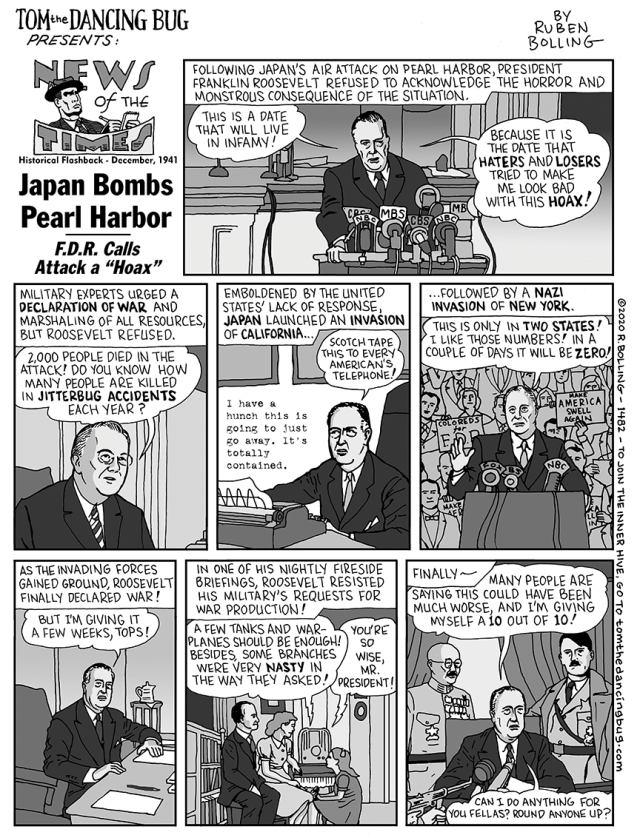
Next we turn to those anti-Trump folks at the Lincoln Project who seem to be producing some of the best political ads of the year so far. If you didn’t know, the Lincoln Project is a group of anti-Trump Republicans headed up by attorney George Conway. Conway is the husband of super speed Trump Administration spokes-liar Kelly Anne Conway:
Sacrifice (1 minute):
Next we go to democraticunderground.com’s Earl G with an excellent representation of how concerned the current president is about our health and safety:

Next we will go back to the Lincoln Project for another fine little video.
Distracted (1.5 minutes):
Now we go to allhatnocattle.com for this view:

A 30 second burn from the Lincoln Project:
Virus In The World
 We need public funding of local newspapers no question about it when things get back to normal. Right now local newspapers are under a terrible strain with the loss of advertising revenue due to the coronavirus economic shutdown and increased health care costs.
On this “news buzz” edition of River to River, host Ben Kieffer speaks with Pulitzer Prize-winning editorial writer for The Storm Lake Times Art Cullen about what he calls an existential crisis for his small town paper. Click on the link at the bottom of the post to help save the paper.
Meanwhile in Coronavirusville, this is a good thing that’s happening:
thehill.com/-democratic-senators-call-for-funding-for-local-media-in-coronavirus-stimulus
More than a dozen senators are calling for any future stimulus package addressing the economic fallout from the novel coronavirus to include funding for local journalism, saying that communities across the U.S. are at risk of losing their source of news because of the pandemic.
“Local news is in a state of crisis that has only been exacerbated by the COVID-19 pandemic,” the senators wrote in a letter sent to the upper chamber’s leadership on Wednesday.
Here is a screenshot of a portion of the letter. Click here to read the entire letter.
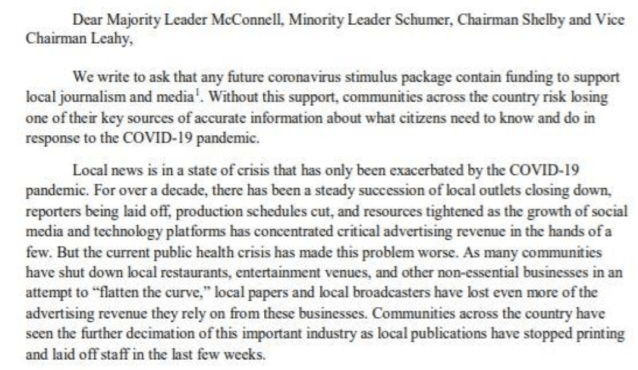
The letter was signed by 18 Democratic senators, including Amy Klobuchar (Minn.), Sherrod Brown (Ohio) and Joe Manchin (W.Va.), as well as Independent Sen. Angus King (Maine).
###
Before you leave, have you chipped in yet to save The Storm Lake Times? Click here to help them reach their goal. They are two thirds of the way there.

The Cullen Brothers owners of The Storm Lake Times. Click on the image to go to their Go Fund Me page.
 Iowa Leaders and Elected Officials Hold ‘Our Lives On The Line’ Digital Town Hall
Town Hall Series Focused on Holding Trump Administration, Senators Ernst & Grassley Along with Congressional Republicans Accountable for Failed Response to Coronavirus Pandemic
Today, April 9, Health Care Voter will continue its Our Lives On The Line digital town hall series with an Iowa town hall to discuss how the coronavirus pandemic has exacerbated the existing weaknesses in our health care system, and how Senators Grassley and Ernst and the Trump administration must respond.
For years, President Trump, Sen. Joni Ernst, (R-IA), Sen. Chuck Grassley (R-IA) and their Republican colleagues have worked relentlessly to undermine Americans’ health care. Even during the coronavirus pandemic, they have continued to put their political interests over the health of the American people by supporting a lawsuit that would repeal the Affordable Care Act. Thursday’s town hall will elevate the voices of Iowans who are demanding that their leaders put lives first.
Co-sponsored by Indivisible, Town Hall Project, Center for American Progress Action Fund, Progress Iowa, Iowa Citizen Action Network, Americans for Democratic Action Iowa, Iowa Alliance for Retired Americans, Indivisible Iowa, Lower Drug Prices Now Iowa, Iowa Main Street Alliance, Tax March Iowa, Alliance for Retired Americans, Iowa Voices and Protect Our Care Iowa, the town hall will feature Black Hawk County Supervisor Chris Schwartz, State President of the Iowa Alliance for Retired Americans Mike McCarthy, and Executive Director of Iowa Citizen Action Network Sue Dinsdale.
WHAT: Our Lives On The Line Iowa Digital Town Hall
WHO: Chris Schwartz, Black Hawk County Supervisor, Mike McCarthy, State President of the Iowa Alliance for Retired Americans, Sue Dinsdale, Executive Director of Iowa Citizen Action Network
Moderated by Rosemary Enobakhare, Health Care Voter Campaign Director
DATE: April 9, 2020
WHEN: 3:00 PM, CDT/4:00 PM, EDT
WHERE: Health Care Voter Facebook
Health Care Voter’s digital town hall series consists of two national and six state-focused Facebook live town halls, featuring members of Congress, governors, local elected officials, advocates, and the medical professionals who are putting their lives on the line to fight the pandemic. Speaker of the House Nancy Pelosi joined a national discussion to kick off the town hall series last week.
Details for the full series of town halls are below:
National Kick Off, March 31 at 6:00 pm Eastern
Arizona Town Hall, April 2 at 5:00 pm Eastern/3:00 pm Mountain
Colorado Town Hall, April 7 at 5:00 pm Eastern/3:00 pm Mountain
Iowa Town Hall, April 9 at 4:00 pm Eastern/3:00 pm Central
Maine Town Hall, April 14 at 3:00 pm Eastern
North Carolina Town Hall, April 16 at 3:00 pm Eastern
Wisconsin Town Hall, April 21 at 4:00 pm Eastern/3:00 pm Central
New Jersey Town Hall, April 23 at 3:00 pm Eastern
Michigan Town Hall, April 28 at 3:00 pm Eastern
National Series Finale, April 30 at 3:00 pm Eastern
Over two years ago, Health Care Voter launched Drive For Our Lives, a nationwide tour to lift up stories about the need to protect the Affordable Care Act. During the first Our Lives On the Line day of action, which kicked off a month-long bus tour, more than 170 rallies were held in 43 states, with hundreds of thousands engaging online including tweets of support from Leonardo DiCaprio, Nancy Pelosi, and Ben Affleck. The bus tour spent a month driving nearly 7,000 miles across the country, rallying in 30 cities and 21 states.
Two years after the first Our Lives On The Line tour, Health Care Voter is going back “on the road” in the middle of a major health care crisis to argue that it’s more important than ever to fight together for access to affordable care, medicines, and vaccines.
To RSVP for the press conference or set up interviews with Health Care Voter spokespeople and partners, please email press@healthcarevoter.org.
# # #
Facebook: https://www.facebook.com/healthcarevoter/
Twitter: https://twitter.com/HealthCareVoter
 by Ralph Scharnau
published with permission
The United States criminal justice system is the largest in the world with more people under some form of correctional control in federal, state, or local prisons and jails. The role of race or ethnic identity in the criminal justice system has been persistent and contentious for many years.
Since the founding of the United States and the introduction of slavery, states, territories, and other governance structures have enacted legislation and adopted policies that have discriminated and segregated African and African-American people. Indigenous people, Hispanics, Asians, and others of non-European descent, received similar treatment at the hands of white officials.
Throughout the history of the United States, race has been an important issue in all aspects of the society, cultural, economic, and political. The abolition of slavery during the Civil War era and the ending of formal racial discrimination during the civil rights era marked racial milestones. Despite the institutional and legal changes that made this possible, race continues to impact the criminal justice system.
Examples of racial bias abound today. Disparities between people of color and whites have been studied and reported when it comes to jury selection, arrest rates, severity of punishment, felony convictions, and restoring voting rights after release from incarceration.
The United States is one of an increasingly small number of countries that subscribe to capital punishment. In late July of 2019, the Trump administration decided to restart federal executions after a 16-year hiatus. The evidence against the death penalty includes findings of racial bias, prosecutorial misconduct, and DNA exonerations of some people on death row.
Statistics reveal the racial biases. A back person is nearly four times more likely to be arrested for marijuana possession than a white person despite equal rates of use. Blacks and Hispanics are more likely to be imprisoned than whites. The U.S. has the highest incarceration rate of any major industrial country. About 70 percent of the imprisoned U.S. population are black and Hispanic. More young black men are imprisoned in the U.S. than attend colleges and universities.
African-American males have a one in four chance of going to prison even though the census figures show a U.S. population composed of 13 percent black. 17 percent Latino, and 61 percent white. Racial profiling continues to be evident in police stops. searches, and use of force during arrests. Non-white arrests of juveniles and transgender individuals exceeds that of the majority population. Similarly. black women are incarcerated at a rate three times higher than white women. Those with prison records often experience employment and voting problems.
The ACLU’s Criminal Law Reform Project (CLRP), focuses on the criminal justice system from policing to sentencing. It seeks to end excessively harsh criminal justice policies that result in mass incarceration, over-criminalization, and racial injustice. The CLRP studies detention and surveillance, police practices, public defense systems. disproportionate sentencing, prosecutorial and/or judicial abuses of authority in the name of public safety, and drug policies which have failed to achieve public health while putting an unprecedented number of people behind bars, CLRP is working to fundamentally change the punishment bureaucracy by reversing the tide of incarceration, protecting constitutional rights, eliminating racism, and increasing government accountability and transparency
Today structural racial/ethnic bias continues to mark our criminal justice system. We should respect the human rights of those who are caught in the criminal justice system. Given the legacy of racial/ethnic discrimination in the United States, this will require persistent efforts to bring greater fairness and equity to our criminal justice system.
Ralph Scharnau
April 2, 2020


