Iowa Pipeline Walk Uncovers New Hero

Kenneth Larkin, Story County, Iowa / photo: fallonforum.com

“All we wanted was to have the house fixed.”  –  Kenneth Larkin

Iowa Pipeline Walk: Day Nineteen
Posted on March 24, 2015

by Ed Fallon

Monday, March 23, 2015 – Cambridge, Iowa
Click here to go to original post at fallonforum.com
For the latest Iowa Pipeline Walk route and schedule detail, click here

I’ve seen plenty of “Gas Pipeline” markers during the course of this walk. Today, I saw my first “Oil Pipeline” marker – on the front lawn of a well-kept farm near Cambridge, Iowa. I wondered about that as I knocked on the door. I was greeted by Kenneth Larkin, and after introducing myself said, “I notice you’ve already got a pipeline running across your property.”

“No,” said Kenneth. “I’ve got five! One carries propane. Two that used to transport LP gas now run fiber optic. The fourth one, the one marked ‘Oil Pipeline,’ doesn’t really carry oil. It carries distillates – gasoline, diesel, aviation fuel, kerosene – and they’re all running through the same pipe with a slug of water in between.”

I had no idea you could transport different fuels through the same pipeline at the same time, merely separated by water. Before Kenneth could tell me about the fifth pipeline, I had to ask:

“So, you’re pretty accustomed to pipelines. I suppose it doesn’t bother you to have one more running across your property?”

“No!,” he said. “I don’t like the pipe I’ve got. They’re dangerous. We had an explosion once.”

He went on to explain in great detail – and with evident mastery of the technical aspects – what caused the explosion to occur. I got out my computer and frantically tried to keep up with him. Failing miserably, I piece together the story as best I can:

The pipeline company takes electricity off the high line. They run it through a box with a wire that goes underground to where it’s attached to the pipeline. That reverses the polarity of the ions in the soil, and the pipeline grabs hold of those ions and expands. But the polarity reversal also eats holes in the copper tubing to Kenneth’s propane tank, and follows a line into the house where the propane meets up with the water heater. When the water heater kicks on . . . KABOOM!

“Someone could have been killed if they’d been near the water heater,” mused Kenneth. “My wife, Judy, who has since passed away, had nick-knacks in the window and the explosion blew them clear out to the road ditch.”

I’m still reeling from Kenneth’s story when he says, “Nope. I don’t want this oil pipeline. 

I think that wind and solar are two of the bases that we should pursue more of. Why do we need fossil fuels? This country has advanced so far, but we’re still using more and more oil.”

In just over 30 minutes, this guy has become my latest hero. He’s against the pipeline for personal reasons AND gets the broader social and environmental concerns.

But I want closure on the explosion. “Did the company compensate you for damages?” I ask.

“Well, we just told them all we wanted was to have the house fixed,” said Kenneth. “They drug their feet and they drug their feet and they drug their feet. Close to a year passed, and our lawyer said we might just as well sue them. The day before we were supposed to go to court, I never will forget. This big, black Cadillac sedan pulls in, and three guys in three-piece business suits out of Tulsa, Oklahoma get out. They pull out one of those big check books. I showed them the bills for fixing the house, and they just wrote us a check, and that was that.”

A happy finish to a story that could have ended much worse. But I am still not satisfied.

“What about that fifth pipeline,” I probe.

“Oh, that one belongs to the Koch Brothers,” concluded Kenneth. “It’s empty.”

“Yeah, I know that,” I said. “Do you have any idea why it’s empty?”

Kenneth tells me about a conversation he had with a Magellan Pipeline Company worker. The guy told him that oil running through that pipeline was a product of fracking. It had salt in it. “That salt was supposedly rusting the seams on the inside of the pipes, and that’s why they’re not using them.”

I asked Kenneth if he felt we could stop this new pipeline from being built. “You don’t have enough money to stop them, and Branstad has already sold us down the water,” said Kenneth. “But if the company is not allowed to use eminent domain, then they can be stopped.”

“And as far as I’m concerned,” said Kenneth, “they ain’t coming on my property.
Posted in Ed Fallon, Environment, Farming, Frac Sand Mining, fracking, Local Events | Tagged , , | Comments Off on Iowa Pipeline Walk Uncovers New Hero

Bakken Pipeline Resistance Iowa Meetings

Bakken Pipeline Proposed Route(Editor’s Note: Cheryl Valenta, Bakken Pipeline Resistance Coalition, announced three informational meetings in Cedar Rapids, Cedar Falls and Iowa City about the Dakota Access Oil Pipeline proposed to the Iowa Utilities Board in January).

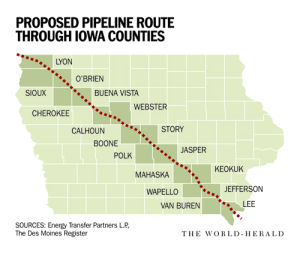
Have you heard about the proposed crude oil pipeline project that will cut through 18 counties in Iowa?

The Bakken Pipeline Resistance Coalition will host an informational meeting and conversation at the Cedar Rapids Public Library about the proposed Bakken oil pipeline on Thursday, April 2, at 7 p.m. in Beems Auditorium, rooms A and B. Taylor Broby, an ISU student from North Dakota and Cheryl Valenta with the coalition will speak, and a short video will be shown with time for questions. Plan to attend to learn about the potential impact to Iowans. Bakken Pipeline information can be found at NoBakken.com.

Another opportunity: the Iowa City Sierra Club will host a similar meeting at the Iowa City Public Library on Wednesday, April 15, at 7 p.m. Wally Taylor, chair, Iowa Sierra Club and Cheryl Valenta will speak.

Earlier that day, UNI is hosting a conference “The Ethics of Energy Production,” UNI Maucker Union, April 15 from 9 a.m. until 4 p.m. Discussion will relate to the proposed Bakken crude oil project, and the Rock Island Clean Line project, with representatives from all angles speaking on these issues. This conference is free, but you must register by calling: 319-273-6194. Full details are here:
http://business.uni.edu/web/pages/departments/energyproductionevent.cfm.

Please take the time to be informed on these important issues. The future of Iowa depends on people who care about the earth.

We hope you can join us. Thanks.

Cheryl Valenta
Bakken Pipeline Resistance Coalition
valenta.cheryl@gmail.com

Posted in Energy, Environment | Tagged , , , , , , , | Comments Off on Bakken Pipeline Resistance Iowa Meetings

This Week On The Fallon Forum: House Rural Caucus Update

fallon forumEd talks about the Pipeline Walk with State Rep. Dan Kelley today at 11:00 a.m. Also, State Reps. Bruce Bearinger and Sally Stutsman discuss the House Rural Caucus – Catch the Fallon Forum live on Monday from 11:00 am – 12:00 noon on KDLF 1260 AM (Des Moines)   Join the conversation by calling in at (515) 528-8122. And you can hear the Fallon Forum on KHOI 89.1 FM (Ames) at 4:00 pm on Wednesday and on KPVL 89.1 FM (Postville) at 7:00 pm on Wednesday.

Iowa Pipeline Walk: Day Seventeen & Eighteen

Thursday, March 19, 2015 – Mingo, Iowa/Friday, March 20, 2015 – Maxwell, Iowa

For original blog with photo, click here.
For the latest Iowa Pipeline Walk route and schedule detail, click here.

Walkin’ the Bakken is proving to be a bigger undertaking than I imagined. My deepest thanks to all of you along the route who have helped with logistics or who have walked with me. Thank you, thank you, thank you!

I also want to acknowledge three colleagues who are making a huge difference in the success of the Walk. Shari Hrdina, who served as the Administrative Director of the Great March for Climate Action, keeps all the pieces from falling through the cracks. And there are so many pieces! Shari is the glue behind the scenes, and we could not do this without her.

Peter Clay works with our local supporters along the route to organize meetings. Peter joined last year’s Climate March for 700 miles, and is now instrumental as a volunteer with the Bakken Pipeline Resistance Coalition. He continues to keep us networked and supporting each others’ efforts.

Landowners are asking lots of legal, procedural and technical questions that I can’t answer. Managing this critical task is David Goodner of the Des Moines Catholic Worker. David is one of the most promising young organizers I know, and he’s getting back in touch with the hundreds of landowners and rural Iowans I’ve met along the Walk.

Of course, with legal questions, it helps to have . . . a lawyer! Several experienced attorneys are working with landowners and other parties opposed to the pipeline. Wally Taylor with the Iowa Chapter of the Sierra Club and I recently discussed the contracts signed by landowners – many of whom are opposed to the pipeline. Here’s what Wally shared:

“A number of attorneys agree that the easements landowners are signing or being asked to sign by Dakota Access have serious problems that adversely impact landowners. In fact, for landowners who have already signed easements, they could declare the leases null and void. Landowners should not sign anything until they have discussed the easements with an attorney. Review by an attorney would only require a short conference that would not be very expensive but would save the landowners a lot of heartache.

“We have also discovered that Dakota Access is now presenting an addendum to the easement to provide insurance coverage. The insurance allegedly covers liability of the company up to $5 million per year. This is per occurrence, not per landowner. There is also an additional umbrella coverage for another $5 million. One problem with this is that $10 million doesn’t even begin to cover the cost of cleanup.

“Other pipeline spills have incurred costs of hundreds of millions of dollars, or even over a billion dollars. Another problem is that this is an insurance policy. Anyone who has dealt with insurance companies knows that the company will either deny coverage or try to limit the amount of the insurance payment. A landowner would have to take legal action to be properly compensated, Ed-walking-down-countryside-low-large-300x244involving great time and expense.”

More and more Iowans are stepping forward to help defeat the pipeline. Perhaps you are already engaged as well. If not, and if you’d like a niche in this critical undertaking, let me know and we’ll make it happen!

Posted in Climate Action, Climate Change, Fallon Forum | Tagged , , , , | Comments Off on This Week On The Fallon Forum: House Rural Caucus Update

Iowa Lawmaker Gets A Laugh Not In A Good Way

iowa lawmaker reading book

Ross Paustian Republican Party State House District 92 Scott County 389 West Parkview Drive Walcott, IA 52773 563-284-6783 Ross.Paustian@legis.iowa.gov

Friday, March 20, 2015:

Another testy week in Des Moines.

We all certainly could use a laugh to lighten the mood in the Capitol building, but, once again, an attempt at such got very lost in translation. A silly book title (with blank pages inside, I am told), an inappropriate caption for a picture of a representative holding said book, and social media converged to send an inaccurate picture of Iowans nationwide.

No laughs, and less motivation to dialogue and work together.

Today we have the third example in little over a week of how far we are from substantive debate. Republicans brought forth HR 8, encouraging a constitutional amendment to restrict the authority of the federal government. Yesterday, we had the discussion on changing the collective bargaining procedures for teachers. Last week we had discussion about prerequisites for performing abortions.

Hopefully, all three of these are dead, dead, dead in the Senate chamber. Republicans were likely aware of this fate, and although referring to the proposed changes as minor in scope, and knowing that there would be principled opposition to each, they engaged all of our legislators in a certain waste of time and money.

I would feel better about the floor time spent on these, if anyone had brought up sincere points that had a chance of educating and changing minds on these issues. But there were none. There was no attempt to present a thorough picture of all the tangents in each issue. No one started these floor “debates” with even the slightest intention of listening for new information, and that is where the disrespect of bringing these issues up at all, solidifies into rancor and distrust.

We get it, that you disapprove of abortion. But making it illegal, or harder to access, doesn’t end it. Doesn’t even lower the numbers substantially. Punitive laws that make no difference to reducing those numbers are not Christ-oriented, just vengeful.

We get it that you hate taxes. Change the debate to focusing on our current and future common needs, not finding arbitrary levels of “low taxes.”

We get it that you want to root out inefficiencies in education. Show us that this is not a backhanded attempt to dismantle public education, by being as vigorous about finding inefficiencies in other areas.

We get it that you don’t like “government.” But there will always be “governing” by some process, and a representative democratic republic is always a better choice than the oligarchy/theocracy that republicans are pushing for, no matter what size it is. Smaller does not equal efficient, period.

Posted in Iowa legislature 2015 | Tagged , | 1 Comment

School Funding, Payroll Debit Cards, Texting: The Courtney Report

tom-courtney-2

Editor’s note: This is an excerpt of the weekly newsletter from Senator Courtney. For the full newsletter, please go to his website


CALL THE GOVERNOR: IOWA STUDENTS ARE WORTH MORE

If the future of Iowa children, job creation and economic growth matter to you, please make your voice heard on funding for our students and schools.

The House and Senate are in gridlock. The Senate has approved a 4 percent increase in funding for our K-12 schools. However, House Republicans have voted to scale back educational opportunity with a meager 1.25 percent increase. That is not enough to keep up with rising costs, let alone compete with other states.

When asked about the impact on their students, Iowa school superintendents said they would have to increase class sizes, fire teachers, delay buying new classroom materials and reduce course offerings. Iowa is already more than $1,600 below the national average in annual per-pupil investment. The result is that other states are increasing student achievement faster than Iowa and out-performing us.

Iowa is competing with the world for high-skill, high-wage jobs. We must increase our commitment to great schools, student achievement and teacher quality.

Contact Governor Branstad and tell him to break the gridlock on school funding. Call his office at 515-281-5211 or send him a message at www.governor.iowa.gov/constituent-services/register-opinion.

MAKING STATE GOVERNMENT MORE ACCOUNTABLE & TRANSPARENT
Over the last year, the Senate Government Oversight Committee has investigated numerous allegations of hush money, slush funds, black lists and lack of transparency throughout Governor Branstad’s administration.

This week, the Senate approved SF 321 to ensure state agencies that save money by purchasing through the state’s master contracts get those dollars back. The Department of Administrative Services would no longer be able to retain rebates and use them for its own purposes. Rebates would be returned to the rightful agency, rewarding them for their fiscal responsibility while adding accountability and transparency to state spending.

In addition, we hope to restructure the state’s infamous “black list.” In the past, Iowans had no idea they were on this black list — also known as a “do-not-hire” list — unless they applied for a state position and were denied.

Senate File 332 would establish procedures for putting somebody on the state’s do-not-hire list, which would make them ineligible for state agency employment. Under the bill, the Department of Administrative Services may only designate an individual as ineligible for state employment under specific circumstances. The individual must be notified of their status at the time of termination and has a right to appeal.

The bill also requires the Department of Administrative Services to post all vacant positions, with a public announcement of vacancies at least 10 days in advance of the application deadline. This will allow all qualified individuals the chance to find out about job openings.


PAYROLL DEBIT CARDS MUST BE FAIR FOR IOWA WORKERS

This week, the Senate approved legislation aimed at clarifying the law regarding payroll cards. A payroll card — which is similar to a debit card — is an increasingly popular way to pay employees.

Legislators recently heard from Iowans who came to the Statehouse to tell their stories. We learned that many Iowans don’t have a choice in how they are paid and may incur high fees when paid by payroll card. Nobody should have to pay a fee to collect their wages.

Senate File 460 is a simple, common sense bill that aims to protect the pay and rights of employees.

SF 460 requires an employee to agree voluntarily to payment via a payroll card. The agreement must be in writing, and the employee must have the option to withdraw all the wages due in a pay period without incurring a fee. The bill also requires the employer to keep the records of consent and to provide another payment method if an employee requests it at a later time.

GETTING TOUGHER ON TEXTING WHILE DRIVING
Texting while driving is dangerous. Between 2001 and 2013, more than 8,600 Iowa crashes were caused by drivers distracted by a phone or other device. These crashes resulted in more than 4,200 injuries and dozens of deaths.

In 2010, Iowa made it a crime to write, read or send a text message while driving, but the law is a secondary offense. That means officers can only write a ticket for texting if they pull you over for speeding or another violation.

Polls show more than 80 percent of Iowans want tougher laws for texting while driving. Texting behind the wheel is a primary offense in 39 other states, including Minnesota, Wisconsin and Illinois. That gives officers the authority to pull over a driver specifically for texting.

Iowa will join those states if Senate File 391, approved this week by the Senate, becomes law. The bill makes texting while driving a primary offense and clarifies that the texting ban is applicable to any electronic communication done by hand.

Texting makes the chance of an accident 23 times greater because it involves three types of distraction– it takes our mind off driving, our eyes off the road and at least one hand off the steering wheel. Drivers who text have slower reaction times, are 70 percent less likely to stay in their lane and often fail to notice traffic signs.

Teens have been the primary focus of Iowa’s texting and driving laws and education efforts. Texting results in car crashes that kill an average of 11 teens each day nationwide.

However, many parents don’t set a good example for their kids. When educators from the Governor’s Traffic Safety Bureau talk with Iowa teens, half the students say their parents text while driving.

Learn more about the dangers of texting while driving at www.iowadot.gov/CurbItClickIt/facts_stats.html.

Posted in Blog for Iowa, Courtney, Courtney Report, Economy, Education, Iowa legislature 2015, Jobs | Tagged , | Comments Off on School Funding, Payroll Debit Cards, Texting: The Courtney Report

Simply Stated: A Party Is Its Budget

republican budget

Surely this is not the first time you have heard this: budgets are moral documents. They also are the means by which political parties translate all their rhetoric and advertisements into actual policy. When you hear Republicans claim that they support Social Security, check their budget. Do they support the lowly grunts in the military? Check the budget. Access to health care for all? Check the budget. What about education?

In simple terms, the Republican budget lays bare the plans of Republicans to take health care from large swaths of people, take food from families, take away unemployment compensation and in short totally shred what is left of the social safety net. In return they give more huge tax breaks to the wealthy. Trickle down is still their mantra. Trickle down didn’t work then and it doesn’t now. The idea that some rich person’s cup will overflow spilling some money on us peons is insane. The cups grow forever.

Beyond the cruelty to the mass of Americans, the biggest fallacy of a Republican budget is that it spurs the economy. An economy runs on money moving in the system, not on it being stagnant in a few hands.

Once more the Congressional Progressive Caucus has released their budget. This is a budget that puts the people first. Getting money into the hands of those who will spend it is also the best way to make the economy grow. Why you ask? Because demand creates economic activity. The poor and middle class have a huge amount of pent up demand that will drive the economy just as it drove the economy in the years before Ronald Reagan.

Meteor Blades over at dalykos has a good quick analysis of the budget being offered by the CPC. You had better read it there because you know our major media will totally ignore it.

Posted in Blog for Iowa, Budget, Economy, Hunger In America, progressive values | Tagged | Comments Off on Simply Stated: A Party Is Its Budget

Sunday Funday: The High Holy Days Of Basketball Edition

These guys now have time to take the quiz

These guys now have time to take the quiz

It only comes but once a year, so let’s all try to wring every ounce of joy out of this holiday season. May the gods and goddesses of the scoring table smile kindly on your team.

Were you paying attention last week or were you in front of the TV?

1) Senate Leader Mitch McConnell is using a vote on Human Trafficking to delay a vote for what Obama nominee?

2) Twenty years ago on March 20th, Tokyo subways were attacked by terrorists who used what for their attack?

3) Netanyahu was re-elected as Prime Minister of Israel. He needs a coalition of a majority of the Knessit. How many seats are there in the Knessit?

4) Tom Cotton, junior senator from Arkansas, has picked up quite a nickname due to his authorship of the letter to Iran. What is that nickname?

5) One of the most powerful cyclones ever, Pam, devastated what tiny island nation?

6) What state has implemented some extraordinary measures in response to water shortages?

7) In the Muncie, Indiana Walmart restroom, a local man was running what business?

8) The Secret Service has asked congress for $8 million in order to build an exact replica of what building?

9) The state of Iowa placed how many teams in the NCAA tournaments?

10) Mortal sin, Iowa style. What candidate’s campaign advisor tweeted offensive things about the Iowa caucuses?

11) A letter sent to the White House was laced with what substance?

12) There was a resignation from the US House last week. Who resigned and why?

13) John Rowland, former governor of what state, was sentenced to 30 months in prison for violating clean election laws?

14) What former presidential candidate and former heavyweight boxing champion have arranged to have a charity boxing event?

15) Democrats and Republicans in the Iowa senate agree, doing what while driving is not a good idea?

What happened to ISU? I had them going all the way!

1) Loretta Lynch

2) Sarin gas

3) 120. Netanyahu needs to control 61

4) Tehran Tom

5) Vanuatu

6) California

7) a meth lab

8) the White House

9) 5 – 3 in the men’s tournament and 2 in the women’s.

10) Scott Walker

11) cyanide

12) Aaron Shock of Peoria. He resigned due to investigations of his spending.

13) Connecticut

14) Mitt Romney and Evander Holyfield

15) texting

Posted in Humor | Comments Off on Sunday Funday: The High Holy Days Of Basketball Edition

Iowa’s Problem Of Priorities

Iowa Fiscal Partnership
Once again the folks at Iowa Fiscal Partnership provide solid analysis on why Iowa is having trouble funding even its most basic services at a time when politicians of all stripes claim the economic outlook in this state is good. The answer lies in the priorities that Iowa’s legislators set. Like so many states these days, priorities are skewed to the immediate gratification of business owners at the expense of their customers, the citizens of Iowa.

Peter Fisher, Research Director at Iowa Policy Project, offers a concise analysis in this backgrounder at the Iowa Policy Project. Fisher’s conclusion is also very concise:

We have a problem of priorities. We keep underfunding services for average Iowa families — education, health, work supports, natural resources — in order to finance massive tax reductions to businesses that don’t need it. And we spend in excess of $350 million each year on business tax credits that continue on autopilot, with no sunset, despite the state’s own analyses that fail to find evidence of appreciable benefit to the state from some of the largest of these subsidies.[7]

It is time to admit that the tax cuts enacted in 2013 were excessive, and are causing long term damage to the state. At the very least, the $50 million increase in the business property tax credit portion of those tax cuts scheduled for next year should be delayed or eliminated.

But that is not enough. There should be a moratorium on any further tax cuts or tax credits. All business tax credits should be subject to effective caps and sunsets to force a serious evaluation.

Without such measures, we will continue down the road of tax-cutting our way to mediocrity and shortchanging our children’s future.

Handing out favors to businesses will not meet what should be Iowa’s real priorities. It is not working in other states either. The booming state economies – California and Minnesota – have budgets that put people first and have raised taxes.

Posted in Budget, Economy, Education, Iowa Legislature, Iowa legislature 2015, Iowa Policy Project | Tagged , | Comments Off on Iowa’s Problem Of Priorities

Ed Fallon On The Iowa Bakken Oil Pipeline

Bakken Pipeline Proposed RouteBlog for Iowa caught up with Ed Fallon in Iowa City at a March 11 fundraiser for his Iowa Pipeline Walk along the proposed route of the Dakota Access oil pipeline from the Bakken shale formation through Iowa to Illinois.

Fallon presented a slide show of his experiences on last year’s Great March for Climate Action across the U.S., and answered questions during an event attended by about 35 supporters.

Discussions ranged over a variety of related topics. Two seemed most important: eminent domain and an environmental study of the Dakota Access pipeline.

Rep. Bobby Kaufmann (R-Wilton) is leading a bipartisan effort to restrict use of eminent domain by private companies like Dakota Access in Iowa.

“I intend to introduce legislation in the Government Oversight Committee,” Kaufmann said in an email to constituents. “My committee is funnel proof and next week I will introduce an Eminent Domain Omnibus bill that will attempt to address the numerous eminent domain abuses going on throughout the state.”

When asked about the legislation, Fallon acknowledged the several bills filed regarding eminent domain had not yet been finalized into one.

“My biggest hope is it defines public use so clearly that you can’t come in and build a pipeline across Iowa and use eminent domain to build that,” Fallon said. “Because it’s not oil that’s being used here, it’s not being produced here, it’s being refined in Texas and shipped for the most part overseas.”

A bipartisan group of legislators sent a letter to the Iowa Utilities Board asking the regulatory body commission an environmental impact study of the proposed Dakota Access oil pipeline.

According to the Cedar Rapids Gazette, the letter raised eight concerns:

1. Safety risks and hazards associated with the product(s) to be transported through the pipeline;

2. Potential damage to water, land, soil, water, air and wildlife/wildlife habitat during construction;

3. Threats to the environment, farmland, wildlife and public health as a result of spills or explosions;

4. Spill prevention and clean up provisions;

5. Liability for damages to both public and private property and sufficiency of resources to cover such liability;

6. Adequacy of inspection/monitoring/enforcement mechanisms and resources;

7. Responsibility for planning, training, and equipping for emergency response;

8. Indirect impacts of the oil extraction process facilitated by the pipeline that may affect public health and safety as well as environmental security.

“If studying the environmental impact is something we do before we decide to move forward on this, then that has value,” Fallon said. “But if it’s something we do after the fact, after the damage is done, after the decision is made, then it’s kind of a moot point.”

During the question and answer session, Jack Knight of the Allamakee County Protectors indicated that delaying the IUB approval process through an environmental study was a valuable tactic in preventing the oil pipeline from being built.

Opponents of the Dakota Access oil pipeline have a bigger issue and Fallon touched upon that during our interview.

“Based on what the entire scientific community is telling us, that oil needs to remain in the ground,” he said. “Really this conversation about the pipeline is a sidebar, but a really important one.”

For more information about Fallon’s work, Blog for Iowa recommends, “Hitting the Pavement,” in the March 16 issue of the Newton Daily News, or follow him on FallonForum.com.

Posted in Ed Fallon, Energy, Environment, Fallon Forum, fracking | Tagged , , , , , , | 1 Comment

Water Summit March 21st

water-summit-scene-logoeicc.edu/news4/water-summit

Water quality is one of the most important environmental issues facing Iowa today. But understanding the many different issues and aspects involved in it can be difficult.

Quad Citians have a rare opportunity to learn more and have their questions answered at the March 21st Water Summit: An Environmental Event Focusing on Iowa’s Water Quality. Hosted by Davenport SCENE, the event will be held in the Davenport West High School Auditorium, 1 – 3 p.m., and is free to the public.

A panel of five experts from the agricultural community, local and state government, and private business has been selected to lead the discussion and answer questions. All five are intimately involved in issues dealing with water quality across the state of Iowa.

Attendees to the event will increase their understanding of water issues, and learn how Iowans can respond to improve and protect our water quality.

The panelists include:

Sean McMahon, Executive Director of the Iowa Agriculture Water Alliance (IAWA). The IAWA is a nonprofit organization committed to advancing the success of the Iowa Nutrient Reduction Strategy by increasing farmer awareness of the initiative and their adoption of science-based practices proven to have quantifiable environmental benefits. It was created and is funded by the Iowa Corn Growers Association, Iowa Soybean Association and Iowa Pork Producers Association.

As executive director, McMahon works to champion farmer adoption and engagement in conservation and production practices for continuous improvement of nutrient management and water quality.

Randy Moore, President, Iowa American Water Company and Member of the EPA’s National Drinking Water Advisory Council (NDWAC). Iowa American Water is the largest investor-owned water utility in the state, providing water services to approximately 195,000 people. In his role, Moore works to strengthen customer, regulatory and local government relationships, drives operational and financial results and is the principal external contact for American Water in Iowa.

NDWAC provides practical and independent advice to the U.S. EPA on matters and policies related to drinking water, including regulations and guidance required by the Safe Drinking Water Act. The council may also propose actions to encourage cooperation and communication on drinking water quality among the EPA and other governmental agencies, interested groups, the public and technical associations and organizations.

Dr. Mary Skopec, Senior Research Scientist for the Water Monitoring and Assessment Section (WMAS) at the Iowa Department of Natural Resources/Geological Survey Bureau (GSB) and Coordinator of the IOWATER Volunteer Water Quality Monitoring Program. At the GSB, she has worked on a variety of water quality projects including the development of a statewide database to track pesticide occurrences in Iowa’s water resources. Dr. Skopec currently coordinates the WMAS analyses of data from the statewide Ambient Water Monitoring Program.

IOWATER is a project of Iowa’s Department of Natural Resources. It trains volunteers to conduct basic water chemical, physical and biological measurements. Its mission is to protect and improve Iowa’s water quality by raising citizen awareness about Iowa’s watersheds, supporting and encouraging the growth and networking of Iowa’s volunteer water monitoring communities, and promoting water monitoring activities as a means of assessing and understanding Iowa’s aquatic resources.

Bill Stowe, CEO and General Manager of Des Moines Water Works (DMWW). Stowe has served in his current position since 2012. His previous positions include Assistant Manager-Public Works/Engineering for the City of Des Moines, Human Resources Director for the City of Des Moines, Operations Manager for MidAmerican Energy, as well as an analyst for Shell Oil, labor relations representative for Inland Steel Industries and a field examiner for the National Labor Relations Board.

Dr. Franics Thicke, Owner/Operator of Radiance Dairy and member of the National Organic Standards Board (NOSB). An organic farmer for more than 30 years, Dr. Thicke currently operates an 80-cow, certified organic dairy in Fairfield, producing milk, cream, yogurt and cheese for sale at local grocery stores and restaurants. He has been active in many organic and environmental organizations including the Iowa Environmental Protection Commission, the Leopold Group Sierra Club in Southeast Iowa, Food Democracy Now, the Organic Farming Research Foundation and the Midwest Organic and Sustainable Education Service.

NOSB is a Federal Advisory Committee whose members are appointed by the U.S. Secretary of Agriculture. The NOSB advises USDA on which substances should be allowed or prohibited in organic farming and processing, based on criteria under the Organic Foods Production Act. As a member of NOSB, Dr. Thicke also serves on its Environmentalist/Resource Conservationists Subcommittee.

Davenport SCENE (Sustainable City Empowered Network for Education) is supported by a grant from the U.S. Institute of Museum and Library Services.

Davenport SCENE is a unique partnership of several local agencies including Eastern Iowa Community Colleges/Scott Community College Library and the college’s Advanced Technology Environmental and Energy Center, Figge Art Museum, Davenport Public Library, Nahant Marsh Educational Center, Quad Cities Food Hub, Junior Achievement, Living Lands and Waters, and River Music Experience.

The goal of the partnership is to advance the science and information literacy of Davenport residents of all ages regarding environmental sustainability and energy efficiency in order to move Davenport toward becoming a sustainable city.

For more information call 563-441-4150.

Posted in water | Tagged | Comments Off on Water Summit March 21st