Hope Springs From Saturday

Photo Credit: Des Moines Register

Photo Credit: Des Moines Register

In the life of a political activist, only occasionally do events transpire that make our efforts seem worthwhile.

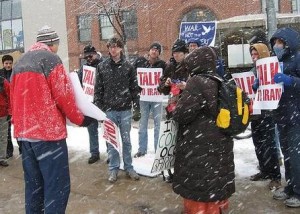
It began during the George W. Bush administration with inauspicious red and white signs that simply said, “Talk to Iran.”

On Saturday, Jan. 16, Secretary of State John Kerry announced,

Today, more than four years after I first traveled to Oman at the request of President Obama to discreetly explore whether the kind of nuclear talks that we ultimately entered into with Iran were even possible, after more than two and a half years of intense multilateral negotiations, the International Atomic Energy Agency has now verified that Iran has honored its commitments to alter – and in fact, dismantle – much of its nuclear program in compliance with the agreement that we reached last July.

The United States not only talked to Iran, but convinced them — not only through verbiage, but with tough, international economic sanctions — that they should end their nuclear program. It worked as Secretary Kerry indicated.

It is days like today that give us hope that peace in the world is more than something nice to say to friends and colleagues. Peace has a tangible basis in reality, part of which this president, his administration and the P5+1 nations helped bring about.

Already the voices of extremism criticize the results of the Iran Deal, saying sanctions relief will fund extremism by the powerful Islamic nation. Perhaps what they hate most is the fact this president succeeded where none of them would even take the first step.

There are legitimate concerns about Iran’s future policies, actions and choices in the Middle East. However, this subzero day in Iowa we understand and can take heart in the fact that every so often it is possible to break out of the world of paper promises, social media and itinerant gossip to create a reality that includes the reduced threat of nuclear weapons.

This political cycle there is talk about the United States withdrawing from international engagement: the Iran Deal, the COP21 climate agreement and more. Some presidential candidates talk about building a wall around our country to keep people out. Such actions would be to our detriment.

The world is a scary place, and what is scarier is our lack of action to address the gravest threats of our time. Nuclear abolition and mitigating the causes of global warming are at center stage calling for action. Partly, the solution lies in talking — as we did with Iran — as international partners. Partly it lies in empowering women, world-wide, and educating girls. Solutions to our problems exist or can be developed if we persist.

Saturday’s results provide hope that peace is possible with the international community working together.

If a person blinked, they might have missed what just happened. Hopefully, more of us will be inspired by what happened with Iran and engage in the tough problems facing us before it is too late.

Posted in Nuclear Abolition, Nuclear Disarmament | Tagged , , , , | Comments Off on Hope Springs From Saturday

MLK Day 2016 Iowa Events

MLK with flag

Many events are planned for Monday’s national MLK Day of Service and observance of civil rights leader Martin Luther King Jr.’s birthday.

SERVICE: The website www.allforgood.org includes a database of formal projects planned for Monday, including several in the Des Moines area. Several organizations are soliciting donations of clothing, food and personal items.

This is a selection of Des Moines-area donation sites and other holiday events:

AMES: Birthday celebration, 6:30 p.m., Ames Middle School, 3915 Mortensen Road. Cake and a program commemorating King’s life and service.

DES MOINES: MLK prayer breakfast, 7:30-9:30 a.m., Community Choice Credit Union Convention Center at Veterans Memorial, 833 Fifth Ave. $30. Proceeds benefit the Grubb Annual Campaign. Includes breakfast and a keynote address by Olympic athlete Jackie Joyner-Kersee. Registration required at http://midwestix.securemytix.com/event/3910600.

DES MOINES: Martin Luther King Jr. celebration, 4 p.m., Forest Avenue Library, 1326 Forest Ave. Program honors King’s legacy.

DES MOINES: Speech by Alveda King, niece of Martin Luther King Jr. and pastoral associate for Priests for Life. 6-7:30 p.m., North High School auditorium, 501 Holcomb Ave. Free. Hosted by Concerned Women for America of Iowa. A $25 breakfast follows at 7:30 a.m. Tuesday at Airport Holiday Inn and Conference Center, 6111 Fleur Drive in Des Moines.

DES MOINES: Donation collection for families in need, Iowa College Student Aid Commission, 430 E. Grand Ave., floor 3. Bring toilet paper, diapers sizes 3, 4 and 5, baby formula, wipes, personal hygiene goods, toothbrushes, shampoo and conditioner. Call 818-471-2198 for information.

URBANDALE: Imagine Enough for Everyone, 9 a.m.-2 p.m., Urbandale Public Library, 3520 86th St. Bring new personal care items, scarves and hats, and food items. You can also knit and color on site and pledge action against hunger. www.ImagineEnough.com.

Eastern Iowa

Cedar Rapids

African American Museum of Iowa

Monday: 3 p.m., “The Life and Legacy of Dr. Martin Luther King Jr.” Museum educator Krystal Gladden will put King’s work into the context of the opposition to desegregation, especially in the South. 3:45 p.m., “The Children’s March.” Film detailing events leading up to the Birmingham March on May 2, 1963, when hundreds of children faced police dogs, fire hoses and arrest to march against segregation. Details: 55 12th Ave. SE; admission by donation; programs appropriate for ages 10 and up, parental guidance recommended; (319) 862-2101 or Blackiowa.org

Coe College

Monday: “A Day On, Not A Day Off,” morning speeches and music open to the public, afternoon service activities by Coe community. 9:30 a.m., Welcome by Coe President Dave McInally; 9:45 a.m., music by gospel singers; 10 a.m., keynote address by Brie Swenson-Arnold, Coe associate professor of history; 10:45 a.m., speeches and slam poetry by Coe students; 11:45 a.m., closing remarks by community leader Stacey Walker, with more gospel music. Details: Kesler Lecture Hall in Hickok Hall, 1220 First Ave. SE; free; Coe.edu/aboutcoe/coenews

MOUNT MERCY UNIVERSITY

Monday: Discussion on King’s “I Have a Dream” speech, 3:50 to 5 p.m., Betty Cherry Heritage Hall; student service projects during the day. Details: 1330 Elmhurst Dr. NE, Mtmercy.edu

ST. PAUL’S UNITED METHODIST CHURCH

Sunday: DeAmon Harges, community builder and social innovator, preaching at 8:15 a.m. in the chapel, 9 a.m. in the sanctuary, 10:30 and 11:30 a.m. in the Wesley Center; he also leads a workshop from 3 to 4:30 p.m. in the Wesley Center. Monday: 7 p.m., sanctuary, 26th Annual Community Observation Celebration, with Harges speaking about asset-based community development and presentation of the Dr. Percy & Lileah Harris “Who Is My Neighbor?” award. Details: 1340 Third Ave. SE; Stpaulsumc.org

Iowa City

The Spot

Monday: Community project, 9 to 11 a.m.; awards ceremony, 11 a.m., highlighting area youth, plus entertainment; community project, 2 to 4 p.m. Sponsors: Neighborhood Center of Johnson County, Black Voices Project, AmeriCorps, United Action for Youth, Community Partnerships for Protecting Children, Iowa Legal Aid, and Johnson County Social Services. Details: 1030 Crosspark Ave.

University of Iowa

MLK Celebration week includes a student service day Monday, followed by speakers and special programs, all free and open to the public. Mlk.uiowa.edu/#events

Monday; Day of Service for UI community; public food/item drive for the Shelter House and Crisis Center, at local Hy-Vee food stores (need list at Mlk.uiowa.edu/#events)

Tuesday: 7:30 p.m., speaker Jamilah Lemieux of Brooklyn, N.Y., digital news and lifestyle editor for Ebony magazine; Main Lounge, Iowa Memorial Union, 125 N. Madison St.

Wednesday): Noon to 1 p.m., Martin Luther King Jr. Distinguished Lecture by Paul Farmer, Kolokotrones University professor of global health and social medicine at Harvard Medical School; Room 1110A, UI Medical Education Research Facility, 375 Newton Rd.; 5 to 6:30 p.m., Chief Diversity Office’s 2016 Update on Diversity and Inclusion, Iowa Theater, Iowa Memorial Union, 125 N. Madison St.

Thursday: 11:30 a.m. to 12:30 p.m., “White Privilege: Racism, White Denial, and the Cost of Inequality” film screening and reception, Ellig Classroom (N120) College of Public Health Building, 145 N. Riverside Dr.; noon to 12:50 p.m., speaker Dr. Chris Buresh, Room 1117, Medical Education Research Facility, 375 Newton Rd.

Feb. 19: Noon to 2 p.m., Martin Luther King Jr. Research Symposium, Jones Commons, N300 Lindquist Center, 240 S. Madison St.

West Branch

Herbert Hoover Presidential Museum

Monday: 2 p.m., “Selma” screening. The 2015 movie chronicles the tumultuous three-month period in 1965 when King led a campaign to secure equal voting rights. The epic march from Selma to Montgomery culminated in President Lyndon Johnson signing the Voting Rights Act of 1965. Details: Figge Auditorium, 210 Parkside Dr.; free with paid museum admission, free to $10; Hoover.archives.gov

Quad Cities

Events celebrating Martin Luther King Junior Day will not only recognize the civil rights leader’s birthday, but also look to the future. Monday, residents in the area will have several chances to remember the national holiday.

United Neighbors in Davenport will hold its annual King Day Celebration from 10:30 am until noon. Ida Johnson, a member of Women’s Connection and a past recipient of the Iowa MLK Lifetime Achievement Award, will be the guest speaker.

In Rock Island, the King Center will hold its 33rd annual Memorial Service and Awards Celebration, from 10:30 am until noon. The guest speaker will be Reverend P. Wonder Harris, who will talk about breaking the “silence of injustice.”

In Galesburg, Knox College will present its Martin Luther King Convocation at 11 am. Three faculty members will speak, on issues like protesting, and the college’s choir will perform.

Posted in Local Events | Tagged , , , | Comments Off on MLK Day 2016 Iowa Events

Five Years Ago On Feb. 1st

traffic in Chicago on Feb. 1, 2011

traffic in Chicago on Feb. 1, 2011

Just a gentle reminder of what can happen in Iowa in February. Five years ago one of our family was making a major career move that involved a cross country move. Lucky for them and the sibling that helped, the move was to the south and they were able to avoid one of the worst blizzards anyone alive can remember.

As for the rest of us, well, we got buried up to our butts in fluffy white. As if that wasn’t enough, the wind blew at about 40 miles per hours resulting in buried cars and doors blocked by snow.

In case you forgot the caucus is on Feb. 1st this year. Let us hope for cool and dry.

WQAD map of accumulations  Feb. 1, 2011

WQAD map of accumulations Feb. 1, 2011

Posted in 2016 Election Campaign, Iowa Caucuses | Tagged | Comments Off on Five Years Ago On Feb. 1st

Sunday Funday: Debate Day Edition

but can they pass the quiz?

but can they pass the quiz?

There will be a real debate among candidates who truly want to lead this country and are prepared through their experience and temperament to do so. Therefore, it will be in contrast to the junior high lunch room food fights over who can hate the most people and groups. Real issues will be discussed and real world solutions will be offered. Hopefully,  Americans will be able to deal with this type of format. Hopefully, most Americans will be informed enough to understand real issues.

Also, unlike the recent Republican debate, this debate will be shown on network television – NBC – at 8PM central time. And one more major difference will be that the moderator will be an actual journalist, Lester Holt, rather than a handpicked cheerleader. So watch for the intellectual stimulation and self-edification.

Were you paying attention last week? It was surely a busy week!

1) Which Republican presidential candidate refused to participate in his party’s debate because he was demoted to the undercard debate?

2) One of the major issues at the Republican debate was Ted Cruz’s birthplace. Where was Ted Cruz born?

3) Marco Rubio may also have a birth issue. Do you know what it is?

4) In the State of the State speech, Governor Branstad pushed to get money for water quality from a tax currently going to what?

5) Today is birthday #74 for The Greatest. Who is The Greatest?

6) Many folks last week spent time dreaming about how they would spend their lottery winnings. What was the final jackpot worth?

7) Just prior to the State of the Union address a US Navy boat was picked up by what country?

8) David Bowie died of cancer last Sunday. Bowie was not his real last name, but he needed to change his real name because there was already a rock and roll star that shared what name that was Bowie’s real name?

9) Bowie’s last recording was released when?

10) Darn it! Iowa didn’t win the collegiate football championship last week. Who did?

11) Oscar nominations were announced Thursday. Which nominated picture told the story of uncovering the priest sex scandal in the Boston Archdiocese?

12) SCOTUS struck down Florida’s death penalty because it is imposed by who or what?

13) Texas Gov. Greg Abbot and presidential contender Marco Rubio renewed calls for a special convention to do what?

14) The Sanctuary Occupiers in Oregon sent out a call for help to get needed supplies for their occupation. Instead of supplies they have gotten boxes of what?

15) Oil prices slipped under what threshold Friday dragging the stock market down with it?

16) Donald Trump stopped for a hamburger at a New Hampshire diner. Another patron called Trump what as she exited the diner?

17) What just beyond fledgling cable news channel announced it would cease operations before April 30th?

18) What GOP governor and VP possibility told an interviewer that “we’ve never in the history of this country passed any laws or done anything based on race or religion. Let’s not start that now.”?

19) For $217 million each, the US Navy bought 10 ships that can’t withstand what?

20) A dangerous strain of flu is spreading big concerns across the US in what domestic species?

It will be very cold tonight so a fire and popcorn will be good additions to watching tonight’s debate.

Answers:

1) Rand Paul

2) Calgary, Alberta Canada

3) he was born in Miami, but neither parent was a citizen. Some are questioning his eligibility.

4) school infrastructure

5) Muhammed Ali

6) $1.6 billion as an annuity

7) Iran. the boat had strayed in the Persian Gulf

8) David Jones (Davy Jones of the Monkees)

9) On his 69th birthday two days before he died

10) Alabama again

11) Spotlight

12) the death penally was imposed by a judge only, no jury

13) amend the constitution. Abbot has 9 big changes he thinks the country needs

14) dildos

15) $30 a barrel.

16) a racist. “enjoy your burger, racist.” she shouted at Trump as she left

17) Al Jazeera US

18) Gov. Nikki Haley of South Carolina

19) high seas. Not good for a navy ship

20) dogs

Oh and a Happy Birthday goes out to a Michelle Obama of Washington, DC from the folks here at blogforiowa.

Posted in Humor | Comments Off on Sunday Funday: Debate Day Edition

Progress Iowa On The State Of The State

progress iowa

Once again the folks at Progress Iowa listen to Governor Branstad and find his words do not match reality. Three press releases from Progress Iowa’s Communication Director Monica Biddix shows how the Governor is out of step with Iowans. Three specific areas are highlighted, but the overall thrust of the Governor’s speech is to ignore what the average Iowan is concerned about.

The first area that Branstad falls far short of the expectations of Iowans is his continuing distortion of job numbers under his administration. From the press release:

Progress Iowa Responds to Gov. Branstad’s Distorted Job Figures

““Governor Branstad’s job claims just don’t add up. He wants us to believe two minus one equals two by refusing to count any jobs that are lost, and Iowans aren’t buying it. We deserve to hear the truth from our Governor, not political distortions meant to cover up a failed campaign promise.”.”

To validate this statement the press release cited the Des Moines Register in December took the Branstad Administration to task (as have many news organizations in Iowa) for the distortion:

As reported by the Cedar Rapids Gazette, Branstad crowed, “We hit that mark last week,” and then asked Townsend to back up the PowerPoint slide to again show the evidence that, just in the nick of time, he had met his deadline for creating 200,000 new jobs.


Here’s the thing: The net increase in jobs since January 2011 is actually about 101,700.
(emphasis added)

The second area that Progress Iowa takes issue with the Governor on is his idea to take money from a sales tax earmarked for schools to address the severe water quality problem in Iowa.

Progress Iowa Responds to Gov. Branstad’s False Choice Between Quality Water and Quality Education

Progress Iowa executive director Matt Sinovic issued the following statement in response to Governor Branstad’s proposal to divert funding from Iowa schools:


“Governor Branstad just doesn’t get it. Iowans deserve quality water and quality education, and our state budget should reflect that. After vetoing bipartisan legislation last year that would have added $55.7 million for K-12 education, he’s now attempting to divert funds specifically earmarked for education, and today refused to follow state law by pursuing funding for next year. Iowans deserve better than being presented with this false choice by their Governor. By undercutting both clean water and Iowa schools, the Governor proved today he doesn’t truly value either.”

Finally, Progress Iowa took note that the Governor once again seemed to pretend that middle class or poverty issues did not exist in the state:

Branstad Ignores Middle Class in Condition of the State Address

Branstad refuses to say the words ‘middle class’ during condition of the state address for the second year in a row

Des Moines, Iowa — Governor Branstad failed to mention Iowa’s middle class during his Condition of the State address for the second year in a row. Today Branstad outlined his priorities for the upcoming year and legislative session.

Progress Iowa Executive Director Matt Sinovic issued the following statement in response to the Governor’s remarks, which also failed to mention poverty or our state’s stagnant minimum wage:

“For the second year in a row, Governor Branstad failed to even mention the words ‘middle class’ during his condition of the state address. The Governor also failed to mention poverty, or bring up the minimum wage, despite the fact that Iowa’s low-wage workers have been waiting longer than any in the country for a raise.”

“Perhaps he failed to mention the middle class because his agenda is an attack on Iowa’s middle class. By shortchanging our schools, outsourcing the health care of 560,000 Iowans by privatizing Medicaid, and refusing to pursue an increase in our state’s minimum wage, he is leaving the middle class and those in poverty behind.”

“Iowans know that the foundation of our economy and our state’s success is a strong and growing middle class. The Governor’s priorities in his address today were completely out of step with everyday Iowa values.”

Comment:
Iowa needs to retire this governor once and for all in 2018. He needs to be replaced with a person who is in touch with everyday Iowans and in touch with reality.

Posted in Branstad, Jobs, middle-class, poverty, Progress Iowa | Tagged , , | Comments Off on Progress Iowa On The State Of The State

The Big Short: A Warning

We were finally able to take a little time to see the recently released movie “The Big Short.” As most folks already know this film follows the few people that realized early on that the national and world economy was based on the very shaky grounds of mortgage based securities where the mortgages were often never based on sound loan practices. These were more commonly known as toxic mortgages. At that time this is what was undergirding the economy. The rare folks that realized the situation were then able to place a type of bet – known as a short – that the economy would fail.

The movie ends well before the full scope of the crash becomes apparent. But we all remember what happened. Who can forget the Bush administration essentially going absent even before the election of 2008? Who can forget that the very day following the election the nation almost as a whole looked to the president-elect, fully 2 months from taking office, to start fixing the problems? Who can forget the Bush administration putting whatever roadblocks they could in the path of the new president?

Who can forget the Republican obstruction in forging a stimulus? Due to that obstruction the stimulus that was finally passed was nowhere the size nor the scope that was needed for the crisis at hand. One of the leaders of that Republican obstruction was Chuck Grassley. Following their success in redirecting the stimulus, Republicans were able to then thwart any real legislation against the casino that Wall Street has become. Republicans were also able to take most of the teeth out of legislation controlling banking . The weakened Dodd-Frank bill that was meant control banks has then been further eviscerated by court decisions and resistance.

Thanks in great degree to Republican obstruction, while our economy looks strong on the outside cracks still exist that could let the dam burst

As for one of the stars of the Republican obstruction that has left our economy on shaky grounds, our own Chuck Grassley, he is still burnishing his reputation as Mr. Obstruction for the party of Obstruction. Chuck is now in the business of stopping the State Department from functioning and stopping as many nominees to federal courts. Appointments to the courts are at a 50 year low and show no signs of getting any better. In fact, Majority Leader Mitch McConnell said last week that week that even the trickle of confirmations is likely to totally dry up.

Grassley’s campaign slogan this year should be “I won’t do a damn thing and will wreck things that have been done.”

If you can, take a little time to see “The Big Short.” It may rekindle some bad memories, but America must never forget how Wall Street and the banksters were able to push the world to the brink of economic collapse over their greed!

Posted in 2016 Election Campaign, Charles Grassley, Republican Obstruction, Republicn Policy | Tagged , , , , , | Comments Off on The Big Short: A Warning

NRA And Gun Sellers Stoke Fear, Make Money

AlecPaul Deaton passed this on from InZaneTimes:  Seeking zanity in an inzane world

by Arnie Alpert

I wrote this one for AFSC’s “Acting in Faith” blog.

Next time you hear the National Rifle Association referred to as a “gun owners” group, ask yourself if the news would have a different impact if the NRA were called a “gun sellers” group. Or next time you read a story in which the NRA is called a “gun rights” group or “second amendment defenders,” consider what the impact would be if it were labeled a “lobby for firearms manufacturers.” The fact that makers and peddlers of firearms are big dollar supporters of the NRA ought to be part of the story.

According to the Violence Policy Center’s 2013 report, Blood Money II: How Gun Industry Dollars Fund the NRA, the NRA’s “Corporate Partners Program” generates between $19.3 million and $60.2 million a year for the organization. Included in the figure, the report says, are eight gun industry ‘corporate partners’ who have donate a million dollars or more a year.

“The NRA’s so-called ‘corporate partners’ in the gun industry are the nation’s top-selling manufacturers of firearms and accessories. One of the companies that has donated a million dollars or more to the NRA is Remington Outdoor Company (formerly Freedom Group), manufacturer of the Bushmaster assault rifle used at Sandy Hook Elementary School in Newtown, Connecticut,” according to VPC.

The big donors, in the million-dollar-plus category, are Midway USA, Beretta, Brownells, Freedom Group, Pierce Bullet Seal Target Systems, Springfield Armory, Smith & Wesson, and Strum Ruger. Several firearm retailers (Cabella’s, Davidson’s, and Greg Martin Auctions) are in the $250,000 to $500,000 range.

“They are our voice” was how Smith & Wesson’s CEO, James Debney, put it in an NRA video.

“In its early days, the National Rifle Association was a grassroots social club that prided itself on independence from corporate influence,” writes Walter Hickey in Business Insider. Those days are gone.

“The bulk of the group’s money now comes in the form of contributions, grants, royalty income, and advertising, much of it originating from gun industry sources,” he writes, and adds, “The NRA also made $20.9 million — about 10 percent of its revenue — from selling advertising to industry companies marketing products in its many publications in 2010, according to the IRS Form 990.”

“Some companies donate portions of sales directly to the NRA,” Jarret Murphy reported several years ago on Alternet. “Crimson Trace, which makes laser sights, donates 10 percent of each sale to the NRA. Taurus buys an NRA membership for everyone who buys one of their guns. Sturm Ruger gives $1 to the NRA for each gun sold, which amounts to millions. The NRA’s revenues are intrinsically linked to the success of the gun business.”

That the NRA’s own website is notably lacking in details about the organization’s finances and governance does make it hard to understand the powerful organization’s inner workings. CNN Money says the organization’s revenue grew to $350 million in the year after the Sandy Hook mass killings, with about half coming from the members.

The NRA still provides marksmanship training and sponsors educational programs, but its reputation is based on its political role, including more than $3 million a year in federal lobbying expenses and nearly $30 million in election-related projects during the last campaign cycle. According to the Center for Responsive Politics, “the NRA’s influence is felt not only through campaign contributions, but through millions of dollars in off-the-books spending on issue ads.” Its lobbying targets include members of Congress, but also the Department of the Interior, the Department of Agriculture, and the Alcohol and Tobacco Tax and Trade Bureau.

The Center for Public Integrity puts it this way: “The power of the gun lobby is rooted in multiple factors, among them the pure passion and single-mindedness of many gun owners, the NRA’s demonstrated ability to motivate its most fervent members to swarm their elected representatives, and the lobby’s ability to get out the vote on election day. But there’s little doubt that money, the political power it represents, and the fear of that power and money, which the NRA deftly exploits, have a lot to do with the group’s ability to repeatedly control the national debate about guns.”

The NRA is perhaps the key place where the culture of fear and the money-drenched political system have their closest correlation. Fear of crime, which often carries a racial tinge. Fear of immigrants, likewise. Fear of government officials taking or outlawing guns. Stoke those fears, and too many Americans rush to the local or online arms market for more guns and send money to the NRA. The manufacturers and peddlers of firearms add to the NRA’s cache of cash. The NRA uses its millions to stoke more fear and the cycle goes on.

And that’s what I’m afraid of.

Posted in gun control | Tagged , | Comments Off on NRA And Gun Sellers Stoke Fear, Make Money

Say Hello To Iowa’s Right-Wing Stink Tank

SPN_exposed_red

Click on the image to learn more about how the State Policy Network aids ALEC and spins disinformation in the states.

Monday, in honor of the opening day of the 2016 Iowa legislative session,  BFIA posted about the State Policy Network, a web of so-called think tanks, apparently founded by ALEC, that push a right-wing agenda in every state across the country, yes, including Iowa  http://stinktanks.org/what-stinks/.

The so-called Public Interest Institute, so-named to disguise the fact that it is anything but interested in the public interest, is located in Mt. Pleasant, Iowa on the Iowa Wesleyan campus and is a member of the State Policy Network.  The information here about this creepy anti-science, anti-union, pro-climate change denial, organization is from the Center for Media and Democracy’s publication, SourceWatch, but you can also visit their website and see for yourself.

http://www.sourcewatch.org/Public_Interest_Institute

The Public Interest Institute (PII) is a “non-profit, non-partisan, public policy research organization located on the campus of Iowa Wesleyan College in Mt. Pleasant, Iowa.”[1] The PII researches issues “such as limiting government spending and privatization of government services” as well as “principles and methods to promote and encourage human rights, economic freedom, economic growth, and the creation of jobs… in Iowa.”[2] PII is a member of the State Policy Network

Global Warming

In 2009 the institute was a co-sponsor of the Heartland Institute’s 2009 conference for climate change skeptics.[3]

Ties to the Franklin Center for Government and Public Integrity

The Public Interest Institute has hosted writers from the ALEC-connected Franklin Center for Government and Public Integrity, which screens potential reporters on their “free market” views as part of the job application process.[4] The Franklin Center funds reporters in over 40 states.[5] Despite their non-partisan description, many of the websites funded by the Franklin Center have received criticism for their conservative bias.[6][7] On its website, the Franklin Center claims it “provides 10 percent of all daily reporting from state capitals nationwide.”[8

Franklin Center Funding

Franklin Center Director of Communications Michael Moroney told the Center for Public Integrity (CPI) in 2013 that the source of the Franklin Center’s funding “is 100 percent anonymous.” But 95 percent of its 2011 funding came from DonorsTrust, a spin-off of the Philanthropy Roundtable that functions as a large “donor-advised fund,” cloaking the identity of donors to right-wing causes across the country (CPI did a review of Franklin’s Internal Revenue Service records).[9] Mother Jones called DonorsTrust “the dark-money ATM of the conservative movement” in a February 2013 article.[10] Franklin received DonorTrust’s second-largest donation in 2011.[9]

The Franklin Center also receives funding from the Wisconsin-based Lynde and Harry Bradley Foundation,[11] a conservative grant-making organization.[12]

The Franklin Center was launched by the Chicago-based Sam Adams Alliance (SAM),[13] a 501(c)(3) devoted to pushing free-market ideals. SAM gets funding from the State Policy Network,[14] which is partially funded by The Claude R. Lambe Foundation.[15] Charles Koch, one of the billionaire brothers who co-own Koch Industries, sits on the board of this foundation.[16] SAM also receives funding from the Rodney Fund.

Ties to the American Legislative Exchange Council

PII has ties to the American Legislative Exchange Council(ALEC) through Richard Vedder, a member of their advisory board.[17] Mr. Vedder is listed as a “scholar” at the American Legislative Exchange Council[18] and is the recipient of ALEC’s Adam Smith Free Enterprise Award.[19]

Please see SPN Ties to ALEC for more.

About ALEC

ALEC is a corporate bill mill. It is not just a lobby or a front group; it is much more powerful than that. Through ALEC, corporations hand state legislators their wishlists to benefit their bottom line. Corporations fund almost all of ALEC’s operations. They pay for a seat on ALEC task forces where corporate lobbyists and special interest reps vote with elected officials to approve “model” bills. Learn more at the Center for Media and Democracy’s ALECexposed.org, and check out breaking news on our PRWatch.org site.

Personnel
Board of Directors

David M. Stanley, Chairman and Chief Executive Officer
Robert H. Solt, Vice-Chairman and Treasurer
Dr. Donald P. Racheter, President
Andrea S. Failor, Secretary
Charles C. Espy, Jr.
Richard Oberman
Stanley M. Howe, Director Emeritus

Academic Advisory Board

Dr. Richard Wagner – George Mason University, chair
Dr. Robert Bish – University of Victoria
Dr. Edgar Browning – Texas A&M
Dr. Richard McKenzie – University of California at Irvine
Dr. William Peirce – Case Western Reserve University
Dr. Randy Simmons – Utah State University
Dr. Eugenia Toma – University of Kentucky
Dr. Gordon Tullock – George Mason University
Dr. Richard Vedder – Ohio University
Dr. Bruce Yandle – Clemson University

Core Financials

2010[20]:

Total Revenue: $1,119,463
Total Expenses: $510,401
Net Assets: $7,198,734

2009[21]:

Total Revenue: $1,661,139
Total Expenses: $530,950
Net Assets: $6,589,672

Click here for more information and references.

Contact Details

600 North Jackson Street
Mount Pleasant, IA 52641
319.385.3462
Public.Interest.Institute@LimitedGovernment.org
http://www.LimitedGovernment.org

Posted in ALEC | Tagged , , | 2 Comments

President Obama’s State Of The Union Address

president obamaHere is the full text — as prepared for delivery — of President Obama’s seventh and last State of the Union Address:

Mr. Speaker, Mr. Vice President, Members of Congress, my fellow Americans:

Tonight marks the eighth year I’ve come here to report on the State of the Union. And for this final one, I’m going to try to make it shorter. I know some of you are antsy to get back to Iowa.

I also understand that because it’s an election season, expectations for what we’ll achieve this year are low. Still, Mr. Speaker, I appreciate the constructive approach you and the other leaders took at the end of last year to pass a budget and make tax cuts permanent for working families. So I hope we can work together this year on bipartisan priorities like criminal justice reform, and helping people who are battling prescription drug abuse. We just might surprise the cynics again.

But tonight, I want to go easy on the traditional list of proposals for the year ahead. Don’t worry, I’ve got plenty, from helping students learn to write computer code to personalizing medical treatments for patients. And I’ll keep pushing for progress on the work that still needs doing. Fixing a broken immigration system. Protecting our kids from gun violence. Equal pay for equal work, paid leave, raising the minimum wage. All these things still matter to hardworking families; they are still the right thing to do; and I will not let up until they get done.

But for my final address to this chamber, I don’t want to talk just about the next year. I want to focus on the next five years, ten years, and beyond.

I want to focus on our future.

We live in a time of extraordinary change – change that’s reshaping the way we live, the way we work, our planet and our place in the world. It’s change that promises amazing medical breakthroughs, but also economic disruptions that strain working families. It promises education for girls in the most remote villages, but also connects terrorists plotting an ocean away. It’s change that can broaden opportunity, or widen inequality. And whether we like it or not, the pace of this change will only accelerate.

America has been through big changes before – wars and depression, the influx of immigrants, workers fighting for a fair deal, and movements to expand civil rights. Each time, there have been those who told us to fear the future; who claimed we could slam the brakes on change, promising to restore past glory if we just got some group or idea that was threatening America under control. And each time, we overcame those fears. We did not, in the words of Lincoln, adhere to the “dogmas of the quiet past.” Instead we thought anew, and acted anew. We made change work for us, always extending America’s promise outward, to the next frontier, to more and more people. And because we did – because we saw opportunity where others saw only peril – we emerged stronger and better than before.

What was true then can be true now. Our unique strengths as a nation – our optimism and work ethic, our spirit of discovery and innovation, our diversity and commitment to the rule of law – these things give us everything we need to ensure prosperity and security for generations to come.

In fact, it’s that spirit that made the progress of these past seven years possible. It’s how we recovered from the worst economic crisis in generations. It’s how we reformed our health care system, and reinvented our energy sector; how we delivered more care and benefits to our troops and veterans, and how we secured the freedom in every state to marry the person we love.

But such progress is not inevitable. It is the result of choices we make together. And we face such choices right now. Will we respond to the changes of our time with fear, turning inward as a nation, and turning against each other as a people? Or will we face the future with confidence in who we are, what we stand for, and the incredible things we can do together?

So let’s talk about the future, and four big questions that we as a country have to answer – regardless of who the next President is, or who controls the next Congress.

First, how do we give everyone a fair shot at opportunity and security in this new economy?

Second, how do we make technology work for us, and not against us – especially when it comes to solving urgent challenges like climate change?

Third, how do we keep America safe and lead the world without becoming its policeman?

And finally, how can we make our politics reflect what’s best in us, and not what’s worst?

Let me start with the economy, and a basic fact: the United States of America, right now, has the strongest, most durable economy in the world. We’re in the middle of the longest streak of private-sector job creation in history. More than 14 million new jobs; the strongest two years of job growth since the ‘90s; an unemployment rate cut in half. Our auto industry just had its best year ever. Manufacturing has created nearly 900,000 new jobs in the past six years. And we’ve done all this while cutting our deficits by almost three-quarters.

Anyone claiming that America’s economy is in decline is peddling fiction. What is true – and the reason that a lot of Americans feel anxious – is that the economy has been changing in profound ways, changes that started long before the Great Recession hit and haven’t let up. Today, technology doesn’t just replace jobs on the assembly line, but any job where work can be automated. Companies in a global economy can locate anywhere, and face tougher competition. As a result, workers have less leverage for a raise. Companies have less loyalty to their communities. And more and more wealth and income is concentrated at the very top.

All these trends have squeezed workers, even when they have jobs; even when the economy is growing. It’s made it harder for a hardworking family to pull itself out of poverty, harder for young people to start on their careers, and tougher for workers to retire when they want to. And although none of these trends are unique to America, they do offend our uniquely American belief that everybody who works hard should get a fair shot.

For the past seven years, our goal has been a growing economy that works better for everybody. We’ve made progress. But we need to make more. And despite all the political arguments we’ve had these past few years, there are some areas where Americans broadly agree.

We agree that real opportunity requires every American to get the education and training they need to land a good-paying job. The bipartisan reform of No Child Left Behind was an important start, and together, we’ve increased early childhood education, lifted high school graduation rates to new highs, and boosted graduates in fields like engineering. In the coming years, we should build on that progress, by providing Pre-K for all, offering every student the hands-on computer science and math classes that make them job-ready on day one, and we should recruit and support more great teachers for our kids.

And we have to make college affordable for every American. Because no hardworking student should be stuck in the red. We’ve already reduced student loan payments to ten percent of a borrower’s income. Now, we’ve actually got to cut the cost of college. Providing two years of community college at no cost for every responsible student is one of the best ways to do that, and I’m going to keep fighting to get that started this year.

Of course, a great education isn’t all we need in this new economy. We also need benefits and protections that provide a basic measure of security. After all, it’s not much of a stretch to say that some of the only people in America who are going to work the same job, in the same place, with a health and retirement package, for 30 years, are sitting in this chamber. For everyone else, especially folks in their forties and fifties, saving for retirement or bouncing back from job loss has gotten a lot tougher. Americans understand that at some point in their careers, they may have to retool and retrain. But they shouldn’t lose what they’ve already worked so hard to build.

That’s why Social Security and Medicare are more important than ever; we shouldn’t weaken them, we should strengthen them. And for Americans short of retirement, basic benefits should be just as mobile as everything else is today. That’s what the Affordable Care Act is all about. It’s about filling the gaps in employer-based care so that when we lose a job, or go back to school, or start that new business, we’ll still have coverage. Nearly eighteen million have gained coverage so far. Health care inflation has slowed. And our businesses have created jobs every single month since it became law.

Now, I’m guessing we won’t agree on health care anytime soon. But there should be other ways both parties can improve economic security. Say a hardworking American loses his job – we shouldn’t just make sure he can get unemployment insurance; we should make sure that program encourages him to retrain for a business that’s ready to hire him. If that new job doesn’t pay as much, there should be a system of wage insurance in place so that he can still pay his bills. And even if he’s going from job to job, he should still be able to save for retirement and take his savings with him. That’s the way we make the new economy work better for everyone.

I also know Speaker Ryan has talked about his interest in tackling poverty. America is about giving everybody willing to work a hand up, and I’d welcome a serious discussion about strategies we can all support, like expanding tax cuts for low-income workers without kids.

But there are other areas where it’s been more difficult to find agreement over the last seven years – namely what role the government should play in making sure the system’s not rigged in favor of the wealthiest and biggest corporations. And here, the American people have a choice to make.

I believe a thriving private sector is the lifeblood of our economy. I think there are outdated regulations that need to be changed, and there’s red tape that needs to be cut. But after years of record corporate profits, working families won’t get more opportunity or bigger paychecks by letting big banks or big oil or hedge funds make their own rules at the expense of everyone else; or by allowing attacks on collective bargaining to go unanswered. Food Stamp recipients didn’t cause the financial crisis; recklessness on Wall Street did. Immigrants aren’t the reason wages haven’t gone up enough; those decisions are made in the boardrooms that too often put quarterly earnings over long-term returns. It’s sure not the average family watching tonight that avoids paying taxes through offshore accounts. In this new economy, workers and start-ups and small businesses need more of a voice, not less. The rules should work for them. And this year I plan to lift up the many businesses who’ve figured out that doing right by their workers ends up being good for their shareholders, their customers, and their communities, so that we can spread those best practices across America.

In fact, many of our best corporate citizens are also our most creative. This brings me to the second big question we have to answer as a country: how do we reignite that spirit of innovation to meet our biggest challenges?

Sixty years ago, when the Russians beat us into space, we didn’t deny Sputnik was up there. We didn’t argue about the science, or shrink our research and development budget. We built a space program almost overnight, and twelve years later, we were walking on the moon.

That spirit of discovery is in our DNA. We’re Thomas Edison and the Wright Brothers and George Washington Carver. We’re Grace Hopper and Katherine Johnson and Sally Ride. We’re every immigrant and entrepreneur from Boston to Austin to Silicon Valley racing to shape a better world. And over the past seven years, we’ve nurtured that spirit.

We’ve protected an open internet, and taken bold new steps to get more students and low-income Americans online. We’ve launched next-generation manufacturing hubs, and online tools that give an entrepreneur everything he or she needs to start a business in a single day.

But we can do so much more. Last year, Vice President Biden said that with a new moonshot, America can cure cancer. Last month, he worked with this Congress to give scientists at the National Institutes of Health the strongest resources they’ve had in over a decade. Tonight, I’m announcing a new national effort to get it done. And because he’s gone to the mat for all of us, on so many issues over the past forty years, I’m putting Joe in charge of Mission Control. For the loved ones we’ve all lost, for the family we can still save, let’s make America the country that cures cancer once and for all.

Medical research is critical. We need the same level of commitment when it comes to developing clean energy sources.

Look, if anybody still wants to dispute the science around climate change, have at it. You’ll be pretty lonely, because you’ll be debating our military, most of America’s business leaders, the majority of the American people, almost the entire scientific community, and 200 nations around the world who agree it’s a problem and intend to solve it.

But even if the planet wasn’t at stake; even if 2014 wasn’t the warmest year on record – until 2015 turned out even hotter – why would we want to pass up the chance for American businesses to produce and sell the energy of the future?

Seven years ago, we made the single biggest investment in clean energy in our history. Here are the results. In fields from Iowa to Texas, wind power is now cheaper than dirtier, conventional power. On rooftops from Arizona to New York, solar is saving Americans tens of millions of dollars a year on their energy bills, and employs more Americans than coal – in jobs that pay better than average. We’re taking steps to give homeowners the freedom to generate and store their own energy – something environmentalists and Tea Partiers have teamed up to support. Meanwhile, we’ve cut our imports of foreign oil by nearly sixty percent, and cut carbon pollution more than any other country on Earth.

Gas under two bucks a gallon ain’t bad, either.

Now we’ve got to accelerate the transition away from dirty energy. Rather than subsidize the past, we should invest in the future – especially in communities that rely on fossil fuels. That’s why I’m going to push to change the way we manage our oil and coal resources, so that they better reflect the costs they impose on taxpayers and our planet. That way, we put money back into those communities and put tens of thousands of Americans to work building a 21st century transportation system.

None of this will happen overnight, and yes, there are plenty of entrenched interests who want to protect the status quo. But the jobs we’ll create, the money we’ll save, and the planet we’ll preserve – that’s the kind of future our kids and grandkids deserve.

Climate change is just one of many issues where our security is linked to the rest of the world. And that’s why the third big question we have to answer is how to keep America safe and strong without either isolating ourselves or trying to nation-build everywhere there’s a problem.

I told you earlier all the talk of America’s economic decline is political hot air. Well, so is all the rhetoric you hear about our enemies getting stronger and America getting weaker. The United States of America is the most powerful nation on Earth. Period. It’s not even close. We spend more on our military than the next eight nations combined. Our troops are the finest fighting force in the history of the world. No nation dares to attack us or our allies because they know that’s the path to ruin. Surveys show our standing around the world is higher than when I was elected to this office, and when it comes to every important international issue, people of the world do not look to Beijing or Moscow to lead – they call us.

As someone who begins every day with an intelligence briefing, I know this is a dangerous time. But that’s not because of diminished American strength or some looming superpower. In today’s world, we’re threatened less by evil empires and more by failing states. The Middle East is going through a transformation that will play out for a generation, rooted in conflicts that date back millennia. Economic headwinds blow from a Chinese economy in transition. Even as their economy contracts, Russia is pouring resources to prop up Ukraine and Syria – states they see slipping away from their orbit. And the international system we built after World War II is now struggling to keep pace with this new reality.

It’s up to us to help remake that system. And that means we have to set priorities.

Priority number one is protecting the American people and going after terrorist networks. Both al Qaeda and now ISIL pose a direct threat to our people, because in today’s world, even a handful of terrorists who place no value on human life, including their own, can do a lot of damage. They use the Internet to poison the minds of individuals inside our country; they undermine our allies.

But as we focus on destroying ISIL, over-the-top claims that this is World War III just play into their hands. Masses of fighters on the back of pickup trucks and twisted souls plotting in apartments or garages pose an enormous danger to civilians and must be stopped. But they do not threaten our national existence. That’s the story ISIL wants to tell; that’s the kind of propaganda they use to recruit. We don’t need to build them up to show that we’re serious, nor do we need to push away vital allies in this fight by echoing the lie that ISIL is representative of one of the world’s largest religions. We just need to call them what they are – killers and fanatics who have to be rooted out, hunted down, and destroyed.

That’s exactly what we are doing. For more than a year, America has led a coalition of more than 60 countries to cut off ISIL’s financing, disrupt their plots, stop the flow of terrorist fighters, and stamp out their vicious ideology. With nearly 10,000 air strikes, we are taking out their leadership, their oil, their training camps, and their weapons. We are training, arming, and supporting forces who are steadily reclaiming territory in Iraq and Syria.

If this Congress is serious about winning this war, and wants to send a message to our troops and the world, you should finally authorize the use of military force against ISIL. Take a vote. But the American people should know that with or without Congressional action, ISIL will learn the same lessons as terrorists before them. If you doubt America’s commitment – or mine – to see that justice is done, ask Osama bin Laden. Ask the leader of al Qaeda in Yemen, who was taken out last year, or the perpetrator of the Benghazi attacks, who sits in a prison cell. When you come after Americans, we go after you. It may take time, but we have long memories, and our reach has no limit.

Our foreign policy must be focused on the threat from ISIL and al Qaeda, but it can’t stop there. For even without ISIL, instability will continue for decades in many parts of the world – in the Middle East, in Afghanistan and Pakistan, in parts of Central America, Africa and Asia. Some of these places may become safe havens for new terrorist networks; others will fall victim to ethnic conflict, or famine, feeding the next wave of refugees. The world will look to us to help solve these problems, and our answer needs to be more than tough talk or calls to carpet bomb civilians. That may work as a TV sound bite, but it doesn’t pass muster on the world stage.

We also can’t try to take over and rebuild every country that falls into crisis. That’s not leadership; that’s a recipe for quagmire, spilling American blood and treasure that ultimately weakens us. It’s the lesson of Vietnam, of Iraq – and we should have learned it by now.

Fortunately, there’s a smarter approach, a patient and disciplined strategy that uses every element of our national power. It says America will always act, alone if necessary, to protect our people and our allies; but on issues of global concern, we will mobilize the world to work with us, and make sure other countries pull their own weight.

That’s our approach to conflicts like Syria, where we’re partnering with local forces and leading international efforts to help that broken society pursue a lasting peace.

That’s why we built a global coalition, with sanctions and principled diplomacy, to prevent a nuclear-armed Iran. As we speak, Iran has rolled back its nuclear program, shipped out its uranium stockpile, and the world has avoided another war.

That’s how we stopped the spread of Ebola in West Africa. Our military, our doctors, and our development workers set up the platform that allowed other countries to join us in stamping out that epidemic.

That’s how we forged a Trans-Pacific Partnership to open markets, protect workers and the environment, and advance American leadership in Asia. It cuts 18,000 taxes on products Made in America, and supports more good jobs. With TPP, China doesn’t set the rules in that region, we do. You want to show our strength in this century? Approve this agreement. Give us the tools to enforce it.

Fifty years of isolating Cuba had failed to promote democracy, setting us back in Latin America. That’s why we restored diplomatic relations, opened the door to travel and commerce, and positioned ourselves to improve the lives of the Cuban people. You want to consolidate our leadership and credibility in the hemisphere? Recognize that the Cold War is over. Lift the embargo.

American leadership in the 21st century is not a choice between ignoring the rest of the world – except when we kill terrorists; or occupying and rebuilding whatever society is unraveling. Leadership means a wise application of military power, and rallying the world behind causes that are right. It means seeing our foreign assistance as part of our national security, not charity. When we lead nearly 200 nations to the most ambitious agreement in history to fight climate change – that helps vulnerable countries, but it also protects our children. When we help Ukraine defend its democracy, or Colombia resolve a decades-long war, that strengthens the international order we depend upon. When we help African countries feed their people and care for the sick, that prevents the next pandemic from reaching our shores. Right now, we are on track to end the scourge of HIV/AIDS, and we have the capacity to accomplish the same thing with malaria – something I’ll be pushing this Congress to fund this year.

That’s strength. That’s leadership. And that kind of leadership depends on the power of our example. That is why I will keep working to shut down the prison at Guantanamo: it’s expensive, it’s unnecessary, and it only serves as a recruitment brochure for our enemies.

That’s why we need to reject any politics that targets people because of race or religion. This isn’t a matter of political correctness. It’s a matter of understanding what makes us strong. The world respects us not just for our arsenal; it respects us for our diversity and our openness and the way we respect every faith. His Holiness, Pope Francis, told this body from the very spot I stand tonight that “to imitate the hatred and violence of tyrants and murderers is the best way to take their place.” When politicians insult Muslims, when a mosque is vandalized, or a kid bullied, that doesn’t make us safer. That’s not telling it like it is. It’s just wrong. It diminishes us in the eyes of the world. It makes it harder to achieve our goals. And it betrays who we are as a country.

“We the People.” Our Constitution begins with those three simple words, words we’ve come to recognize mean all the people, not just some; words that insist we rise and fall together. That brings me to the fourth, and maybe the most important thing I want to say tonight.

The future we want – opportunity and security for our families; a rising standard of living and a sustainable, peaceful planet for our kids – all that is within our reach. But it will only happen if we work together. It will only happen if we can have rational, constructive debates.

It will only happen if we fix our politics.

A better politics doesn’t mean we have to agree on everything. This is a big country, with different regions and attitudes and interests. That’s one of our strengths, too. Our Founders distributed power between states and branches of government, and expected us to argue, just as they did, over the size and shape of government, over commerce and foreign relations, over the meaning of liberty and the imperatives of security.

But democracy does require basic bonds of trust between its citizens. It doesn’t work if we think the people who disagree with us are all motivated by malice, or that our political opponents are unpatriotic. Democracy grinds to a halt without a willingness to compromise; or when even basic facts are contested, and we listen only to those who agree with us. Our public life withers when only the most extreme voices get attention. Most of all, democracy breaks down when the average person feels their voice doesn’t matter; that the system is rigged in favor of the rich or the powerful or some narrow interest.

Too many Americans feel that way right now. It’s one of the few regrets of my presidency – that the rancor and suspicion between the parties has gotten worse instead of better. There’s no doubt a president with the gifts of Lincoln or Roosevelt might have better bridged the divide, and I guarantee I’ll keep trying to be better so long as I hold this office.

But, my fellow Americans, this cannot be my task – or any President’s – alone. There are a whole lot of folks in this chamber who would like to see more cooperation, a more elevated debate in Washington, but feel trapped by the demands of getting elected. I know; you’ve told me. And if we want a better politics, it’s not enough to just change a Congressman or a Senator or even a President; we have to change the system to reflect our better selves.

We have to end the practice of drawing our congressional districts so that politicians can pick their voters, and not the other way around. We have to reduce the influence of money in our politics, so that a handful of families and hidden interests can’t bankroll our elections – and if our existing approach to campaign finance can’t pass muster in the courts, we need to work together to find a real solution. We’ve got to make voting easier, not harder, and modernize it for the way we live now. And over the course of this year, I intend to travel the country to push for reforms that do.

But I can’t do these things on my own. Changes in our political process – in not just who gets elected but how they get elected – that will only happen when the American people demand it. It will depend on you. That’s what’s meant by a government of, by, and for the people.

What I’m asking for is hard. It’s easier to be cynical; to accept that change isn’t possible, and politics is hopeless, and to believe that our voices and actions don’t matter. But if we give up now, then we forsake a better future. Those with money and power will gain greater control over the decisions that could send a young soldier to war, or allow another economic disaster, or roll back the equal rights and voting rights that generations of Americans have fought, even died, to secure. As frustration grows, there will be voices urging us to fall back into tribes, to scapegoat fellow citizens who don’t look like us, or pray like us, or vote like we do, or share the same background.

We can’t afford to go down that path. It won’t deliver the economy we want, or the security we want, but most of all, it contradicts everything that makes us the envy of the world.

So, my fellow Americans, whatever you may believe, whether you prefer one party or no party, our collective future depends on your willingness to uphold your obligations as a citizen. To vote. To speak out. To stand up for others, especially the weak, especially the vulnerable, knowing that each of us is only here because somebody, somewhere, stood up for us. To stay active in our public life so it reflects the goodness and decency and optimism that I see in the American people every single day.

It won’t be easy. Our brand of democracy is hard. But I can promise that a year from now, when I no longer hold this office, I’ll be right there with you as a citizen – inspired by those voices of fairness and vision, of grit and good humor and kindness that have helped America travel so far. Voices that help us see ourselves not first and foremost as black or white or Asian or Latino, not as gay or straight, immigrant or native born; not as Democrats or Republicans, but as Americans first, bound by a common creed. Voices Dr. King believed would have the final word – voices of unarmed truth and unconditional love.

They’re out there, those voices. They don’t get a lot of attention, nor do they seek it, but they are busy doing the work this country needs doing.

I see them everywhere I travel in this incredible country of ours. I see you. I know you’re there. You’re the reason why I have such incredible confidence in our future. Because I see your quiet, sturdy citizenship all the time.

I see it in the worker on the assembly line who clocked extra shifts to keep his company open, and the boss who pays him higher wages to keep him on board.

I see it in the Dreamer who stays up late to finish her science project, and the teacher who comes in early because he knows she might someday cure a disease.

I see it in the American who served his time, and dreams of starting over – and the business owner who gives him that second chance. The protester determined to prove that justice matters, and the young cop walking the beat, treating everybody with respect, doing the brave, quiet work of keeping us safe.

I see it in the soldier who gives almost everything to save his brothers, the nurse who tends to him ‘til he can run a marathon, and the community that lines up to cheer him on.

It’s the son who finds the courage to come out as who he is, and the father whose love for that son overrides everything he’s been taught.

I see it in the elderly woman who will wait in line to cast her vote as long as she has to; the new citizen who casts his for the first time; the volunteers at the polls who believe every vote should count, because each of them in different ways know how much that precious right is worth.

That’s the America I know. That’s the country we love. Clear-eyed. Big-hearted. Optimistic that unarmed truth and unconditional love will have the final word. That’s what makes me so hopeful about our future. Because of you. I believe in you. That’s why I stand here confident that the State of our Union is strong.

Thank you, God bless you, and God bless the United States of America.

Posted in President Obama | Tagged , | Comments Off on President Obama’s State Of The Union Address

Grassley, GOP Criticized Despite Restrepo Senate Confirmation

May as well be in Iowa cutting grass

May as well be in Iowa cutting grass

Justice delayed is justice denied.

pfaw.org

People for the American Way (PFAW) Statement on Senate Confirmation of Luis Restrepo

Today, more than a year after being nominated by President Obama, Judge Luis Restrepo was confirmed to the United States Court of Appeals for the Third Circuit. Today’s vote followed months of needless delays by Senate Majority Leader Mitch McConnell, assisted by Senator Pat Toomey of Pennsylvania and Senate Judiciary Chairman Charles Grassley.

“During the long wait for Judge Restrepo’s confirmation, yet another vacancy has opened up on the Third Circuit,” said Baker. “If Republicans decide to start caring about the ordinary people they purport to represent, moving expeditiously to fill that vacancy, among others, would be a reasonable place to start.”

“Americans of every stripe should be glad that Judge Restrepo was confirmed today. He will be a true asset to the Third Circuit Court of Appeals. But Senate Republicans should be embarrassed about how they’ve played politics with the courts for months on end,” said People For the American Way Executive Vice President Marge Baker.

Judge Restrepo was nominated with bipartisan support from his home state senators, but at every turn Republicans delayed and dragged their feet, saying one thing and doing another. Not a single senator raised any concerns about Judge Restrepo’s fitness for the bench—this was anti-Obama politics plain and simple. If Americans need another example of who’s causing gridlock in Washington, the expanse of time that it took us to get to this vote is a perfect example.

Upon today’s vote, Restrepo becomes the second Latino judge ever to serve on the Third Circuit and the first from Pennsylvania.

Today’s vote comes during a period of historic obstruction of judicial nominees in the Senate. Since Mitch McConnell became majority leader in January 2014, the number of current circuit and district court vacancies has climbed from 40 to 71 today, a nearly 80% increase. Despite Restrepo’s confirmation, the current Senate’s confirmation rate remains far behind that of Democrats who controlled the body during the last two years of President Bush’s term eight years ago.

Posted in Charles Grassley | Tagged , , , | Comments Off on Grassley, GOP Criticized Despite Restrepo Senate Confirmation