Paulsen Retires But House Continues in ALEC’s Hands

A Legislator for Every Corp.

A Legislator for Every Corp.

Just in case the citizens of Iowa were concerned that the retirement of Kraig Paulsen as speaker of the House next January might loosens ALEC’s grip on the Iowa House rest assured that the most likely successor is even tighter with ALEC than Paulsen was.

Linda Upmeyer is the former chair of ALEC and heir apparent to the Speaker’s chair next January. Once again, for those who are new to this, ALEC is the American Legislative Exchange Council. Behind that innocuous sounding name lies a corporate group that writes very corporate friendly legislation and helps member legislators get such legislation passed. In short, ALEC creates legislation that is extremely favorable to corporations. If conditions do not exist that would call for an ALEC solution, ALEC members work to make such conditions exist.

Let’s take the recent school funding line item veto by Governor Branstad. Branstad is also in the tank for ALEC, having been a founding member some 40 years ago. One of ALEC’s major agendas is to gut public schools and create a clamor for alternative, profitized schools. One of the best ways to do so is to cut public funding to public schools. As the money goes down, schools will inevitably be unable to maintain the high quality that we in Iowa once took as our birthright. If you lived in Iowa you got to attend the best schools in the country.

Paulsen and his colleagues in House refused to move on a major underfunding of schools continuing the policy they have established over the Branstad term. Democrats refused to leave Des Moines without more money for schools and an assurance that Branstad would give the money due consideration. Thanks to an upsurge in tax revenues it looked like the compromise of a one time cash infusion to the schools would be safe from the Branstad veto pen. But, no it wasn’t. Branstad tried to duck any media scrutiny by vetoing school funding on a Friday night before a major holiday weekend. That was July 3rd.

Many were surprised by the veto. Those who have watched Branstad over the years were not. His loyalty is not to Iowa, but to the corporations of ALEC and their mission to profitize every aspect of our lives. The House leadership fought tooth and nail to pass a school budget that that would send Iowa’s schools in reverse, much like many other Republican led states in the country. When they finally compromised, it was done in such a way that the compromise could be carved out by the line item veto pen.

Don’t forget that the environment for the cutting of school budget money was set up years before when the legislature passed major tax cuts geared mostly to corporations.

Expect another major row over school budgets next year with nearly the same scenarios. Republicans under Upmeyer will once more propose little if any increase and will refuse to budge. Once again they will break the law they themselves pushed by refusing to even attempt to pass a school budget on time. As they waste our time and money in Des Moines, Iowa’s school children will be crowded into larger classrooms with even less individual attention. We can expect Iowa’s test scores to continue to fall.

We can also expect to hear more and more voices calling for the private sector to come rescue our schools. Most of these voices will be from people who are invested in some way in having schools profitized. You can bet that Speaker and former ALEC chair Upmeyer will have an ALEC approved bill ready to make that happen. Head of the House Ways and Means committee chair and ALEC task force member Tom Sands will be ready to give his stamp of approval and former founding member of ALEC Terry Branstad will be ready to sign it and declare a major step forward for Iowa.

Thus will Iowa go down the road to being a subsidiary of ALEC and their member corporations.

As Iowa is led along this prepared path to its ALEC endorsed conclusion, remember legislation is seldom reversed. Also remember that the major media voices in this state – newspapers, radio TV and magazines – are corporate owned and will be pushing for profitized corporate answers to what ever problems come up or are created.

Posted in ALEC, Branstad, Education, GOP, Iowa Legislature | Tagged , , , | Comments Off on Paulsen Retires But House Continues in ALEC’s Hands

Iowa And The Clean Power Plan

Clean Power Plan

Clean Power Plan

(Editor’s Note: The Iowa Environmental Council released the following Aug. 3. The coming debate will be about whether or not, and how, Iowa complies with the new rules. The press release outlines what they are).

Clean Power Plan presents opportunity for Iowa
Carbon pollution cuts will benefit Iowa economy, communities and working lands

DES MOINES – Monday the U.S. Environmental Protection Agency (EPA) announced the finalization of the Clean Power Plan, a landmark standard that sets the first-ever federal limits on carbon pollution from power plants. By establishing state-specific carbon pollution reduction goals based on each state’s energy portfolio, the Clean Power Plan will cut 32 percent of carbon pollution from U.S. power plants by 2030 (from 2005 levels).

The final Clean Power Plan calls for Iowa to reduce its carbon pollution rate to 1,283 lbs/MWh by 2030, a slight increase from the originally proposed 1,301 lbs/MWh. Both goals are based on reductions from 2012 carbon pollution levels. However, the baseline or starting point for those calculations has changed. Therefore, while the final Clean Power Plan calls for Iowa to cut carbon pollution from its power plants by 41 percent, this cannot be directly compared to the originally proposed 16 percent reduction.

As a national wind energy leader, Iowa is well-equipped to meet this modest goal, and could have achieved a significantly stronger goal. The final Clean Power Plan presents significant opportunities for Iowa’s wind sector to help reduce emissions in other states.

The Iowa Environmental Council issued the following statement in response to the announcement of the final standard:

“We applaud the EPA and Administrator McCarthy’s leadership in finalizing the Clean Power Plan. The plan will improve Iowa’s economy, protect our communities, safeguard our working lands and strengthen our energy independence. However, Iowa’s carbon reduction goal remains one of the lowest in the country. While achievable, this modest reduction goal doesn’t begin to realize Iowa’s full clean energy potential. As a national leader in wind energy generation and manufacturing, Iowa is already on track to achieve and surpass a its carbon reduction goal. Though the Council would have liked to see a stronger goal, we look forward to working with the state’s leaders over the next year to shape a strong implementation plan that maximizes Iowa’s potential for renewable energy growth and energy efficiency savings.”

Energy Program Director Nathaniel Baer was among leading clean energy advocates invited to join President Obama at the White House for a media event earlier this afternoon announcing the finalization of the plan.

Wind energy accounts for 28.5 percent of Iowa’s electrical generation – the highest of any state. Recent studies show that Iowa’s wind energy potential is over 570,000 MW and 20,000 MW of this could be developed by 2030. By increasing the regional and national demand for clean energy, the Clean Power Plan will expand opportunities for wind as well as solar energy development, strengthening Iowa’s economy and job market.

In addition to improving Iowa’s economy, the Clean Power Plan benefits the state’s communities, cultural heritage and environment. Power plants are our nation’s largest source of carbon pollution, which threatens public health, agriculture and Iowan’s quality of life. By cutting carbon pollution and encouraging a transition to clean energy, the Clean Power Plan will make Iowa a safer, healthier and more attractive place to live and work.


Posted in Environment, Iowa Environmental Council | Tagged , , , | Comments Off on Iowa And The Clean Power Plan

Hiroshima Day Around Iowa

no nukes cowAs we approach the 70th anniversaries of the August 6 and 9, 1945 U.S. atomic bombings of Hiroshima and Nagasaki, we have a unique opportunity to impact people’s thinking, to educate them about the crime of the A-bombings and the continuing dangers of nuclear weapons, and to build the popular movement needed to eliminate the threat they pose to human survival.

The need to abolish nuclear weapons is as urgent as ever. The hands of the Bulletin of the Atomic Scientists’ Doomsday Clock stand at 3 minutes to midnight. The U.S., which has driven the nuclear arms race since its beginning, plans to spend $1 trillion to “modernize” its nuclear bombs, warheads and delivery systems and maintain them well into the 21st century, while children go hungry and the country moves into relative decline for lack of infrastructure investment. Every other nuclear-armed state is modernizing its nuclear arsenal. And recent scientific studies demonstrate that even a limited exchange of 50-100 nuclear warheads will lead to global cooling, famine, and the deaths of up to 2 billion people across the planet. Nearly 16,000 nuclear weapons, 94% held by the United States and Russia, pose an intolerable threat to humanity and the global environment.

Nuclear weapons have again taken center stage in confrontations between the United States, its NATO allies, and Russia. These countries have turned a civil conflict in Ukraine into a violent proxy war. The tensions engendered by this confrontation have been intensified vastly—potentially catastrophically—by the brandishing of nuclear arms by both sides. This has included forward deployments of strategic bombers to Europe by the United States, positioning of Russian strategic bombers in Crimea, and an accelerated tempo of military exercises and patrols both conventional and nuclear. And the confrontation in Europe is but one of several potential nuclear flashpoints, with new tensions and arms-racing from the Western Pacific to South Asia.

On Thursday, 6 August 2015 from 8:30 a.m.to 5:00 p.m., there will be a meditative walk in Washington Park to acknowledge the 70 anniversary of the U.S. Nuclear attack on Japan. There will be a series of posters with information about the destruction that would be caused by a 475 kt thermonuclear device activated 1000 ft above the Washington Park Gazebo. I will conduct a water only fast at the park that day. We have access to the Gazebo and its electricity and will apply for a Courtesy Permit from the City of Dubuque to make use of the Park.

~ Richard Fischer, Dubuque

In 1989, Mayumi Fukuda with the “Never Again Campaign” traveled from Japan to live with my family for six weeks. Our young children were intrigued by her accent, kimonos, paper cranes and the yogurt culture she brought with her from Japan and nurtured each day.

I organized dozens of opportunities for Mayumi to speak in schools, churches and with the media. She spoke about the horror of the atomic bombings of Hiroshima and Nagasaki – and the horror of the attack on Pearl Harbor. She spread the message that nuclear weapons and war itself must be abolished.

It was clear to me then, as it is now, that dropping atomic bombs on Hiroshima and Nagasaki was a humanitarian outrage – and strategically unnecessary. Given this history and as a life-long peace activist, perhaps it has surprised some of you to hear me call for a World War II-scale mobilization in response to the climate crisis.

Since last year’s Climate March, this call has been part of my message, part of how I have built bridges to broader audiences. This is not a statement on the comparative morality or immorality of World War II, but simply to challenge people to remember that, in response to a global crisis, America once retooled an entire economy – and did it fast! We can do that again, this time for peaceful purposes. We can refocus our efforts on strengthening our economy, retooling our energy grid, and adapting our infrastructure to withstand the coming changes, especially if we invest NOW the money that is being spent on upgrading and modernizing an arsenal that must never be used.

Most years over the past three decades, I have attended the annual August 6th Hiroshima Commemoration in Des Moines. This year’s event is called “Hiroshima/Nagasaki: 70 Years Later: The Fate of the Earth.” It’s at 7:30 p.m. at the Japanese Bell just east of the Iowa State Capitol.

~ Ed Fallon, Des Moines

Posted in Nuclear Abolition, Nuclear Disarmament | Tagged | Comments Off on Hiroshima Day Around Iowa

70 Years After Dropping The Bomb

70th Hiroshima AnniversaryIowa Physicians for Social Responsibility and Global Zero to host a day of speakers, workshops, film and bicycling in commemoration of the 70th anniversary of detonating the atomic bombs over Hiroshima and Nagasaki on Aug. 9.

Forum from 9:30 a.m. to 3:30 p.m. at the Ashton House followed at 3:30 p.m. by Iowa City Bike Around the Bomb.

Featured speakers are David Chappell from the Nuclear Age Peace Foundation on “Why Peace is Possible” and Steven Starr who is a PSR Senior Scientist on “Converging on the Russian Border.” (Speaker Bios) Lunch (vegan) will be provided for a suggested donation of $10 or you can bring your own lunch. (Full Program)

Following the Forum you may join in a Bike Around The Bomb event sponsored by Global Zero. The 7-mile course will circle the area in Iowa City that would be destroyed by a Hiroshima size nuclear bomb.

Organized by PSR Iowa and Global Zero. Cosponsors: Iowa UNA, Veterans for Peace, and UI Center for Human Rights.

Learn more about the Ashton House.

Click here to register and/or donate.

Posted in Nuclear Abolition, Nuclear Disarmament | Tagged , , , , , | Comments Off on 70 Years After Dropping The Bomb

Revisiting Webb 2016 In Iowa

trippi-bookAfter re-reading my post “5 Reasons Jim Webb’s Stock is Up” I stand by what I wrote.

For a blog post it holds up reasonably well.

At the same time, tick-tock for #WebbNation in Iowa.

Two weeks later and three weeks until Labor Day, I don’t see the Webb ground game in action, except occasional emails, list-serve messages, and social media posts. Joe Stanley is working, and posts about activities occasionally in social media. Webb has a small number of Iowa events planned. If there is more, it’s invisible.

“There is a lot of work for him to do before Labor Day to catch up with Clinton and Sanders,” I wrote, believing the campaign would make progress. “It’s going to take more than Joe Stanley’s happy face to develop and execute a Webb ground game.”

I’m not the only one who noticed Stanley. On Tuesday Rachel Weiner of the Washington Post tracked me down for a discussion and quoted me in a blog post she wrote.

Stanley was quick to respond on Twitter and proceeded to protect his tweets, as Weiner reported. What gives?

Hillary and her staff know the game, having been through it before. Bernie Sanders’ campaign experienced rapid growth pains, but now also knows the drill. Martin O’Malley seems disciplined and personable, and the first time I attended one of his events, he had caucus commitment cards available and ready to sign. This is what Iowa Democrats expect of presidential candidates. Identification of and turning out your people caucus night is what provides a ticket out of Iowa.

If Webb is playing strategy close to the vest, what could it be if it doesn’t include the block and tackling typical of winning Iowa’s Democratic caucuses? One expects a canvasser from #WebbNation would have called or reached out by now, something the Clinton, Sanders and O’Malley campaigns have already done, multiple times.

There aren’t many other paths for #WebbNation.

There are a lot of veterans in Iowa—enough to win the caucus outright if a candidate can unite enough of them behind him or her. Veterans represent a natural Webb constituency, and a list of Iowa Democratic veterans exists. Webb should be working it. But is he?

Jim Webb ≠Joe Stanley, as Stanley tweeted yesterday. They have known each other and campaigned together for a long time. Stanley is one of the faces of #WebbNation and his antics on social media serve as a distraction from what else Webb may be doing to ID caucus supporters.

Whatever that may or may not be, there is very little evidence of a Webb ground game in Iowa. High profile events like the Des Moines Register Soap Box at the state fair, and the stock and trade of county fair and central committee meetings, yes. But not the political grunt work needed to organize for a candidate in Iowa.

“How different has this time been with the Internet?” emailed a friend from a past campaign yesterday. “I feel like everyone is mini-stalking people in Iowa through Twitter.”

The Internet serves a weird function this cycle, making for laziness among reporters anxious to generate clicks. Yes, some stalking is going on, but to win the caucuses actual people need to show up at a specific time and place. Making that happen takes work that lies outside the Internet.

The clock is ticking until Labor Day when the next phase of the canvass begins: a mad rush to end of year holidays, the new year and closing the deal with Democratic caucus goers.

I like Jim Webb and would like to see him win delegates to the state convention. The question is whether the campaign will emerge from the special ops mode it is in and organize. Today it is an open question and there is time, but not much time, to make it happen.

Posted in 2016 Election Campaign | Tagged , , , | Comments Off on Revisiting Webb 2016 In Iowa

Confederate Flag: Heritage And Hate

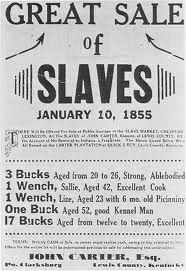
Great Slave SaleSlavery and Jim Crow discrimination cast a long shadow on American society. Racial hatred remains a potent force in our society, as a recent horrific event reminds us. On June 17, a white gunman massacred nine blacks in a Charleston church. Dylann Roof, the alleged assassin, reportedly wanted to start a race war. He posed with the Confederate flag in photos posted on a website that espouses white supremacy.

Many Americans, including those grieving the loss of loved ones, pointed to the flag as emblematic of Roof’s hatred and racism. They called for its removal from the statehouse grounds in Charleston, the state capital and birthplace of the Confederacy. Defenders of the flag see it as merely a symbol of Southern heritage and states’ rights detached from slavery and Jim Crow.

The Confederate flag ranks as one of America’s most divisive but enduring symbols. Most applauded when the South Carolina legislature voted quickly and decisively to bring it down. Yet, heated debate over the banner lit up the Internet. Confederate flags sold out online. Several large retailers like Amazon and Walmart reacted by announcing they will no longer sell Confederate flag emblazoned merchandize.

Flags are important symbols because they signify allegiance—in this case, to a rebellion that sought the unimpeded right to buy and sell human beings and brutally compel their unpaid labor. The history of the Confederate flag shows that it represents white supremacy, treason, and a repudiation of the post-Civil War goal of creating an interracial democracy. A look at the declarations of secession conventions, newspaper editorials, and political speeches makes clear that southern leaders seceded and went to war to protect slavery and pacify fears of racial equality.

South Carolina’s leaders first flew the Confederate flag over the statehouse dome in 1961 to mark the 100th anniversary of the Civil War. It remained there to represent official opposition to the civil rights movement. This changed dramatically after June 17 as more Southern states removed their Confederate flags. It appears that the Confederate flag may soon be gone with the wind.

Yet both racial justice and free speech will continue to spark controversy. Government speech and private speech are not the same. The First Amendment guarantees an individual’s liberty to speak unrestrained by government. When South Carolina’s government leaders voted to no longer fly the Confederate flag, the decision reflects the view of the people’s representatives. One can still protest the decision, but the state changed direction by not putting its support behind a symbol of oppression and inequality.

Dispelling our legacy of violent racism requires more than taking down a flag. The murders of blacks by white supremacists are only the most sensational manifestations of American society’s enduring fear and mistrust of black people. As we’ve seen in recent months, there are police departments that treat African-American communities as occupied territory and young black men, especially, as guilty by default. It’s like Jim Crow: Keep the black people in their place. At another level, purging voting lists often means making it more difficult for blacks and the poor to participate in elections.

The Confederacy is more than a flag, more than a region, more than southern nostalgia about the Lost Cause. The Confederacy has endured for a century and a half after the war ended as a state of mind that encompasses white supremacy, black subjugation, unrestricted gun rights, and defiance of the legitimacy of the federal government.

As states and municipalities remove the Confederate flags and put them in appropriate museums, they should raise the ideals of liberty and equal rights. The related issues of institutional racism and gun control also need to be addressed.

Ralph Scharnau teaches U.S. history at Northeast Iowa Community College, Peosta. He holds a Ph.D. from Northern Illinois University. His publications include articles on labor history in Iowa and Dubuque. Scharnau, a peace and justice activist, writes monthly op-ed columns for the Dubuque Telegraph Herald.

Posted in Progressive Community | Tagged , , , , | Comments Off on Confederate Flag: Heritage And Hate

In Iowa's Hands

Photo Credit Paul Deaton

Photo Credit Paul Deaton

The Johnson County Board of Supervisors set a public forum Aug. 12 to collect information regarding its proposal to increase the county-wide minimum wage to $10.10 per hour in three stages by 2017.

Something bigger than incremental hourly wage increases is at stake.

There are legal hurdles for the supervisors to jump in passing an ordinance, but to a person they are smart people and a vocal minority of the community has been supportive. State Senator Bob Dvorsky, who represents part of Johnson County, Cedar County and the City of Wilton weighed in favoring the proposal this week.

This action is indicative of local frustration with failure to act on the part of state and federal government. This is the third such prominent case where local authorities have taken things into their own hands absent governance.

The most familiar is the lawsuit initiated by the Des Moines Water Works over its increased costs of removing nitrates, mostly generated from farming operations, from the capitol city’s drinking water. Governor Branstad asked the public utility to “tone it down and start cooperating” in its criticism of the agricultural community. The water works is planning to spend $183 million for new nitrate treatment equipment because of increased levels in the Raccoon River resulting mostly from farm runoff.

Art Tate, superintendent of Davenport public schools, said he was going to break state law after the state legislature failed to provide adequate resources to his district during the most recent legislative session.

These examples present a dim picture for state governance, as each problem could be governed by the state with more effectiveness and broader impact.

Taking things into our own hands is a native impulse and very American. It is the same kind that gets small scale entrepreneurs to start businesses and community groups to form to solve local problems.

When in western Iowa a couple years back, a group of us stopped at a small diner attached to a truck stop in Missouri Valley, hoping to grab a quick breakfast before our scheduled event in Des Moines. The place was packed, but we placed our order, mindful of the time.

After about 20 minutes, a woman came from the kitchen and made an announcement, “Our cook just quit, and I’m not sure what we’re going to do about it.”

A regular patron stood up and said, “Hell, I can cook eggs, and rushed to the kitchen before anyone cold stop him.”

After ten more minutes, we tipped our server and said we had to go without eating.

The native impulse to take things into our own hands is part of what’s good about living in Iowa. What would be better is if people would connect the dots between the problems we all share and the purpose of government.

There are minimum wage earners who would spend extra money in their paycheck. Urban dwellers don’t deserve to pay for an unrecognized cost of agriculture. School children deserve the best education possible, and it’s possible to do much more than we are. Importantly, we deserve better governance.

Until people take matters into their own hands and elect men and women who will serve the electorate more than moneyed interests, we will be stuck. It is possible, using the same hands with which our country was built, we will engender democracy again by using the ballot box. It’s something sorely needed in Iowa.

Posted in Progressive Community | Tagged , | Comments Off on In Iowa's Hands

Pledge To Mobilize

Listen live Mondays at 11 am

Listen live Mondays at 11 am

Dear Friends,

America urgently needs a heroic, collective response to climate change. We need the kind of mission-driven national mobilization that fired-up our country during World War II. A new initiative called the Pledge to Mobilize gives people a clear way to demand that politicians get behind the major climate mobilization we urgently need.

And Iowa is now front-and-center in the campaign to make that happen.

Fallon HrdinaIn the months leading up to the Iowa Caucuses, Shari Hrdina (who bears a striking resemblance to Rosie the Riveter, does she not?) and I will work with The Climate Mobilization to build a grassroots movement in Iowa. We are excited about this, and hope you’ll sign the pledge and volunteer to help get the message out across the state.

During last year’s Great March for Climate Action, 90% of my time was spent walking through so-called “Red America.” I talked a lot with conservative Republicans. I would tell the story my Dad told me when I interviewed him for a book about his life after he was diagnosed with terminal cancer. My Dad was a kid during World War II, growing up in the South Bronx, the son of Irish immigrants. He couldn’t understand why America was doing nothing in response to the atrocities occurring in both Europe and the South Pacific. Then Pearl Harbor happened, and the entire nation mobilized. My Dad would go down to the railroad tracks and collect cigarette boxes. He’d remove the foil for the scrap metal drives that were crucial to the war effort. That was his contribution, something he felt proud of.

And when America got involved as a nation, we retooled an entire economy in a matter of months.

With climate change, we again need that kind of national response, that collective sense of purpose and commitment. In Iowa, we have a unique opportunity to challenge the candidates running for President. We deserve to know if they are willing to confront the grave truth of the climate crisis honestly, courageously, and with the kind of determination our parents and grandparents demonstrated during World War II. We deserve to know if they have the wisdom and fortitude to pledge to mobilize NOW to fight climate change.

Will you work with Shari and I and The Climate Mobilization to bring the urgency of the climate crisis to the forefront of the Iowa Caucuses?

************

On today’s Fallon Forum:

1. Dr. Maureen McCue with Iowa Physicians for Social Responsibility discusses the global movement to eliminate nuclear weapons;

2. Attorneys Keith Puntenney and Bill Hannigan talk about the lawsuit filed last week over the question of whether the Iowa Utilities Board has the legal authority to grant eminent domain to an oil pipeline company;

3. Tim Kruse with Green Light Renewable discusses some of the breaking developments in the solar revolution;

4. Margaret Klein Solomon, founder of The Climate Mobilization, tells us about the Pledge to Mobilize.

Join us live every Monday from 11 a.m.- noon CDT on KDLF 1260 AM (Des Moines) and online. Call 515-528-8122 to add your voice to the conversation. The program re-broadcasts Wednesday on KHOI 89.1 FM (Ames) at 4 p.m. and Wednesday on KPVL 89.1 FM (Postville) at 7 p.m. Podcasts available, too.

Thanks! – Ed Fallon

Posted in Ed Fallon | Tagged , , , | Comments Off on Pledge To Mobilize

Clean Power Plan Adopted Today

WHY-WHY-NOTToday the Obama administration is expected to formally adopt the Clean Power Plan with targeted reductions of greenhouse gas emissions from coal-fired power plants of 32 percent by 2030 compared to 2005 levels.

If readers care about mitigating the causes of global warming and ceasing the practice of dumping more than 110 million tons of CO2 into the atmosphere each day as if it were an open sewer, this is it.

This is the majority of the United States plan to reduce emissions at the 21st United Nations Conference of the Parties in Paris (COP21) this December. It’s what we plan, as a nation, to do about climate change.

Today’s adoption of the Clean Power Plan is expected to be greeted with derision, litigation, delay, obfuscation, contempt, denial and politically correct, but meaningless statements.

The Environmental Defense Fund, The Nature Conservancy and the World Wildlife Fund US queried 50 companies for their position on EPA’s Clean Power Plan. Their carefully worded responses are here.

They range from this:

“Starbucks signed the Ceres letter supporting the EPA Clean Power Plan.”

to this:

“We don’t have a position on the EPA’s proposed Clean Power Plan, and Target does not support the US Chamber’s position.”

to this:

“Cargill is part of Risky Business to lead a dialogue across the philosophical spectrum about the long-term impact that climate change could have on the ability to produce food and the ways that agriculture can adapt to ensure global food security. We believe progress can best be made by engaging with groups and discussing our point of view. In fact, Greg Page, former CEO of Cargill, briefed Tom Donahue, president and CEO of the US Chamber of Commerce, this summer about the Risky Business project and its findings. We also spoke with the Farm Bureau about the Risky Business report and asked their advice about how to effectively engage farmers on the climate change issue.”

to this:

“Caterpillar filed comments with EPA opposing the coal-plant rules. The company said: ‘Caterpillar strongly urges EPA to withdraw the Proposed Rule in order to (1) reevaluate the agency’s legal authority to establish requirements on both the entire electric sector and end-users of electricity; (2) conduct a more full and realistic estimate of the economic impacts of its proposed rule; (3) consider changes that avoid the adverse impacts outlined in these comments; and (4) provide guidance to states so that they have the tools necessary to minimize adverse impacts as they construct compliance plans.’ In its sustainability report, Caterpillar says: ‘We support intelligent, responsible public policies addressing climate and energy issues.’”

Gov. Terry Branstad has been critical of the proposed clean power rule, saying it will push energy costs higher and “hurt Iowa consumers and cost Iowans jobs,” according to the Des Moines Register.

If everyday Iowans don’t support the Clean Power Plan, then what? Doing nothing is not an option when it comes to mitigating the causes of climate change, and the Clean Power Plan is something.

There are few better options to take climate action than supporting the Clean Power Plan. Letting government officials know of your support is part of the picture, but what matters more is making the discussion part of everyday life. We may be accused of being “political” in our social circles, and that may be better than suffering the consequences of inaction, now and going forward. The Clean Power Plan is a solution worthy of our support. As the administration adopts it today, so should we.

Posted in Environment | Tagged , , , , | 2 Comments

Why We Must Regulate Financial Firms

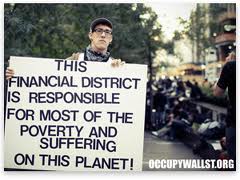
occupy wall st

Americans seem to love their rich folk. They look at them as superheroes that have somehow shook the bonds of terrestrial powers and made themselves above other humans. Thus we tend to think that those who have money are not bound by the laws and rules that bind us mere mortals. Often those in state legislatures and national congresses share that love of the rich. So there are those in law making bodies that believe we should free the rich from the laws which restrict them.

As John Steinbeck once observed
“Socialism never took root in America because the poor see themselves not as an exploited proletariat but as temporarily embarrassed millionaires.”

Therefore America has a lot of poor folks who are wannabe rich folks who do not want restrictions on those they see as what they will be someday soon. All this is to preface some discussion of the role of Goldman-Sachs in governmental bankruptcies from Greece to Detroit and beyond. Despite the shenanigans that led to a near world meltdown in 2008 to 2010, companies like Goldman-Sachs remain pretty much untouched even bankrolled to some extent by a so called “government of the people.” Is the reason that so many of us look at the rich as some kind of uber mensch who stand above laws and rules of men? Is it because so many of us see ourselves in those roles someday?

A recent article in The Nation illustrates that under so many of the public financial difficulties around the world lie Wall Street financial firms:

The crisis was exacerbated years ago by a deal with Goldman Sachs, engineered by Goldman’s current CEO, Lloyd Blankfein. Blankfein and his Goldman team helped Greece hide the true extent of its debt, and in the process almost doubled it. And just as with the American subprime crisis, and the current plight of many American cities, Wall Street’s predatory lending played an important although little-recognized role.

In 2001, Greece was looking for ways to disguise its mounting financial troubles. The Maastricht Treaty required all eurozone member states to show improvement in their public finances, but Greece was heading in the wrong direction. Then Goldman Sachs came to the rescue, arranging a secret loan of 2.8 billion euros for Greece, disguised as an off-the-books “cross-currency swap”—a complicated transaction in which Greece’s foreign-currency debt was converted into a domestic-currency obligation using a fictitious market exchange rate.

skip

Then the deal turned sour. After the 9/11 attacks, bond yields plunged, resulting in a big loss for Greece because of the formula Goldman had used to compute the country’s debt repayments under the swap. By 2005, Greece owed almost double what it had put into the deal, pushing its off-the-books debt from 2.8 billion euros to 5.1 billion. In 2005, the deal was restructured and that 5.1 billion euros in debt locked in. Perhaps not incidentally, Mario Draghi, now head of the European Central Bank and a major player in the current Greek drama, was then managing director of Goldman’s international division.

Greece wasn’t the only sinner. Until 2008, European Union accounting rules allowed member nations to manage their debt with so-called off-market rates in swaps, pushed by Goldman and other Wall Street banks. In the late 1990s, JPMorgan enabled Italy to hide its debt by swapping currency at a favorable exchange rate, thereby committing Italy to future payments that didn’t appear on its national accounts as future liabilities.

skip

Goldman-Sachs used much of the same tactics to plunge American cities into debt way beyond their means:

Three years ago, the Detroit Water Department had to pay Goldman and other banks penalties totaling $547 million to terminate costly interest-rate swaps. Forty percent of Detroit’s water bills still go to paying off the penalty. Residents of Detroit whose water has been shut off because they can’t pay have no idea that Goldman and other big banks are responsible. Likewise, the Chicago school system—whose budget is already cut to the bone—must pay over $200 million in termination penalties on a Wall Street deal that had Chicago schools paying $36 million a year in interest-rate swaps.

A deal involving interest-rate swaps that Goldman struck with Oakland, California, more than a decade ago has ended up costing the city about $4 million a year, but Goldman has refused to allow Oakland out of the contract unless it ponies up a $16 million termination fee—prompting the city council to pass a resolution to boycott Goldman. When confronted at a shareholder meeting about it, Blankfein explained that it was against shareholder interests to tear up a valid contract.

Another fine example of predatory lending and complicated contracts that choked local government happened about 4 years ago in Jefferson County (Birmingham) Alabama. This time it was JP Morgan in charge:

Yesterday, Jefferson County, Alabama, filed the largest municipal bankruptcy in U.S. history, the final step in a sordid tale involving sewers, credit swaps, and some of the nation’s biggest banks. The bankruptcy became necessary “after an agreement among elected officials and investors to refinance $3.1 billion in sewer bonds fell apart.”

The swap deal that sunk Jefferson County was crafted by the mega-bank JP Morgan Chase (in concert with other banks, including Goldman Sachs). As Rolling Stone’s Matt Taibbi put it when describing JP Morgan’s actions in Jefferson County, “here you can see a trail that leads directly from a billion-dollar predatory swap deal cooked up at the highest levels of America’s biggest banks, across a vast fruited plain of bribes and felonies — ‘the price of doing business,’ as one JP Morgan banker says on tape.” And while Jefferson County was pushed over the cliff, JP Morgan has bounced back to record profits, and its municipal business has continued “unscathed.”

Meanwhile workers are furloughed and pensions are cut.

These are but a few examples that easily illustrate why financial firms must be regulated with hard enforcement and real penalties for their reckless actions.

Posted in Economy, financial reform, poverty | Tagged , , , , | Comments Off on Why We Must Regulate Financial Firms