Des Moines, IA. – November 14, 2023 – Iowans are shelling out hundreds of millions of dollars to treat their drinking water and pay for treatment of life-threatening health care issues caused by nitrate pollution from concentrated animal feeding operations (CAFOs) in the state, according to a new report published today by the Iowa Environmental Council (IEC).
“It’s eye-opening to see what CAFOs are really costing Iowans, beyond just operator costs or what the oversight costs the DNR. Every Iowan is paying in some way for these operations – some more than others. Even if you don’t have a CAFO in your community, you’re probably paying higher water bills as utilities struggle to reduce nitrate in your drinking water. You’re paying healthcare costs as well, whether it’s direct medical bills or increasing healthcare premiums as Iowa’s cancer rate increases,” said Alicia Vasto, IEC Water Program Director.
Given the congestion of the FM dial in major cities and urban areas, most new-station opportunities will be in rural areas and smaller cities and towns in the US, and significant competition for stations in populated areas is likely.
While time is running out to get started, Prometheus is still available to help your existing local nonprofit apply for a chance to get your community’s voices on the air.
Will the Silurian Aquifer have enough water to support the population that draws from it? Answers to that question are a bit sketchy due to infrequent research into groundwater projections. A 2011 study published by the Iowa Department of Natural Resources had this to say about nearby Coralville, which draws water from the Silurian Aquifer.
The City of Coralville may have to limit its future withdrawal of water from the Silurian aquifer to maintain the sustainability of the resource. Contingency plans should be prepared by the City of Coralville to evaluate alternative water sources.
Groundwater availability modeling of the Silurian Aquifer in East-Central Iowa, November 2011.
Read that quote again and say after me, “Yikes!”
Last summer, water usage on our community’s public water system surged with the drought. We are also on the Silurian Aquifer. So much more water was used during the worst days of drought the well faltered. We instituted voluntary conservation practices and the issue resolved. Usage dropped by 26 percent the following month. The question repeats itself. Will there be enough water in the aquifer?
In 2006 a similar study was published by the U.S. Geological Survey. While I was on the board of health, we reviewed it, and saw it’s conclusion that until 2025, projections indicated there would be enough water to serve the population. That was good enough for the Public Health Department and the Board of Supervisors back then. It may be time for a new survey, and perhaps one of the involved entities has already undertaken it. I hope so. The message was clear in 2011: decrease reliance on the Silurian Aquifer.
Things have shifted. Two of Big Grove Township’s neighboring cities, Tiffin and North Liberty, are among the fastest growing in Iowa. All those people will need water and their public water systems draw from the Silurian Aquifer. Similarly, there has been an exodus of population from rural parts of the state with many moving to urban areas where there are jobs, healthcare, and commerce. This also creates more localized demand for groundwater. Finally, our rivers have been a source of drinking water, as they are in Iowa City. Surface water quality in Iowa continues to get worse with extractive agricultural operations going on in almost every square inch of the state. For how much longer can cities rely on river water for humans to use? Drawing more from the Silurian Aquifer may not be a reasonable alternative when Coralville is being told to make other plans.
My point in this post is ground water is not a limitless resource. We should each be taking steps to minimize household use and if on a public well, use more of our water during off peak hours. The talk about water used for flushing the toilet, watering the lawn, and fixing household leaks is not a liberal conspiracy. Conservation benefits everyone.
We don’t know if there will be enough water for human populations. We cannot live without adequate water and our scientists and governmental organizations should make sure the projected usage models are accurate, and then work on solutions to shortages. If the Silurian Aquifer goes dry we are in for a wake up call. I predict it won’t be pleasant.
Editor’s Note: I checked with the county and, in fact, a new study of the Silurian Aquifer is in progress. Looking forward to reading it when finished.
“I’m Melissa Vine, a single mother of four boys, businesswoman, and nonprofit director. Today, I’m announcing my candidacy for the United States House of Representatives.
Join our movement at https://melissavine.com”
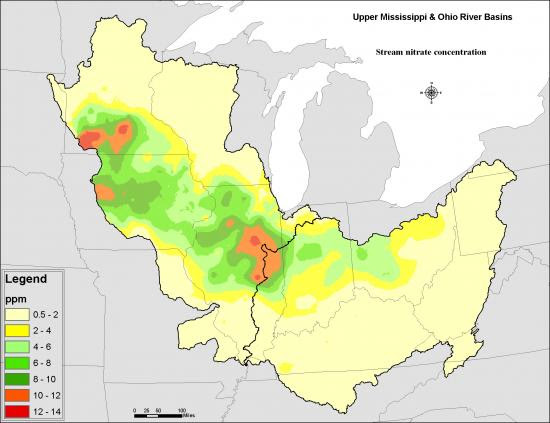
This image shows that Iowa and Illinois farmland are the biggest overall source of Mississippi River pollution. Field tile lines that accelerate the movement of rainwater to streams magnify this problem, as well as both the flooding and low stream flows that result from intense rains and drought caused by climate change.
Editor’s Note: Rep. Chuck Isenhart represents House District 72 in the Iowa legislature. This article is from his constituent newsletter. For more information about Rep. Isenhart, click here. To subscribe directly to his newsletter, click here.
More than 75 people came to the E.B. Lyons Nature Center in June to hear “retired” University of Iowa research engineer Chris Jones and author of “The Swine Republic” talk about the dirty waters flowing off of Iowa’s farmlands and animal feeding operations. (“Retired” because his premature departure from the job of measuring the water quality in Iowa’s rivers and streams was the result of political pressure from Republican state senators.) Here is a link to the visual aids Jones used to describe Iowa’s world of hurt. Note in particular the slide depicting the volume of hog manure in watersheds compared with the number of people in other states and cities that produce an equivalent amount of human waste. Jones is one of a growing number of scientists who are translating their work into stories that people can understand, reaching out to the public to tell those stories, and making clear what policymakers need to do to actually make a difference. Jones’ author tour coincided with weekly reports of beach warnings and closures that warn visitors about the unhealthy state of Iowa’s parks and river trails. The attention he is getting from average citizens coincides with the 10th anniversary of the state’s so-called “Nutrient Reduction Strategy,” a menu of practices that could change Iowa’s status as the biggest polluter of the Mississippi and Missouri rivers IF the state were to require landowners to use them, which we do not.
Since so many people are now paying attention, and anniversaries are used to “take stock” of ourselves and our relationships, I believe it is time for Iowa’s elected officials to stop, take off the rose-colored glasses, and make a clear-eyed assessment of whether or not taxpayers are getting what they are paying for.
Along with State Rep. Monica Kurth, ranking member on the House Agriculture Committee, on World Water Day (March 22) I approached State Auditor Rob Sand to seek a review of state spending related to Iowa’s water resources.
On World Water Day, we requested that his office audit the performance of the state’s water quality programs, with special attention to the Nutrient Reduction Strategy and initiatives implemented with state appropriations in the last 10 years.
The Nutrient Reduction Strategy was created pursuant to a directive from the federal Environmental Protection Agency following the adoption of the 2008 Action Plan of the Mississippi River/Gulf of Mexico Task Force. In a 2011 memo, the EPA reaffirmed its commitment to “accelerating the reduction of nitrogen and phosphorus loadings of our nation’s waters,” in collaboration with the states. t
Iowa’s response was developed through a process directed by the Secretary of Agriculture, with the support of Iowa State University. It was adopted by the Department of Agriculture and Land Stewardship, as well as the Department of Natural Resources. Over time, the document has been incorporated into Iowa statutes.
Programs funded based on the nutrient reduction strategy include the “Water Quality Initiative.”
Appropriations bills called for the development of “demonstration” projects, but — except for language mentioning an option to focus on “priority” watersheds — provided little direction and few requirements or accountability provisions related to goals, timelines, and in-stream monitoring, with public reporting of quality measures of Iowa surface waters and waters leaving the state.
Other funding being leveraged through IDALS and DNR to support the nutrient reduction strategy and initiatives related to surface water and groundwater include the soil and water conservation cost-share program; the conservation reserve and enhancement programs; watershed, water and water quality protection programs; the lake restoration program, the groundwater protection program, the Resource
Enhancement and Protection Program, as well as the groundwater and water quality monitoring programs.
Additional public expenditures in support of the strategy are made through the Iowa Nutrient Research Center, the Iowa Flood Center and the Iowa Nutrient Research and Education Council.
Multiple sources of non-state funding also have been accessed through USDA, EPA, HUD, Homeland Security and the Iowa Finance Authority, including the EPA Section 319 program, the state revolving loan fund and special grant programs such as the Regional Conservation Partnership Program.
Public resources being dedicated to soil conservation, water quality and watershed protection efforts expanded following the 2018 adoption of SF 512, which established water quality infrastructure and water quality financial assistance programs.
At the time, Governor Reynolds also recommended no less than $124.8 million in annual funding through the Natural Resources and Outdoor Recreation Trust that she proposed covering with an increase in the sales tax. How current funds are being spent should inform how such additional funds be used, if a sales tax increase is approved by the Legislature in the future.
With the state’s growing list of impaired surface waters, Iowa’s water quality has been described as a multi-billion, multi-decade challenge if we are to achieve the 45 percent reductions in pollution called for by the EPA.
In our letter to Auditor Sand, Rep. Kurth and I wrote:
“Public resources are being used to remedy problems stemming in great part from the practices of private individuals, exacerbated by climate-related weather disruptions. As we double and triple down on these outlays, citizens want to know if current tax dollars are being spent effectively. For example: What landowner participation rates are we seeing? At what scale are changes in land use and practices being adopted? How do these measures compare with rates preceding adoption of the nutrient reduction strategy? Are we getting the clean water our investments are made to produce? How do we compare with other states? Is Iowa doing its part to limit and reverse our contributions to downstream pollution?
Therefore, we request that your office assess the use of funds for water quality improvement, including the nutrient reduction strategy, and evaluate the performance and efficiency of its associated programs to identify adjustments that can be made to optimize efficiency and performance, enhance results commensurate with the scale of the problems, achieve the best return on investment, and provide for ongoing accountability and oversight, ensuring that tax dollars are spent judiciously.”
Rep. Kurth and I understand that any inquiry the state auditor may conduct will be performed according to his statutory authority and customary protocols, which are focused on documenting how taxpayer dollars are spent and whether that spending complies with the law. As part of his “PIE” program – Public Innovations and Efficiencies – Sand could solicit public and agency input into how Iowa’s water quality initiatives can be improved to produce certified results.
Recently, the governor signed a controversial bill that restricts the auditor’s access to information he needs to do his job. An investigation into water quality spending could expose how that law hurts taxpayers and the public, making government less accountable and vulnerable to corruption.
While we have yet to get a response from Auditor Sand, when we do readers of this newsletter will be among the first to know. In the meantime, we all need to rise to the challenge posed by Chris Jones and start telling legislators and the governor that we expect more for our money.
Ahead of Joe Biden and Xi Jinping’s Nov. 15 meeting at the Asia-Pacific Economic Cooperation conference in San Francisco, the parties pledged to strengthen their cooperation on climate change. The U.S. State Department released a statement detailing areas of agreement. Both presidents pointed to the importance of the upcoming Conference of the Parties (COP 28) that begins Nov. 30, in Dubai, United Arab Emirates.
The luster has gone off the Conference of the Parties, as hundreds of fossil fuel lobbyists participate as delegates to impede progress toward conference goals of eliminating use of fossil fuels. Biden and Jinping’s mentioning COP was important to regenerate interest. Their agreement on climate change was significant, yet hardly noticed in major media.
Members of the Climate Reality Leadership Corps, part of The Climate Reality Project founded by former Vice President Al Gore to address the climate crisis, seeks three outcomes of COP 28.
During a year of record-breaking temperatures and climate disasters, we cannot afford to stay silent. We must ensure that global leaders convening in Dubai hear our demands for an agreement at COP 28 to:
Phase out fossil fuel emissions and stop funding fossil fuel projects.
Increase funding for climate solutions in countries that need it most.
Email from The Climate Reality Project, Nov. 14, 2023.
Fossil fuel interests are fighting any and every advance that leads to a true net-zero economy. My Congresswoman Mariannette Miller-Meeks (R-IA01) has taken the fossil fuel companies’ positions and attended COP 26 and COP 27. In a newsletter earlier this year, she wrote:
Americans have suffered the consequences of reckless and misguided energy policy. From day one of his administration, President Biden has waged an all-out war on American fossil fuel production that has contributed to record inflation and weakened our national security.
Miller-Meeks Weekly Script, April 16, 2023.
Miller-Meeks couldn’t be more wrong. The Washington Post recently called out people like her regarding the so-called war on fossil fuels:
Former vice president Mike Pence framed the issue in one of the presidential debates: “On day one, Joe Biden declared a war on energy, which was no surprise, because when Joe Biden ran for president, he said he was going to end fossil fuels, and they’ve been working overtime to do that ever since.”
It sounds just awful. But I have good news for Republicans: U.S. fossil fuel exploitation is pretty much booming. Here are a few stats from this supposed war’s front lines:
After plummeting early in the pandemic, U.S. crude oil production has been climbing and is now back near record highs. That’s according to data released by the U.S. Energy Information Administration. The agency also projects that oil production will hit new all-time highsnext year.
U.S. natural gas production has also been hovering around record highs.
To date, the Biden administration has approved slightly more permits for oil and gas drilling on public lands than the Trump administration had over the same periods of their respective presidencies, according to Texas A&M professor Eric Lewis. (My Post colleague Harry Stevens has previously covered this in depth.)
If “energy independence” means exporting more than you import, we’ve achieved it in spades. The United States has been exporting more crude oil and petroleum products than it imports for 22 straight months now, far longer than was the case under Trump.
When fossil fuel interests and Republicans who parrot their talking points focus on the so-called war on fossil fuels, it distracts society from pursuing solutions to the climate crisis. There are viable solutions to ridding the world of man-made greenhouse gas emissions caused by burning fossil fuels without compromising our quality of life. They distract us because distraction is a time-tested method of furthering their interests while seeking to avoid blame for causing the the climate crisis.
As society races toward exceeding the 1.5 degree Celsius limit in increasing global temperatures since the pre-industrial era, it seems increasingly evident we will wait until it is too late to take action. While Biden and Xi call our attention to COP 28, it seems doubtful the conference will accomplish what is needed. The United Nations Framework Convention on Climate Change is all we currently have to address the climate crisis as a global society. Individual countries doing so is not enough. We’ll see if delegates get serious this December. I am hopeful they will.
The November 9 JFAN Annual Meeting, Bigger Is Not Better: Rural Communities in the Wake of Livestock Consolidation, was a great success. A total of over 500 people either participated in the meeting or viewed the recording now on the JFAN YouTube channel.
Check out the all-star panel:
“Art Cullen, Pulitzer Prize-winning editor of the Storm Lake Times; Dr. Chris Jones, water quality expert and author of The Swine Republic; Chris Petersen, independent hog farmer; and Sonja Eayrs; family farmer and rural advocate participated in a rich discussion on how rural communities are impacted by livestock consolidation during the 2023 JFAN Annual Meeting. JFAN Executive Director Diane Rosenberg moderated the event.”
“Rural America pays a heavy price for the multinational corporate takeover of livestock farming. Just four companies control a disproportionate 67 percent of the pork, 73 percent of the beef, and 54 percent of the chicken markets.”
Iowa gets national press attention yet again and not in a good way. These Iowa Rs apparently didn’t get the memo. from Kim Reynolds and Bob Vander Plaats who both have abandoned Donald Trump and endorsed Ron DeSantis as have other Republican legislators.
Below is a video of what went on before the Trump rally Saturday in Ft. Dodge. And yes, in case you are wondering, voters in Bobby Kaufmann’s district do know what Bobby is really like as shown here and they apparently like that kind of thing.
“Every single person in this country needs to see not only what happens when Trump speaks at his rallies, but what happens before. This is utterly deranged.” – Ben Meisalas
Indeed.
MAGA-R State Representative Mike Sexton is up first followed by MAGA-R State Representative Bobby Kaufmann. Iowa Republican party chair Jeff Kaufmann, father of Bobby, also makes an appearance and you can see where Kid Kaufmann gets his intelligence and charm. And if you’re still watching, the Trump “golden shower” comments wind things up at the end.
Jessica Rosenworcel, who just happens to be the first female to hold the permanent chairperson position on the FCC, announced a proposal to support local journalism. Proposal would incentivize “the production of local programming by prioritizing the processing and review of applications from broadcast stations that invest in and prioritize local programming in communities across the country.”
Also of interest, according to Google, Rosenworcel was first nominated to the FCC by President Barack Obama in 2011. Her confirmation was delayed for months by none other than Chuck Grassley. Aren’t Republicans fun?
Media Contact:
Katie Gorscak
katie.gorscak@fcc.gov

For Immediate Release

CHAIRWOMAN ROSENWORCEL SHARES PROPOSAL TO SUPPORT LOCAL JOURNALISM
Proposal Would Prioritize License Application Review for Broadcasters that Provide Locally Originated Programming
  --
WASHINGTON, November 14, 2023—Today, Federal Communications Commission Chairwoman Jessica Rosenworcel announced a proposal that, if adopted, would begin a proceeding to advance the Commission’s longstanding policy goal of supporting local journalism and broadcasters’ commitment to meet the needs and interests of local communities.  This proposal explores incentivizing the production of local programming by prioritizing the processing and review of applications from broadcast stations that invest in and prioritize local programming in communities across the country.

“There’s something special about when you hear a local voice on the airwaves or see a familiar face on your television set in the evening.  Over time we’ve come to trust those voices and they provide an important service to these communities,” said Chairwoman Rosenworcel.  “We want to recognize that dedication when it comes time for license renewals and transactions and this proposal does just that.”

The Chairwoman circulated the proposal, as summarized:

· A Notice of Proposed Rulemaking to support local journalism that proposes to prioritize processing the review of applications for license renewal or for assignment or transfer of license filed by radio and television broadcast stations that provide locally originated programming.

###

Media Relations: (202) 418-0500 / ASL: (844) 432-2275 / Twitter: @FCC / www.fcc.gov

This is an unofficial announcement of Commission action.  Release of the full text of a Commission order constitutes official action.  See MCI v. FCC, 515 F.2d 385 (D.C. Cir. 1974).
Governor Kim Keynolds: (515) 281-5211 U.S. Capitol Switchboard: (202) 224-3121 Iowa Members of Congress - Rep. Randy Feenstra (R) - Rep. Ashley Hinson (R) - Rep. Mariannette Miller-Meeks (R) - Rep. Zach Nunn (R) Iowa US Senators - Senator Joni Ernst (R) - Senator Charles Grassley (R)





 The November 9 JFAN Annual Meeting, Bigger Is Not Better: Rural Communities in the Wake of Livestock Consolidation, was a great success. A total of over 500 people either participated in the meeting or viewed the recording now on the
 This is huge and so needed.
 Blog For Iowa