
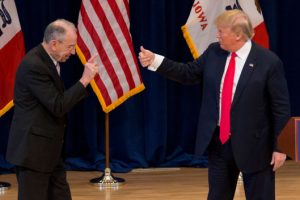
hobnobbing with criminals?
Back in early 2016 Supreme Court Justice Antonin Scalia died. When a Supreme Court Justice dies, the constitution says that the president shall appoint a replacement ‘with the advice and consent of the Senate.’ For most of us we would read that as a prescription of what is to be done. Not Chuck Grassley.
The timing of Scalia’s death was during a year of a presidential election. Because of the term limitation in the constitution, everybody understood that there would be a new president the next January. Yet most understood that that should not limit Obama’s powers to appoint a new Justice. It was in the constitution. But Chuck Grassley said ‘no.’
Grassley was backed by senate majority leader Mitch McConnell, Neither intended to let Obama fill the empty seat. Thus Grassley went into a stall claiming there was no mandate for the senate to ‘advise and consent.’ Along the way Republicans made a lot of ridiculous claims, but there was no way to force their hand.
The gamble that Grassley took was that a Republican would win the White House in the presidential election and thus they would choose who would replace Scalia. Sadly, Grassley’s long shot bet paid off. The most unlikely candidate ever became president and with it came the power to fill the Scalia seat on the Supreme Court.
That appointment was Neil Gorsuch – a very ‘conservative’ or maybe better described as ‘anti-government’ justice. Gorsuch along with then current justices Roberts, Thomas, Alito and Kennedy kept the Court’s 5 to 4 ‘conservative’ slant with some occasional swing.
Then one more justice retired and another died and the unlikely president now had a chance make the Court solidly right wing with little to stop them from basically making policy from the bench. We have seen that solid 6 to 3 majority tear apart settled law from stem to stern in the past couple of years. From abortion to admissions policies they are looking to re-orient the country through judicial decisions.
At this point I must remind folks that Donald Trump lost the popular vote and only won the electoral college vote by a few votes in certain states such as Wisconsin. So if a few more people had voted for Clinton in states like Wisconsin we would not be staring down a Supreme Court that is hell bent on changing what is known as the regulatory state.
I was reminded of this while reading a story from Thom Hartmann concerning a case the Supreme Court (from here on in referred to as SCOTUS) decided last year and one that will be on the docket this fall. The object of these two cases is to disallow a regulating agency to make a rule on something unless congress specifically named that thing in the bill as something to be regulated.
That will make bills almost impossible to write if they need to specifically must name, for instance, every environmental pollutant, or every insect that must be covered by the endangered species act.
Among other things on the rightwing billionaire wish list: virtually the entirety of America’s ability to protect its citizens from corporate predation rests on what’s called the Chevron deference (more on that in a moment), which the Court appears prepared to overturn with a case they just accepted this year.
Declared Republican presidential candidate Vivek Ramaswamy says he wants to eliminate the Department of Education “on day one” if he’s elected president. If the Supreme Court has its way, he wouldn’t have to bother. It’ll become impotent.
Far-right conservatives and libertarians have been working for this destruction of agencies — the ultimate in deregulation — ever since the first regulatory agencies came into being with the 1906 creation of the Pure Food and Drugs Act, a response to Upton Sinclair’s bestselling horror story published that year (The Jungle) about American slaughterhouses and meat-packing operations. {my bolding}
Hartmann then relates how regulatory agencies grew, including the story of Neil Gorsuch’s mother’s attempt to destroy the EPA from within, and how the regulating process should work. He also notes that without these agencies, government would probably come to a halt.
Hartmann ends by discussing the West Virginia vs. EPA 2022 decision which gutted the what was known as the “Chevron deference.” Up to that point the Chevron deference had allowed regulatory agencies to regulate through what courts called a reasonable process.
Hartmann also notes that in the West Virginia vs. EPA case those voting to overturn regulating agencies all had some vested interest in seeing regulating overturned:
In addition to Gorsuch, the Court’s decision-makers in West Virginia v EPA included Amy Coney Barrett whose father was a lawyer for Shell Oil for decades, and John Roberts, Samuel Alito, and Brett Kavanaugh who are all on the Court in part because of support from a network funded by fossil fuel billionaires and their industry (among others).
So there you go – a presidential candidate wins because of small wins in enough states for him to win in the antiquated electoral college. He is then able to fill the seat on SCOTUS left by Antonin Scalia’s death and Chuck Grassley’s mockery of the constitution.
The new president appoint SCOTUS justices who are opposed to regulations and in 2022 cause great harm to the regulatory process. Coming up in 2023/2024 they have decided to hear a case – Loper Bright Enterprises v Gina Raimondo – that may serve as the bullet that kills regulation.
This will be coming at a time when the climate crisis is threatening life on earth – but we can do little about what the SCOTUS does.

 Blog For Iowa
And besides the climate crisis, once regulatory agencies are gutted, how do we know the food and drink we consume will be safe? What about other products we use? But, you know…HER EMAILS.
LikeLike