
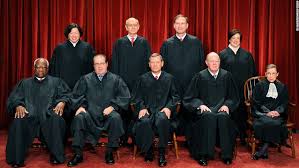
 June starts Monday. As with all Junes, the Supreme Court (referred to as SCOTUS herein) will be issuing their decisions on cases that they heard over the past term. Over the period of the current Court, some very controversial subjects have been heard. In a few cases the Court ruled on issues that were not in the original scope of the case. The most notable of these was Citizens’ United v. the FEC. In case that doesn’t ring a bell, that is the case that opened the door to really huge money in campaigns.
Throughout the current session the Court prepares for the next year by deciding what cases they will hear next year. This is a process called granting certiorari or granting cert.Court watchers keep a close eye on cases that are granted cert to get a gauge of where the Court plans got move in the next year. Sometime during the past rolling year Court watchers focused on King v. Burwell (the ACA subsidy case) and the gay marriage cases as cases to watch once they were granted cert.
Tuesday night the Court granted cert to a case from Texas challenging the current method of making each legislative district roughly the same size by population. The challenge is that while total population of different districts may be close, the voting eligible population may be drastically different across districts.
Consider that for a few moments and you come to the realization that voting eligible populations in cities will probably usually be lower because of a younger populace, concentration of immigrants, concentration of felons and other factors. Democratic votes tend to aggregate into cities. Thus with a lower voting eligible population, districts within cities would be fewer. Fringe districts would have a greater mix of suburb and rural populations mixed in. Add that to the already badly gerrymandered legislative district maps across the country and one can see that this tilts basically one direction.
As so many have said “The game is rigged.” Now it will be even more rigged.
Using Iowa as an example, one could easily see that an Iowa City would lose much of its clout with its large young population and large number of immigrants. Other cities in Iowa would mirror that.
Counting only eligible voters may be hard, if not impossible. It may also be currently illegal. Problems like that have never stopped the Roberts Court from plowing ahead. Probably the most ideological Court in history with the exception of the Taney Court pre-Civil War, the Roberts Court has had an agenda of destroying any legacy of liberalism or fairness left from the New Deal and post New Deal Days.
Taking on one person, one vote will help make state legislatures much redder. No doubt this decision will then be applied to federal legislative districts, thus keeping the US House Republican. With age catching up to them they can see that their days of using Court decisions to alter America’s political structure is coming to an end.
There are a couple of big liberal targets that right wingers have yet to take down. Those are Social Security and Medicare – with little brother Medicaid – of course. Republicans, tea baggers and all stripe of right wingers have tried all sorts of legislative methods to damage these programs. They have not tried a SCOTUS test in about 80 years. There will be lots of pressure on the Roberts Court to find cases that will do some damage to these programs in the next couple years.
To see what damage the Court will do this year, keep an open tab for http://www.scotusblog.com/. This is by any definition a historic Court.

 Blog For Iowa