
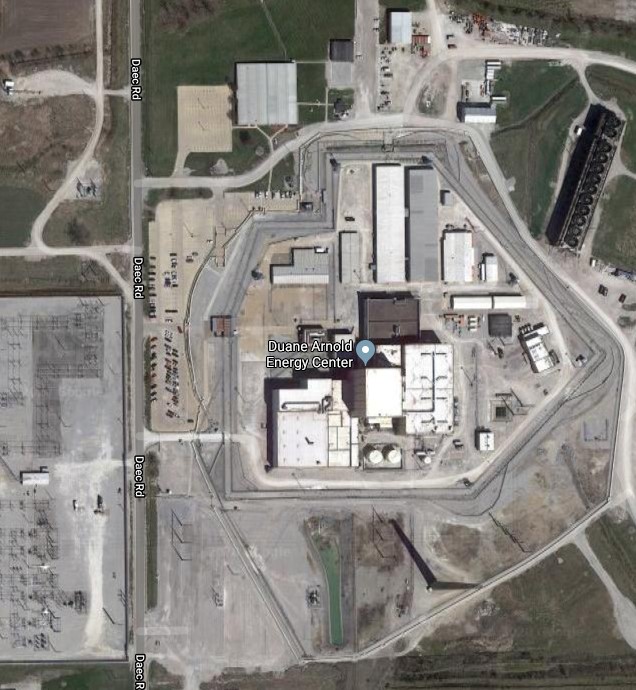
On December 16, 2010, the United States Nuclear Regulatory Commission renewed the license for the Duane Arnold Energy Center in Palo, Iowa for an additional 20 years, extending the license to the year 2034. Who really knew?
As a government agency, the Nuclear Regulatory Commission has formal protocols for just about everything it does. These protocols are supported by staff as evidenced by the fact that when the author was having trouble downloading the Duane Arnold Environmental Impact Statement from the web site, I received a response within half an hour to my query. That was pretty quick.
My sense is that there is little public participation in what this agency does and that procedure trumps content, creating liabilities for the public. There is little evidence folks care about this. Consider the public meetings on environmental scoping for re-licensing.
On the Duane Arnold license renewal page, I clicked on the link that read “public involvement.” There were two public meetings for environmental review of Duane Arnold on April 22, 2009. (It seems ironic that this was Earth Day). A copy of the slide show is available, a brief summary and transcripts of both sessions taken by a court reporter from a Washington, DC firm. It seems thorough, but without much content.
At the afternoon session, the speaker asked, “Does anybody have any questions they would like to ask?” The court reporter noted, “no response.” A physics teacher from the Solon, Iowa school district had registered to speak and he said, “I’m the only one?” His comments can be found here. Comments from the evening meeting are duly documented by the court reporter, “Any questions from anyone? ‘No response.’” Procedures may have been followed and with time a person could locate and all the public comments. Few seem likely to do this without compensation. It all contributes to a sense that re-licensing was preordained and the public was sleeping.
Where we live, our electricity costs 13-1/2 cents per kilowatt hour on our bill from the electric utility. By any measure, in Iowa, electricity is cheap. While our cost does not reflect the environmental degradation from mining and transporting power plant fuel, nor does it reflect the cost to human health of unregulated emissions from burning coal, it does reflect the cost of what goes on at Duane Arnold, at least I think it does. Part of the cost of operating Duane Arnold is supposed to be the decommissioning the plant, something that has gotten more expensive since the plant was built and has been avoided by the owners for another 20 years by re-licensing.
The environmental impact statement for the Duane Arnold Energy Center is 432 pages of formal writing that is specific to the process of proposing nuclear energy plants. It is pretty dry. In it, a lay person can easily see that much was not considered by the NRC in its re-licensing of the plant.
- In an era of growth for renewable energy, could the megawatts of electricity sourced from Duane Arnold be sourced elsewhere with less environmental impact?
- Did the NRC adequately assess the environmental impact on the Cedar River and on the Pleasant Creek Reservoir?
- Did the NRC adequately assess disposal of 20 additional years of spent nuclear fuel?
- Was the cost of decreasing availability of nuclear fuel considered?
- Is the release of tritium to the environment worth the potential health risks when one option would have been to decommission the plant and stop releasing tritium?
- Are the regulations with which the re-licensing complied adequate to protect human health?
These are rhetorical questions which reflect some cynicism about the re-licensing process. Perhaps the NRC met technical requirements for oversight of the re-licensing process, but are the technical requirements adequate? Another cynical question…of course they aren’t.
The truth is that the license has been renewed and unless some entity steps forward to challenge the Environmental Impact Statement, these questions will be brushed aside, leaving us hoping that what happened in Chernobyl and Three Mile Island will not happen here. That is if anyone is paying attention.
 Blog For Iowa