
Climate Change Is Getting Real

States beg insurers not to drop climate-threatened homes

by Alex Brown, Iowa Capital Dispatch
June 16, 2024

In the coming years, climate change could force Americans from their homes, not just by raising sea levels, worsening wildfires and causing floods — but also by putting insurance coverage out of reach.

In places including California, Florida and Louisiana, some homeowners are finding it nearly impossible to find an insurance company that will cover their property. Others have seen their premiums climb so high that they can no longer pay. Experts say the trend is spreading throughout the country as natural disasters increase.

Most mortgage lenders require homeowners to maintain insurance. Without access to coverage, millions of Americans could find themselves forced to reconsider where they live. Consumer advocates say long-overdue conversations about development in areas prone to natural disasters are being driven by property insurers, not governments.

“Insurance companies have basically become our land-use officials,” said Doug Heller, director of insurance with the Consumer Federation of America, a research and advocacy nonprofit. “In 2023, the industry suddenly seemed to wake up and say, ‘There’s climate change, forget all those times we’ve nodded our head yes and told you that you can live there.’”

As the crisis escalates, state leaders are desperately trying to convince insurance companies to stick around. States are offering them more flexibility to raise premiums or drop certain homes from coverage, fast-tracking rate revisions and making it harder for residents to sue their insurance company.

Meanwhile, a flood of new policyholders are joining state-backed insurance “plans of last resort,” leaving states to assume more of the risk on behalf of residents who can’t find coverage in the private sector.

Insurers are the climate change canary in the coal mine.

– Dave Jones, director of the Climate Risk Initiative at the University of California, Berkeley’s Center for Law, Energy, & the Environment

Industry leaders note that insurance companies have been hammered by heavy payouts — last year, 28 separate U.S. natural disasters caused at least $1 billion each in damage, according to federal figures — and say they simply can’t afford to provide coverage in the areas that face the highest risk.

Disaster costs are soaring. In the last five years, there have been 102 disaster events in the United States that caused at least $1 billion in damage. In the entire decade of the 1990s, there were 57 billion-dollar events (adjusted for inflation), and in the 1980s there were 33.

Natural disasters are increasing at the same time risk-prone areas are becoming ever more populated, and as property values are climbing. The price of repairs and replacement have skyrocketed due to inflation, workforce and supply chain issues. Insurers say costs also have been driven by an uptick in litigation and fraud.
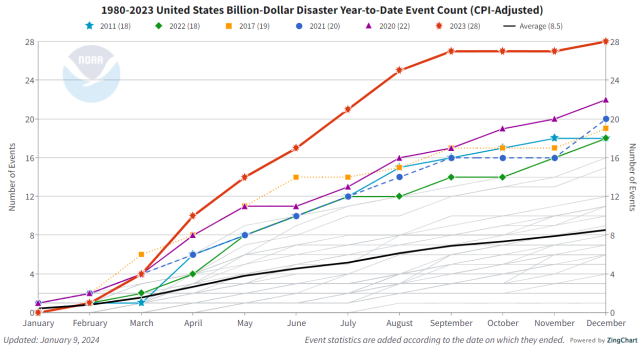
 

Month-by-month accumulation of billion-dollar disasters for each year on record. The colored lines represent the top six years for most billion-dollar disasters. All other years are colored light gray. (NOAA image by NCEI)

“We’re experiencing record-breaking losses as it relates to natural disasters,” said Adam Shores, senior vice president for state government relations with the American Property Casualty Insurance Association, an industry group. “We want to be there, but when the math doesn’t work for a company, they have to make those decisions.”

While the insurance crisis is most acute in certain coastal states, climate experts say every region will face similar challenges, especially as severe storms batter the middle of the country. While some states have made marginal gains in stabilizing the insurance market, some experts say that progress may be short-lived.

“Insurers are the climate change canary in the coal mine,” said Dave Jones, the former insurance commissioner in California and director of the Climate Risk Initiative at the University of California, Berkeley’s Center for Law, Energy, & the Environment. “While these policy and regulatory interventions might help in the short run, they’re likely to be overwhelmed by the increasing risk and loss.”

‘The perfect storm’

In some hard-hit states, policymakers have focused on giving insurance companies more flexibility to adjust their rates and coverage options.

Four hurricanes walloped Louisiana in 2020 and 2021, causing $23 billion in insured losses. Twelve insurance companies became insolvent and dozens left the state. Residents in southern Louisiana especially have struggled to find coverage, and some have moved elsewhere because they couldn’t afford their premiums.
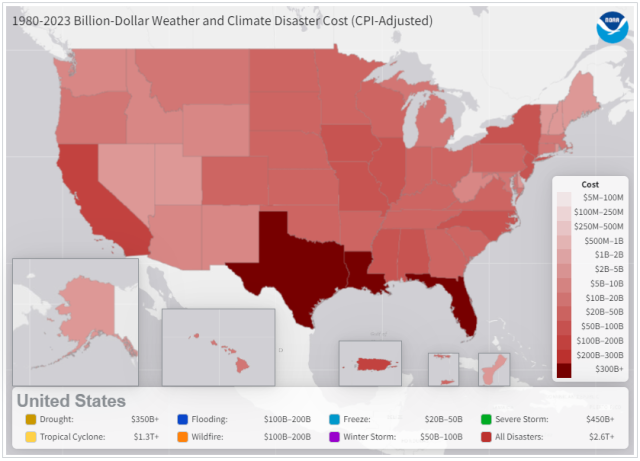
This map depicts the total estimated cost borne by each state from billion-dollar weather and climate events from 1980-2023. (Screenshot from NOAA NCEI Billion-dollar Disasters web mapping tool)

“It’s the perfect storm,” said Louisiana state Rep. Gabe Firment, a Republican. “We just do not have companies willing to write business in Louisiana right now, and you can’t blame them.”

Firment sponsored a measure, enacted this year, repealing a state rule that had blocked companies from dropping long-standing customers. Those dropped can join a state-run plan. Lawmakers hope that — given the ability to cancel the highest-risk policies — insurance companies will remain in the state and avoid massive rate hikes on their remaining customers.

Legislators passed a suite of other laws aimed at the crisis, speeding up the process for insurers to adjust their rates, extending a grant program to help residents fortify their homes and giving companies more time to pay out claims. Firment said the changes are designed to attract more companies back to the state, “but if we get two or three hurricanes this year, all bets are off.”

In California, many major insurers have canceled policies or stopped accepting new applications due to wildfire risk. Regulators there have proposed a rule that would allow companies to incorporate climate change projections into the models they use to set their rates.

“Insurers are not going to continue to write in every market if they can’t price accurately,” said Mark Friedlander, director of corporate communications with the Insurance Information Institute, an industry-backed research group.

Meanwhile, Democratic Gov. Gavin Newsom has put forth a measure that would speed up regulators’ approval of the rate revisions proposed by insurance companies. While seeking to give insurers more flexibility on rates, California leaders also have sought to protect residents by establishing a one-year moratorium on policy cancellations in disaster areas following a wildfire.

Officials at the state Department of Insurance did not respond to Stateline interview requests.

Homeowners’ insurance rates in Texas spiked 23% last year, twice the national average. The state has endured a myriad of disasters in recent years, but consumer advocates fear insurers are weaponizing climate change to jack up rates and demand looser regulations.

“[Insurance companies] are putting a gun to our heads, telling us, ‘Do it our way or we’ll pull up stakes,’” said Ware Wendell, executive director of Texas Watch, a nonprofit advocacy group. “They’re going to cherry-pick the country and only insure parts of the country that have less climate risk.”

The Texas Department of Insurance did not grant a Stateline interview request.

‘Last resort’

In several states, homeowners who can’t find private coverage are joining state-run plans. Originally intended to be a last-ditch option, because they generally offer limited coverage, these plans are seeing more and more residents signing up.

Florida has seen more than 1 million residents join the plan offered by the state-run Citizens Property Insurance Corporation. The plan, which is meant to be a “last resort” option, now stands as the largest in the state.

Insurance rates in Florida have climbed to four times the national average, following hurricanes Ian and Nicole in 2022. The state also has seen an uptick in claims lawsuits that insurance companies characterize as legal abuse.

Legislators changed state law in 2022 to disincentivize such lawsuits, ending homeowners’ ability to collect attorneys fees from insurers in claims disputes. State regulators say insurance rates have stabilized in 2024, and new companies are joining the market. The Florida Office of Insurance Regulation did not grant an interview request.

But some lawmakers say state leaders are eager to help insurance companies while ignoring the underlying issue of climate change.

“Stabilization is important, but [premiums] have stabilized at high rates,” said state Rep. Anna Eskamani, a Democrat. “Floridians can’t afford Florida anymore, and if we’re not taking climate change seriously, then we’re missing the point.”

Eskamani called for leaders to change land-use policies to limit development in high-risk areas.

Even as some Florida homeowners are now shifting from the state-run plan back to the private market, industry experts say the nationwide surge in state-backed policies is troubling. If such plans exhaust their reserves, states impose an assessment on either all insurance companies or all individual policyholders — known in Florida as the “hurricane tax.”

Jones, the former California insurance commissioner, noted that insurers there are worried that growing wildfire risk could force them to bail out the state plan. Nearly 400,000 Californians rely on the state plan for insurance, and state officials have warned that a catastrophic event could wipe out its reserves.

While Californians struggle to find insurance on the private market, Jones called out the insurers that are dropping policies even as they retain financial ties to fossil fuel companies.

“Why are insurers investing in and writing insurance for the very industry that’s making it increasingly challenging for them to write insurance in certain parts of the country?” he said.

In Colorado, lawmakers voted last year to create a state-backed insurance plan like those in more than 30 other states. State Sen. Dylan Roberts, the Democrat who sponsored the bill, said he heard from constituents who were getting dropped by their insurers following the Marshall Fire that swept through Boulder County in 2021.

“We’re going to have more and more Coloradoans every year who are unable to find insurance for their property on the private market,” he said. “To have an insurer of last resort is something we hope isn’t used widely, but it’s something we need to have.”

Some consumer advocates believe states will have to get more involved. Amy Bach, executive director of United Policyholders, a nonprofit that advocates for insurance customers, said governments face the same difficult risk calculations as private companies but are tax-exempt and don’t face the same pressures to return high profit margins to shareholders.

“Publicly supported insurance programs are here to stay,” she said. “It behooves us to build them as smart as we can.”

In Washington state, regulators say they have only a few hundred policies on the state-backed plan, a sign that residents can still access coverage on the private market. David Forte, senior property and casualty policy adviser with the Office of the Insurance Commissioner, said the agency has added actuarial staff to speed up insurers’ rate revision approvals.

He also credited the work of state leaders who have invested millions to reduce wildfire risk. But he cited a 2022 wildfire that nearly swept through the town of Index, before shifting winds changed its direction.

“If that had happened, I think our property market would be different,” he said. “Are we just one bad event away? Probably.”

Iowa Capital Dispatch is part of States Newsroom, a nonprofit news network supported by grants and a coalition of donors as a 501c(3) public charity. Iowa Capital Dispatch maintains editorial independence. Contact Editor Kathie Obradovich for questions: info@iowacapitaldispatch.com. Follow Iowa Capital Dispatch on Facebook and X.

Posted in Blog for Iowa | Tagged , , | 1 Comment

State Auditor On Iowa Press

State auditor Rob Sand has not made an appearance on the Iowa Press program since 2022 when he debated Todd Halibur. Sand was on the program one other time earlier in 2022.  Then all of 2023 passed by without the state auditor appearing as a guest on Iowa Press even once.  You would think being the only statewide elected democrat we have, that it would be a good idea  to have that one democrat on the program at least once a year.  I complained about the lopsided number between Rs and Ds in 2023 in a post, Iowa Press: Republicans 17 Democrats 9.

If you’re one of many who have sworn off  watching Iowa Press because of their obvious disdain for democrats and deferential treatment of Republicans, I declare this one safe for viewing.  You’ll enjoy quite a few zingers Sand gets in.

Posted in Blog for Iowa | Tagged , | Comments Off on State Auditor On Iowa Press

Call Balls And Strikes? Not So Fast!

U.S. Supreme Court

On Thursday, the U.S. Supreme Court decided Food and Drug Administration, et. al., vs. Alliance for Hippocratic Medicine, et.al., a case about use of the drug mifepristone in terminating pregnancies up to seven weeks. The high court found unanimously the plaintiffs lacked standing. They did have other things to say.

Is the Supreme Court calling balls and strikes in this decision? No, they are not.

Politico journalist Alice Miranda Ollstein identified four anti-abortion wins buried in the Supreme Court’s unanimous ruling against them. Read Ollstein’s entire article on Politico’s free website here and give her a follow. My short summary of the pitfalls she identified is as follows:

  • The SCOTUS decision was based entirely on procedures grounds, i.e. the plaintiff did not have standing. The decision avoided discussion of merits of the case.
  • What rights do physicians have to refuse to perform abortions or other health services that they feel conflict with their moral or religious beliefs? Historically, said University of Texas law professor Liz Sepper, a federal law called the Church Amendment gave doctors the right to refuse to participate only in abortion or sterilization, but the new ruling expands the scope to “the full range of medical care.” This could be a major departure from precedent.
  • Justice Clarence Thomas’s separate concurrence with the unanimous decision contained suggestions for other ways abortion opponents could bring legal challenges or pursue restrictions on the pills in Congress or through the executive branch. Such road maps are certainly not necessary and some would say inappropriate.
  • Thomas’s concurrence suggested the sword should cut both ways. This is a flashing warning light for abortion-rights proponents who have long relied on what’s known as third-party standing to challenge abortion restrictions in court. Essentially, many courts have allowed doctors to bring lawsuits on behalf of their pregnant patients because the time-sensitive nature of pregnancy makes it impossible for patients to sue, and because most anti-abortion laws target doctors rather than patients with criminal and civil penalties.
    Thomas wrote, using loaded language favored by the anti-abortion movement, that the court’s decision denying standing to the doctors in the Alliance for Hippocratic Medicine should cut both ways.
    “Just as abortionists lack standing to assert the rights of their clients, doctors who oppose abortion cannot vicariously assert the rights of their patients,” he said.

What may seem like a clean win for proponents of use of the drug mifepristone for ending pregnancies is not clean at all. I recommend reading Ollstein’s entire article here. It seems easy to predict this issue will return to the Supreme Court soon.

Posted in Blog for Iowa | Comments Off on Call Balls And Strikes? Not So Fast!

Do Iowa Democrats Need A Political Convention?

I was selected as a delegate to the Iowa Democratic Party state convention which convenes at 10 a.m. today. There weren’t enough volunteer delegates nominated at the county convention, so I threw my hat in the ring knowing I might not attend. By the time readers see this, I will have decided. I don’t believe a political convention is needed to fairly and effectively organize a political party. Our current habits go way back to before the state’s founding.

During the early 1830s, Iowa didn’t have much of a government. Decisions of consequence were made by businessmen such as George Davenport, Antoine LeClaire, and others. A concern for having clear title to sell lots in the fledgling city of Davenport was real, but not always a main concern for speculators. There was also the sticky issue that the Sac and Fox indigenous tribes believed they had not ceded land for early settlers. The resulting 1832 Black Hawk War settled the matter, as far as that goes, in Eastern Iowa and Southwestern Minnesota. When Davenport, LeClaire and others decided to invest in land speculation, as they did when in 1835 some of the initial platting of city blocks occurred in Davenport, there was little government to restrain them.

On July 9, 1840, in what was then called Bloomington (now Muscatine), Democrats held the first territorial convention in Iowa. Delegates from 16 counties adopted a “non-interference with slavery” platform. The convention elected Augustus C. Dodge as delegate to the national congress and approved a brief platform with multiple resolutions for Dodge to take with him to Washington. Read more about early Iowa political conventions in David C. Mott’s Annals of Iowa article titled “Iowa Political Conventions and Platforms.”

The Democratic Party’s first convention after Iowa achieved statehood on Dec. 28, 1846 was held April 24, 1884 in Burlington. Its purpose was to elect delegates to the national convention of 1884. Resolutions adopted at the convention include granting 160 acres to former Union soldiers in perpetuity, reducing taxes and tariffs, and eliminating laws that infringed on the freedom of Iowans. Delegates approved a state central committee of 13 members. In short, these are the sorts of things Democrats do at current state conventions. If all this sounds familiar, it’s because a lot hasn’t changed.

The most significant change that impacts party politics has been decentralization of information through the internet. We no longer need a group of “special” state delegates to represent our interests. What we do need is a way to be more inclusive in our politics, a way that enables us to participate directly if we so choose.

The Iowa precinct caucuses that chose presidential delegates to the state and national convention was an organizing method that engaged people in Democratic politics. More people attended caucus during presidential years, while in the background the same small group of people ran the party. This year, as part of my convention registration, I had to declare I was a Biden delegate. The meaning of that is much less than if I had joined my colleagues at the Biden table during the 2020 precinct caucuses.

With the demise of presidential preference caucuses, the Iowa Democratic Party must change how we operate. Party Chair Rita Hart is well aware of this and has stated as much in public. I am not hopeful the state party as represented by today’s delegates realizes this as well as Hart does. It seems to me, from emails I received in the run up to the convention, there are too many insiders protecting turf through seldom read resolutions and initiatives. Iowa Democrats, and I’m not talking about the small cadre of leadership, must stop tinkering around the edges of having a party, and devote more energy into electing Democrats where we can and across the board. If the state party doesn’t help us do that in tangible ways, we should ditch it.

I don’t believe the national party will let us do away with a state convention. That said, I’m not sure of the value of meaningless rituals like participating in the convention. Presidential preference used to hold our interest. It is likely a good thing that went away so we can focus more on local races. Whether we will is an open question.

Good luck to today’s delegates.

Posted in Iowa Democrats | Tagged , , , | Comments Off on Do Iowa Democrats Need A Political Convention?

Biden Gains In Polls

Found this email in our inbox yesterday from Simon Rosenberg who is a good person to follow.

Biden Gains In Five Polls

“As I wrote on Tuesday we’ve started seeing meaningful movement to Biden in new polling. 4 polls – CBS, NYT, Morning Consult, Yahoo/YouGov – have shown movement to Biden of 2 points or more. Today we got a fifth. Echelon, a Republican pollster, found Biden gaining 4 points since their last poll, going from 46-49 to 48-47. A highly credible Democratic polling consortium, Navigator, found Biden ahead nationally this week, 48-44 (4 pts).

I think it would be reasonable for Trump’s 34 felony convictions to shift the election 2-3 points toward Biden, and that is what many polls are showing now. It’s why assertions that Trump leads or is favored can no longer be backed up by data.”

Follow Simon at Hopium Chronicles
Twitter @SimonWDC

Biden’s latest ad:

Happy Friday!


Posted in Blog for Iowa | Comments Off on Biden Gains In Polls

Free Public Event To Kick Off Iowa Clean Water Group

From Jefferson County Farmers & Neighbors:

Driftless Water Defenders Inaugural Meeting
Saturday, June 15, 2024 in Decorah, Iowa

The public is invited to attend the first meeting hosted by a new clean water advocacy membership group, Driftless Water Defenders (DWD). This free event will be held on June 15th at 3 pm, at Good Shepard Lutheran Church, 701 Iowa Ave, Decorah, IA

DWD is an Iowa non-profit, 501(c)3 membership corporation, which advocates, educates and litigates to defend Iowa citizens’ fundamental right to access clean water for their homes, businesses and recreational needs.

DWD is headed by its President, clean water advocate Chris Jones, author of the recently-published book, Iowa Swine Republic: Struggles With the Truth About Agriculture and Water Quality. His book has been selected as the State of Iowa’s “Great Reads from Great Places” book to be featured in the 2024 National Book Festival hosted by the Library of Congress’s Center for the Book, in Washington, D.C., in August.

“Iowans have a fundamental right to clean water,” said Jones, in describing the formation of the new advocacy group. “Iowa’s water quality is getting worse and we need organized, citizen involvement if we’re going to turn things around. DWD’s members will push forward with needed clean water advocacy.

At the meeting, Jones will describe and answer questions about the deteriorating condition of lakes, aquifers, streams and rivers in Iowa’s Driftless area— some of which are becoming unsafe for drinking, fishing and swimming.

High nitrate pollution levels have been linked by research scientists to various cancers and are directly harmful to wildlife. Iowa currently has the second highest rate of cancer of any U.S. state; that cancer rate is rising faster than in any other state. Nitrate pollution also feeds algae blooms, which kill fish and can poison humans with cyanotoxins.

“The Driftless region has traditionally had some of the best-quality water in Iowa, but it is getting significantly worse and needs to be protected,” said Jones. “This inaugural meeting of DWD will introduce local residents to Driftless water pollution issues and describe ways that citizens can act to protect their water.”

Those who wish to become members of DWD will have the opportunity to do so at the event.

—–

Jefferson County Farmers & Neighbors, Inc.
PO Box 811
Fairfield, IA 52556
www.jfaniowa.org
641-209-6600
Follow us on Facebook: https://www.facebook.com/JFANIowa

JFAN is funded by grassroots support and gratefully welcomes your donations. https://www.jfaniowa.org/donate-today

JFAN is a member of the Iowa Alliance for Responsible Agriculture (IARA)

Posted in Blog for Iowa | Tagged , , , , | 1 Comment

Miller-Meeks Tries To Steal Credit Plus Sinclair Broadcasting Strikes Again

Republicans are trying to take credit for the Biden administration’s popular infrastructure projects, including Mariannette Miller-Meeks. Reported by Politico, Heather Cox Richardson also mentioned MMM in her newsletter.

“Meanwhile, the measures Democrats advocate are so popular that Republican legislators are taking credit for projects funded by them even though they voted against the laws themselves. Katherine Tully-McManus of Politico pointed out today that Representative Mariannette Miller-Meeks (R-IA) voted against the Bipartisan Infrastructure Law that will deliver nearly $470 million to her district. She has attended a highway ribbon cutting and boasted of the modernization of locks and dams on the Mississippi River in her district despite her “no” vote.”

Please support Christina Bohannan, democrat challenging Miller-Meeks.

In other news…

Right wing Sinclair Broadcasting up to its old tricks pretending to be local

Sinclair injects deceptive attacks on Biden’s age into dozens of local broadcasts

“Two outlets controlled by right-wing media tycoons are working in tandem to aggressively push specious claims about President Joe Biden’s fitness for office to millions of Americans.”

The Wall Street Journal is owned by News Corp, the media conglomerate founded by right-wing billionaire Rupert Murdoch.

Read the full story here

“Delivering right-wing attacks on Biden’s mental fitness under the guise of ‘local news’ is an extremely powerful tactic. While many Americans are distrustful of the national media, 71% believe local news is accurate, including 78% of Ds and 66% of Rs.” – Aaron Rupar

Follow @Rupar  for media commentary

Link to the video showing local Sinclair anchors reading from the same script
https://x.com/atrupar/status/1800521789417943317

If you have a Sinclair owned station in your viewing area, let us know in the comments if you have seen one of these reports. Or you can email us at blogforiowa@outlook.com.

Sinclair Broadcasting And Its History Of Using Local TV To Influence Elections

Below are excerpts from a long, well-researched article, The Growth of Sinclair’s Conservative Media Empire, by Sheelah Kolhatkar in the New Yorker about Sinclair Broadcasting that dates all the way back to the 2004 election and the company’s interference in … Continue reading →

Link to more Blog for Iowa posts about Sinclair Broadcasting going back to 2004

additional station https://khqa.com/ quincy – keokuk

more info:

2018 https://www.cbsnews.com/news/sinclair-broadcast-group-what-you-need-to-know/

2017 https://corridorbusiness.com/kgan-offers-window-into-sinclair-strategy/

2019 https://littlevillagemag.com/cbs-2-fox-28-biden-conspiracy-theory/

little village archive https://littlevillagemag.com/tag/sinclair/

Posted in Blog for Iowa | Tagged , , , | Comments Off on Miller-Meeks Tries To Steal Credit Plus Sinclair Broadcasting Strikes Again

Farm Bill, Book Ban Appeal, Water Webinar, Petition

Passing on these items from CCI‘s weekly organizing letter.

Livestream oral argument on Iowa’s book ban in Appellate Court

Governor Reynolds’ draconian book ban (Senate File 496), currently blocked by a federal judge, will be heard in an appellate court in Minnesota, June 11.

Attorney General Brenna Bird’s office will likely assert that the state government holds absolute authority when it comes to what children can or cannot read in school libraries. CCI, and countless other everyday Iowans reject this notion and embrace the freedom to read and learn.

SF 496 is the sixth case to be heard, with proceedings beginning at 9am on June 11.The public can livestream oral argument here: https://www.ca8.uscourts.gov/news/oral-argument-%E2%80%93-june-10-14-2024-public-access-number

Senator Grassley – stand with independent beef producers!

US Senator Mike Rounds (R-SD) began circulating this Joint Senate letter on Friday urging the Senate Ag Committee to include Mandatory Country-of-Origin Labeling (MCOOL) in the 2024 Farm Bill. MCOOL would help level the playing field for independent beef producers; we know when consumers know where their food is raised, they will choose to support America’s independent family farmers.

Senator Grassley needs to sign onto this letter; he was a champion of COOL when it was first included in the 2002 Farm Bill. But he’s backed down big time because of corporate pressure. Grassley needs to get back to being tough on competition issues, and signing onto the letter is one way he can go to bat for independent family farmers.

The letter will be sent Thursday, June 13, so we need to call Senator Grassley’s office TODAY. Please call Grassley’s office at (202) 224-3744 and urge him to contact Senator Rounds’s office and sign onto the letter.

Reminder: June 27 Safe Drinking Water Act webinar

Iowa CCI has signed onto a legal petition with the Iowa Environmental Council (IEC) asking the Environmental Protection Agency (EPA) to take emergency action to protect our water.

After legal action from local groups last year, the EPA investigated Minnesota’s Karst Terrain and determined that action was needed to protect public health due to nitrates in the drinking water.

Join us on June 27 at 6:30PM to to learn more about this legal petition and discuss ways to get involved in the fight for clean water. RSVP to join us here!

Dubuque moves on community-owned housing

The City of Dubuque submitted an application to the Department of Housing and Urban Development (HUD) for a grant to purchase two mobile home parks and create a community land trust.

In recent years, residents of Table Mound and Terrace Heights mobile home parks have seen their lot rent more than doubled while basic maintenance was neglected and infrastructure improvements ignored. HUD can help stop this bleeding.

But it’s not a done deal, and that’s where you come in. Please sign our petition to HUD encouraging them to approve Dubuque’s application. We want to show HUD that Iowans from all across the state support this and know what benefits Dubuque can benefit other communities in our state.

Posted in Blog for Iowa | Tagged , , , , | Comments Off on Farm Bill, Book Ban Appeal, Water Webinar, Petition

Iowa Press Could Pass For Satire

There’s a parody Twitter account that posts daily memes and tweets about how the NY Times specifically, the media in general, and republicans twist everything to cast shade on Biden and democrats. To give you an idea if you don’t follow New York Times Pitchbot @DougJBalloon, they all go something like this:

“Joe Biden has had the most successful presidency for passing popular legislation since FDR. How will this hurt Democrats?”

The point again is he’s making fun of the media for consistently casting current events as potentially negative for Democrats and Biden’s electoral chances no matter how good or advantageous the event actually may be for them.

Here are a few more actual tweets from the account to give you the hang of what NYT Pitchbot is doing.

“Is the Biden economy creating too many jobs?”

“Eighty years ago today, brave Americans stormed the beaches of Normandy as they began their valiant liberation of Europe. Here’s why that’s bad news for Joe Biden.”

“Should Biden downplay his own success?”

“I don’t believe the polls showing that today’s guilty verdict will hurt Trump in November. But I do believe the polls showing that Gaza will hurt Biden in November.”

Again, these are satirical but the point is, like the Onion, they are meant to expose the absurd degree of Republican friendly bias in the media.

I mention this because I was reminded of it when I watched Iowa Press this weekend and spotted several examples of this type of bias from the Iowa Press panel during Friday’s episode with Rita Hart, Iowa Democratic Party Chair as the guest. I’m not smart enough to be a satirist so I can’t turn these into something funny, but I can recognize a pattern.

For example, one might think they could have asked if Trump’s recent felony conviction by jury might be a drag for republican voters and help democratic chances in November. Or they could have asked if Biden’s infrastructure projects that have helped Iowa might improve democratic prospects in November.  But no.

Brianna Pfannenstiel, double teaming with Erin Murphy, asked Rita Hart instead, for the umpteenth time:

Pfannenstiel:  “President Joe Biden has a historically low approval rating. It’s 29% in Iowa right now according to the last Des Moines Register Iowa Poll. Are you worried that that’s going to be a drag for democrats in Iowa?”

Then, same question in case Hart missed the point,

Murphy: “Do Iowa democratic candidates have to sell Joe Biden as well as themselves? Or do you expect they will try to avoid talking about the President and focus on their own races?”

Why should democrats avoid talking about a successful democratic president who is NOT A FELON? It is republicans who should want to avoid talking about their nominee, convicted felon Donald J. Trump. And that’s exactly where Rita Hart went with it.

Hart: “Well, I think that the contrast here is pretty stark. I think that the American people and Iowans recognize that we are looking at a republican party that is struggling to get behind their nominee because it’s hard to see that we could have a president who is a convicted felon, who has the potential to actually be elected from jail, that he is morally compromised, that he’s a draft dodger, I could go on and on about all the reasons why it doesn’t make sense to elect this guy into the most respected office in the country. And so, we’re going to keep talking about that, about how there is a clear contrast between Donald Trump and Joe Biden, who is working to lower costs for Iowans, who is working on improving health care for Iowans and Americans, who is somebody who is on a much different path by working for common working Americans, rather than to give tax cuts to billionaires and millionaires and to cater to special interests.”

Slam dunk I’d say. Well, it’s easy when they ask the same question of every democrat.

(Side rant – why is Biden’s approval rating so low in Iowa? Might it have something to do with the actual information not breaking through in our republican friendly journalistic environment such as Iowa Press? Or the disinformation from the fifteen conservative talk radio stations around the state?  Or the hostility the republican trifecta heaps on democrats and the so-called free press)? Let’s talk about that.

It’s like when the Iowa Press panel knows a democrat is going to be on the program they pull out their good old Low Biden Approval question.  They asked Jennifer Konfrst the same question last month during Trump’s trial when it wasn’t going well for Trump.

Despite polling indicating a substantial percentage of Republicans said they will not vote for Trump if he was convicted, and despite about 19% of Iowa Republicans opting for Nikki Haley and 21% for DeSantis making it 40% of Iowa repub caucus attendees rejecting Trump, these facts were not brought up as possibly being disadvantageous to republicans and possibly helpful to democrats during this election year.

The Iowa Press panel brought up only topics that in their view would surely make things bad for democrats. They seem to have no knowledge whatsoever about what the democrats and no party voters in this state are worried about or reacting to as far as republican policies and extremist republican office holders.

How about this one? I love Hart’s answer.

Pfannenstiel: RFK Jr. was somebody who has said that he has made it onto Iowa’s ballot in November. Do you have any concerns about his candidacy and whether he takes away votes from Joe Biden in November?

Hart: I think that really the results on our presidential preference cards really made that clear that we did not have one delegate for RKF Jr. So, I think that kind of speaks for itself.

Because we couldn’t possibly leave out the RFK, Jr. tragically-went-over-the-edge development, a true bummer for democrats regardless of who it ends up helping or hurting politically. And some pollsters suggest his candidacy will actually hurt Trump more than Biden.

And lastly because we’re out of time, Kay Henderson asked:

“On June 15th, your party will have a state convention. Do you anticipate a platform fight over the Israel Gaza war, the Israel Hamas war?”

I really wish Rita Hart would have answered, “at least we have a platform.”

Don’t believe me. Watch the program if you can.

If you prefer to read the transcript go to Iowa PBS.

Happy Monday!

Posted in Blog for Iowa | Tagged , , | 2 Comments

Bill Anders Died As He Lived

Earthrise by Bill Anders, Dec. 24, 1968.

Early Saturday morning news media reported Bill Anders died at age 90 while a plane he was piloting crashed into the sea off Washington State. He was a pilot at the beginning of his career and that’s how it ended.

Anders was widely known for his unplanned photograph Earthrise. He was a lunar module pilot on the Apollo 8 mission when he took it. Anders later described taking this photograph as his most significant contribution to the space program, according to BBC. “We came all this way to explore the Moon, and the most important thing that we discovered was the Earth,” Anders said.

Earthrise inspired most everyone.

Officials said Anders’ plane crashed Friday at around 11:40 a.m. PDT, according to the BBC. The U.S. National Transportation Safety Board (NTSB) said he was flying a Beechcraft A A 45 – also known as a T-34. The agency said that the plane crashed about 80 feet from the coast of Jones Island.

Anders’ story has its roots in being a pilot. On Oct. 8, 1997, he told that story as part of the NASA Johnson Space Center Oral History Project. Here is his answer to the first interview question by Paul Rollins. Read the entire interview on the NASA website.

[Early in my Air Force career as a fighter pilot] I was trying very hard to get into the Air Force Flight Test School. … I … talked to Chuck Yeager and the people running [the school] and Yeager … said “We’re really looking for people with advanced degrees.” This was in [1959]. So, I signed up for the Air Force Institute of Technology masters [degree] program [where I] graduated with honors. [I went back] to Edwards thinking I was a shoe-in and [was told by Yeager], “Oh, well [that] the criteria [had been changed and that advanced degrees didn’t count as much as flying time.] … I was disappointed but I still kept trying to get in and [applied] for the Flight Test Program [anyway]. [In the meantime,] … I was driving my Volkswagen bus, [one Friday afternoon] going home from work [in] Albuquerque [New Mexico] at the Air Force Special Weapons Center, where I was an engineer and an instructor pilot [when] I heard this announcement [over the car radio] that NASA was looking for another group of astronauts. Now one had to be a test pilot for the first two groups [of astronauts] and it didn’t occur to me that they would change that. But [for] this group [the radio announcer] went down the list of things [NASA required. He said the applicants] had to be a graduate of Test Pilot School or have an advanced degree. I remember pulling over to the side, tuning it up, and then waiting for the next fifteen minute [news cast where the “… or advanced degree” message was repeated. By the time I got home] … I had decided that … I was going to put in an application. … I wrote up a letter [that weekend], … mailed it to [NASA on Sunday]. [W]hen I got to work at the Air Base the next [Monday the pilot officers were] told that if … we were interested, [we should fill out some] forms [and] submit them through the channels. … I went to my boss and said [that I] already sent [NASA] a letter [of application.] … [H]e said, “Well, that’s okay, just go do it again [through channels].” …[T]o my surprise [I] was asked to come down for the various physicals and tests [several weeks later]. And, to my increasing surprise, [I] kept surviving [the cuts]. [On October 17] of 1963 [(my birthday), I] was called by Deke [Donald K.] Slayton and asked if I wanted to [fly with them, I accepted immediately]. Two days later, I [received] a call from Chuck Yeager who said, … he was really sorry [and that] I was really a great candidate but I didn’t make [the USAF Test Pilot School]. I made the mistake, in retrospect, of saying, “Well, Colonel I appreciate [your call] … but I [have] a better offer anyway.” “What was that?” [he asked surprised]. I told him I [had received] a call from Deke Slayton [to come to NASA. Yeager] said that’s not possible because we … screened all the applicants and since you weren’t a member of the test pilot school you didn’t go forward. I said, “Well, sir, I put in [another application directly to NASA].” … [He was upset about that and] actually put some energy into that trying to get me kicked out of the [NASA] program… [Fortunately he was not successful.] (Interview with William A Anders by Paul Rollins for the National Aeronautics and Space Administration, Oct. 8, 1997).

Bill Anders died as he lived. May he rest in peace.

Posted in Environment | Tagged , , , , | Comments Off on Bill Anders Died As He Lived