
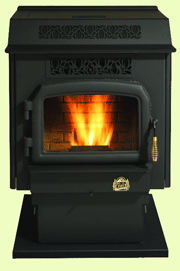
 A few weeks ago, I made a reference to LIHEAP in my story concerning my experiment in heating with corn. The reference was only a passing thought after I had pretty much written the body of the story. So I followed my curiosity and made some calls to see what I could find about LIHEAP and its current status.
What I found was as expected somewhat depressing. While Boehner, Cantor and McConnell whine and cry about the impoverished multi-millionaire “job creator,” real Iowans will be facing a real winter with bone-numbing cold without enough money or aid to pay for a winter’s worth of heat.
‘LIHEAP’ is the acronym for Low Income Heating and Energy Assistance Program.” LIHEAP was established in 1981 to help low income Americans pay for heating and cooling bills that at that time were causing shock due to the quickly rising cost of energy. Since then we have learned that purchasing power of most households has remained static while cost of energy has continued rising to record levels. So LIHEAP has become an increasing necessity for many low income households. However, the trend since 2000 has been to cut safety net programs such as LIHEAP to pay for tax cuts which have been mostly geared to high income or high wealth households.
This year of course the budget battle has stressed debt reduction without accompanying tax raises, thus placing the reduction on program cutting. Programs being cut are mostly those which are of the safety net variety.
With that background, LIHEAP for fiscal 2010 – 2011 was funded at ~ $5 billion. This budget year that funding has been greatly reduced. The Obama Administration proposed cutting the funding in half. That was even too much for congress. While a budget has yet to be passed the continuing resolutions have allowed some LIEAP money to be released to the states. At the pace LIHEAP is being funded on the continuing resolutions the cut will be ~$1.3 billion or about 25%.
Much of the information I have comes from Jerry McKim who is Iowa’s LIHEAP Director. Mr. McKim was quite forthcoming with information. It was pretty obvious that he was quite frustrated by the cutbacks and delays in funding. He deals with the people who feel the pain of the cold.
LIHEAP comes to the states as a block grant and is then portioned on a first come, first served basis. Assistance is offered to those meeting poverty guidelines. Last year Iowa received ~ $71 million. It currently looks like Iowa will be receiving ~ $50 million this year.
Each award is based on various factors such as poverty level, personal factors (such as age, children, health etc.) and fuel type. No award would cover the whole cost of heat for a winter. It currently looks like that award will be reduced by the percentage less that Iowa gets. For example, if a person received $500 last year, this year’s award would be about 25% less or about $375. Since the cost of the heat has gone up, the gap between the assistance and the actual bill must be paid by the individual.
Fortunately, it is against the law for a customer to be disconnected until March 31st. Unfortunately, if the payment is still in arrears come the next November 1st, there is no law that says those that are disconnected must be reconnected for the winter. This leads to a certain number of households disconnected through the next winter. Mr. McKim said this number of Iowa households without heat in a given winter is around 8,700. My guess is that that is about equal to a small city like Marshalltown. To me this is a disgrace. The Iowa Utility board disconnection/ reconnection numbers can be found here.
Here are some sobering facts to think about as you sit in front of the TV this weekend. This is from a press release passed on by Mr. McKim:
PRESS RELEASE
State LIHEAP Directors Release 2011 National Survey
Contact: Mark Wolfe, 202-320-9046
November 1, 2011
Record Heating Oil Prices Place Millions of Poor Families at Risk
New Study Shows Finds that LIHEAP Families are Disproportionally Poor Elderly, Disabled and have Young Children
The National Energy Assistance Directors’ Association (NEADA) representing the state directors of the Low Income Home Energy Assistance Program (LIHEAP) released the results of their annual survey of LIHEAP recipients.
Key Findings:
The Low Income Home Energy Assistance Program (LIHEAP) is the most comprehensive federal program that helps low-income families meet their immediate home energy needs. The average LIHEAP benefit covers about half the cost of home heating, or $450 per year per household. Approximately 8.9 million low-income families received assistance in FY 2011; approximately 10 million households are expected to apply for assistance in FY 2012.
Both the House and Senate appropriation bills would cut LIHEAP between $1.1 billion (Senate) and $1.3 billion (House) from the FY 2011 level of $4.7 billion. The impact of both bills would be dramatic; an estimated 1.6 million very vulnerable households would be cut from the program.
In order to obtain a comprehensive demographic picture of LIHEAP recipients and the characteristics of those who are helped as well as who would be hurt by the program cuts, NEADA conducted a survey of approximately 1,800 households that received LIHEAP benefits in FY 2011. The results show that LIHEAP households are among the vulnerable in the country.
In fact, nearly 90 percent of LIHEAP recipient households have at least one vulnerable member—defined as someone age 60 or older, age 18 or younger, or disabled.
Additional findings underscore the fact that, for these households, a loss of heat or electricity in the winter could have serious health and safety implications.
LIHEAP Households Are Among the Most Vulnerable in the Country
· 40 percent have someone age 60 or older
· 72 percent have a family member with a serious medical condition
· 26 percent use medical equipment that requires electricity
· 37 percent went without medical or dental care
· 34 percent did not fill a prescription or took less than their full dose of prescribed medication
· 19 percent became sick because the home was too cold
· 85 percent of people with a medical condition are seniors
Other key facts reported by the study:
· 45% reported that their energy bills were more than $2,000 in the past year.
· 35% were unemployed at some point during the year.
· 52% said that energy bills were more difficult to pay than in the previous year and 48% of those who said that it was more difficult to pay their energy bills reported that the main reason was their financial situation.
· LIHEAP benefits decreased since the previous year due to the smaller appropriation in FY 2011. Mean heating benefits were $429 in FY 2011, compared to $483 in FY 2009.
· Many LIHEAP recipients were unable to pay their energy bills. 49% skipped paying or paid less than their entire home energy bill, 37% received a notice or threat to disconnect or discontinue their electricity or home heating fuel, 11% had their electric or natural gas service shut off in the past year due to nonpayment, 24% were unable to use their main source of heat in the past year because their fuel was shut off, they could not pay for fuel delivery, or their heating system was broken and they could not afford to fix it and 17% were unable to use their air conditioner in the past year because their electricity was shut off or their air conditioner was broken and they could not afford to fix it.

 Blog For Iowa