Blue Alert LIVE: 6-week abortion ban in Iowa on Friday?
Join Leader Konfrst and Dr. Amy Bingaman (OB/GYN) for a discussion about the upcoming Iowa Supreme Court decision the Governor’s six week abortion ban.
The latest episode of Iowa Press featured Iowa Senate Minority Leader Pam Jochum as the guest. Here is my review of the program.
Let’s start with moderator Kay Henderson’s opener: “Iowa democrats will try to win back State Senate seats this fall after republicans gained a super majority in 2022.”
What’s wrong with that, you may ask. She’s just stating the facts. I’ve picked up this pattern in the national media as well. They don’t tend to say republicans “try.” They more often say simply what republicans are going to do. In this case, Henderson could have said, “Democrats set their sights on winning back senate seats” or “Democrats will focus on…”
Linguistically, the word “try” suggests that it won’t happen. It sounds weak. Is this a purposeful choice, coincidence, unconscious or conscious bias, repeating the narrative, or simply not being thoughtful about how to fairly present information. It could also be they don’t want to hear from Jeff Kaufmann that they are being soft on Democrats. I believe in this instance it was most likely unconscious bias. It wouldn’t be a big deal if it was not a consistent pattern.
Also in Henderson’s opener she chooses to remind viewers that republicans currently enjoy a Super Majority! She’s just sayin’! Not looking good for democrats! They never fail on this.
Starting off Pam Jochum scores a point when she replies to Kay’s “welcome to the program” with “hopefully, this won’t be my last one.” See my previous post about the D-R imbalance on the show. Iowa-Press-Republicans-17/Democrats-9
Next Erin Murphy asks a punchy question about immigration. Notice the Republican framing. I will add what I feel is the subtext in brackets within the text of the question.
Murphy: “Another issue that voters are going to be hearing a lot about is immigration [Rs are making sure we hear a lot about it because they are trying to beat up Biden with misinformation about border policy] and I know that is typically federal policy [is federal policy], but republicans passed a state law here [Rs do whatever they want to do here] that is now being challenged in the courts. We’ve seen polling [I’m not making this up – there’s polling] that actually this topic is important to voters across political boundaries [justification for why they continually ask questions that are basically Republican talking points]. Democrats opposed the state law that passed. If that wasn’t the answer, what is? [there is always only two choices] And what will democrats say to those voters who want action on this issue? [as if Democrats are to blame for the fact that federal law supersedes state law. What should Dems tell voters? As Jochum explains in her answer, Dems will tell voters the facts about how government actually works.]
Jochum gives a thorough answer to Murphy’s question, reminding viewers that we are a nation of immigrants, educating the public about the fact that Iowa’s Republican representatives in congress have the power to do something on immigration because it is a federal issue. She adds that local law enforcement have indicated the Iowa law is unenforceable.
Murphy comes back with a follow-up challenge. As I’ve noted previously, they rarely challenge anything republicans say, especially when it is obviously false or crazy. Using tone that I never see anyone on this panel use with republicans he asked the question again, this time accusing her of “punting” the issue.
Murphy: “So, when your candidates are knocking doors this fall and if a voter asks one of your candidates that question and if the answer is that is the responsibility of the federal government, not me at the Statehouse level, will that resonate with voters?
Jochum replies in part: “I think that it’s part of our job to also educate the voters on who is responsible for immigration law.” She has more to say on the subject, you’ll just have to watch.
If the Iowa Press panel sees it as part of their job to educate voters they do a great job of concealing it. They seem to see their job as being cynical toward Democrats so they don’t lose their jobs.
Next question –
Gruber-Miller: “..republicans this year passed a law changing the AEA system, changing some of the funding and responsibilities. What are you hearing so far about how that is going? And what issues do you think a future legislature may need to come back and take a look at?”
me: Here “change” is a word choice that suggests it is a neutral event with no bad outcome. “Fundamentally altering” the educational landscape in Iowa, would be far more accurate and informative. He makes what they did to the AEAs sound benign. This is important because viewers don’t necessarily know the sordid details of what happened and what Rs did and the results. They won’t find out by watching Iowa Press either unless a Democrat tells them.
Jochum next answered a question by Gruber-Miller on the “private school scholarship, education savings account” law (school vouchers).
After Jochum’s answer Kay added, “the Governor made it an issue in her re-election campaign and was re-elected overwhelmingly. Why do you think it will be an issue in this legislative race?”
me: Overwhelmingly! Emphasis noted. Henderson asks democrats “why” questions a lot. To me, the way she says it communicates that she can’t fathom why the democrat on the stage would think something, suggesting there is no apparent reason for it.
Why would Henderson seemingly have no idea there was enormous push back from the public about the voucher bill? With the amount of public outcry and facts that have come out since the bill passed, it makes perfect sense that it could well be an issue in November. She covers the legislature. She should know.
I feel Henderson was carrying water for the guv on this one. Kim ran on “parental choice” not “let’s destroy Iowa’s public schools” and gave few details during the campaign. Only later did the details come out and voters realized the negative impact the law is having and will continue to have on our public schools. Jochum concurred in a more polite Iowa nice manner and longer response.
I have mentioned previously, the panel has to say to every Democrat that comes on the show that Joe Biden is unpopular in Iowa, a fact that they smartly point out will make things difficult for Democrats. Yes, we all understand Iowa is a VERY RED state! We get it. Can you think of a new question? They did not disappoint. Gruber-Miller did the honors this week. I’ve observed that whenever an interviewee responds to a question with “that is a good question” it usually is a bad question. Jochum was effective in her response to the “Biden is unpopular in Iowa and that is bad for Democrats so what will you do about it” question. Just for the record, they asked the same question of Jennifer Konfrst, Rita Hart and Rob Sand.
These are examples of Republican framing, the mindset of the program’s panel. For info on political framing check out the work of George Lakoff and Gil Duran at FrameLab.org.
They asked Jochum if she was running for governor after she retires from the legislature.
Jochum: “No, I’m not. There are plenty of other younger people, quite frankly, that I think have already expressed some interest in running and I think they would do an absolutely superb job of they decide to do that.”
From the Summer 2024 edition ofThe Prairie Progressive, Iowa’s oldest progressive newsletter. The PP is funded entirely by reader subscription, available in hard copy for $15/yr. Send check to PP, Box 1945, Iowa City 52244. Click here for archived issues
by Kim Painter
This summer in Iowa, the legislative stupid just rolls on. In the last week, we have watched in bemused wonderment as lawmakers, restaurant owners, and lobbyists had a meltdown. Why? Because the feds are enforcing child labor laws – even though Iowa’s GOP passed a state law contravening them, and the lobbyists told the business owners it would all be just fine. Turns out it is not just fine. Illegal staffing has been alleged against some businesses relying on the new state law. Numerous instances are being assessed by the federal government for violations. Penalties could be stiff. As they should be.
Contrary to the belief of Iowa’s GOP legislators, we are not living in a movie production of David Copperfield. It is not what we want as citizens; it is not allowed under federal laws. The fact that so many under the Capitol dome blithely went along with hurtling children into the way back machine, ever closer to 1800s London, is astonishing. Industry excuses, hurriedly composed and articulated this week, are beyond that.
As a vortex of publicity erupted, Iowa’s Restaurant Association began hearing from business owners in their organization who received visits and communications from federal regulators about practices they had adopted upon passage of the new law,
SF 542.
Turns out many felt, and documentation appears to confirm, that the Association at the very least downplayed the risks of adopting the new state law rather than hewing closely to federal guidelines with employees under the age of 16.
At www.bleedingheartland.com Laura Belin gives the best overview of the bill, its passage, its implementation and how it was communicated to restaurant owners. There are moments when I read her communication from the Association’s President & CEO
Jessica Dunker, where I feel sorry for owner/employers trapped between amped-up GOP lawmakers, their own lobbyists, and the feds. But when you distill it all down to its essence, it appears this is what happened:
Said lawmakers, high on multiple conservative “wins” across federal, state and local governments, went to work to undermine protective child labor laws. They passed their bill and were jubilant about the prospect of clearing so much ‘obstruction’ from the pathways of young people seeking ‘a meaningful work experience.’
The bill was signed by our Governor, always eager to clear obstructive bureaucratic protocols out of the way of ‘common sense’ approaches to government or labor and
working conditions.
As the bill was communicated to business owners, it appears – and Belin shows the work on this – information on how and where the new state law might contradict federal law, and thereby create major trouble for them as employers, was not well done. There were print materials, but none with a simple side-by-side of federal and state regulations. There
was a statement about following federal law whenever that is what “gives the most protection.” It appeared in a section titled “Federal Labor Law.” Prior to this, Belin cites
language that appears to wholly ignore tensions between the two sets of laws on the association’s “Legislative Wins” page.
In short, it would have been terribly easy for a busy employer to miss out on the few, obscure signals that using the Iowa law as a polestar mightcause serious trouble. Now, some owners fear closure as it appears the federal law will be enforced with significant strength.
This boondoggle was created by a political party drunk on its ascension to ever greater power, aided by a statewide association eager to tout a giant legislative “win” to its membership.
Now, the association is crying foul. Dunker argues the kind of enforcement being undertaken in Iowa has not happened in the 19 or so other states where power-drunk GOP
legislatures have similarly vivisected child labor laws. I cannot weep for them on this point. We don’t get to tell the IRS that we know dozens of people in dozens of states who
have failed to declare a, b, or c and were never penalized. That’s just not how life, regulatory structures, tax codes, or basic laws work or have ever worked.
In addition, prior to the bill’s passage, federal regulators chimed warnings to Iowa that the impending law would be “inconsistent with federal child labor law in several respects.’
With warnings, time to spare, and any ‘common sense’ at all, the debacle being faced by some Iowa restaurant owners could have been avoided. It should have been. Their legislators let them down. Their association also appears to have some explaining to
do. Meanwhile Iowa and its child workers, for now, appear safe from a slide back into a very off-off-Broadway production of Little Dorrit.
—Kim Painter migrated to Iowa in 1981.
###
Blog for Iowa editor’s note:Action alert from Iowa City Federation of Labor/Johnson County Dems –
**UPDATE – THIS EVENT HAS BEEN CANCELLED DUE TO REYNOLDS CANCELLING THE PRESS CONFERENCE** Series of public forums planned for July & August**
Updated statement from Iowa City Federation of Labor:
Today Governor Reynolds’ office announced cancellation of the press conference she had planned for Monday in North Liberty with the Iowa Restaurant Association. We hope this change of plans also reflects a change of heart and that the Governor and Restaurant Association will cease the disinformation campaign which has encouraged Iowa businesses to violate child labor laws, already resulting in unnecessary dangers to kids and legal problems for Iowa businesses.
In place of Monday’s planned labor community press conference, we invite media and the public to join us for a series of public forums we will host in July and August in partnership with our sister labor federations across the state. These events will expand on information we had planned to share at the press conference, allow for additional Iowa workers to share their experiences with the growing crisis created by the Reynolds administration’s refusal to enforce worker protection laws, and ensure that all Iowans have access to accurate information about workplace rights and how business owners can fully comply with state and federal laws.
We encourage anyone with questions about workplace laws in Iowa to contact us or the other trusted sources of information listed below for assistance:
• Iowa City Federation of Labor: iowacityfedlabor@gmail.com
• U.S. Department of Labor: (515) 284-4625 or1-866-4-USWAGE
Speakers who had planned to participate in Monday’s press conference shared the following comments:
“Our county and cities are proud to provide employment opportunities to scores of young workers who serve our parks and recreations programs and provide other vital public services over the summer. We are equally proud that as employers of teens we follow all labor and employment laws to make sure these jobs are safe and rewarding work experiences for youth, and we expect all employers within Johnson County to do the same.” – Rod Sullivan, Chair, Johnson County Board of Supervisors
“It’s truly outrageous that the Governor of Iowa is telling employers it’s ok to break federal child labor laws. In the past decade I’ve stood with dozens of restaurant, construction, and service workers whose rights have been violated by bad actors. Again and again I’ve seen how our state’s failure to enforce basic workplace laws leaves low-wage workers vulnerable to wage theft, discrimination, or safety hazards—and how often it’s Black, brown, and young workers who experience the worst mistreatment.”—Greg Hearns, Board of Directors, Center for Worker Justice of Eastern Iowa
“Every young person in Iowa deserves the opportunity to gain safe work experience and prepare for career success. It’s why I’ve strongly opposed absurd Republican proposals to put teens in hazardous situations—serving alcohol, driving long distances after late shifts on school nights, working with saws, guillotine shears, explosives, on demolition sites, and more. Iowa Republicans ignored warnings and passed the most extreme child labor laws in the country, but I and other Iowa Democrats won’t stop fighting to restore the commonsense guidelines that young Iowa workers and businesses need to thrive.”—Senator Zach Wahls, (D-District 43)
Iowa House Minority Leader Jennifer Konfrst said the message for Democratic candidates is clear in 2024. There are two issues: reproductive freedom and public education. Both are equally important. Where the rubber meets the road, during local political canvassing, many voters equate a discussion about “reproductive freedom” with one about “abortion.” In fact, Konfrst used both terms in her speech to delegates at the June 15 state convention. My question is will “reproductive freedom” do the work?
In my latest iteration as a political canvasser, beginning during the 2004 election cycle, I’ve been meeting with voters where they are. No one keeps track of how many voters they contact, yet certain themes stand out. One of them is abortion.
There is a hard line for people who oppose abortion. It’s the first question they ask of a canvasser, and the first one to shut down any dialogue if the answer is wrong. “Your candidate wants abortion to be legal? This conversation is over.” The main purpose of the canvass was accomplished: This voter is in the no column. It’s time to move on.
Polling done by the Des Moines Register is clear: “61 percent of Iowans say abortion should be legal in most or all cases and 33 percent said it should be illegal in most or all cases.” Establishing the ability for women and their physician to choose to have an abortion as part of women’s health care has broad support. The key question is will that matter in a hyper-partisan election? The Magic 8 ball returned “Reply hazy, try again.”
At one of my workplaces, my supervisor was an anti-abortion activist. That made for interesting conversations while traversing the countryside together in a rental car, listening to Rush Limbaugh, and making sales calls. I can’t count how many times I heard statistics on abortions from him. Some facts: before Dobbs, in 2021, there were 3,761 recorded abortions in Iowa. 625,978 were reported to the Centers for Disease Control that year. Literally millions of children were being killed by abortionists, my supervisor said. This was the same person who enabled me to meet John McCain, allowed me to register people to vote in the workplace, and let me lobby for the company with Dave Loebsack while we were in D.C. It was a weird work experience.
My point in telling this story is I learned the anti-abortion crowd is well financed, highly organized, and well connected. Groups like Heritage Action, part of the dark money Koch network, plan to keep awareness of how to restrict abortion rights front and center. They are in it for the long haul and are willing to spend resources and time accomplishing their objectives.
It is important to remember anti-abortion activists worked continuously for five decades to overturn Roe vs. Wade. They will not walk away from an electorate because polling shows voters favor the ability to have an abortion. We recently saw debates about abortion pills, in vitro fertilization, military policy toward abortion, and more. Women’s health care will be a constant presence in the election, creating a haze of what-aboutism, misinformation, disinformation, and outright deception. The intent is to obfuscate and by doing so, prevent Democrats from getting elected. Konfrst is right: we need to address this head on through our campaign messaging.
Will voters who support restricting abortion rights crossover and vote for Joe Biden and down ballot Democrats? I wouldn’t think so. We must know who they are and formally identify them in our database. Talking to them may be a lost cause, yet it is part of the canvassing work.
Democrats can bridge the gap where people live. There may be people, regardless of party registration for whom right to choose is valued. According to the Register poll, there are a lot of them. Once we find those people we must give them support, and if needed, some cover in return for a vote. That’s a lot different from asking whether they will vote for a specific candidate. It requires a longer term commitment to community that goes beyond elections. It would be good for Democrats to learn how to do that, and fast.
When it comes to messaging for the November election, we should follow the lead of our political leaders. To the extent Democrats do that, and frame the discussion as one of “reproductive freedom,” winning is possible. In the end, though, we will be talking about abortion because that is the vernacular voters use. There is no escaping it. We should embrace it.
The metaphor Iowa Democratic Party Chair Rita Hart used at the June 15 state convention was apt. After saying Democratic candidates had a tough road ahead, she likened the work leading to the November election to clearing rocks from a farm field. Hart talked about her experience farming in Iowa, having to pick rocks from fields with her siblings, reported the Iowa Capitol Dispatch.
“Sometimes, I think we’re in a rocky place right now, right?” Hart said. “And we’ve got to pick up that rock that makes the most sense for us. … Find the thing that you can do, that you can contribute to this effort, and do it in spades. That’s what we’ve got to do from now until November.”
Democratic political operatives are more used to having a specific plan, falling in line, and then working the plan. “Find the thing that you can do…” is counterintuitive. People scratch their head and ask, what does that even mean. I believe Hart is getting at the idea that Democrats must take more ownership of our politics now that the coordinated campaign is in the rear view mirror. There is no presidential campaign to filter down directives on what should be happening on the ground. As individual Democrats, we own this campaign. If we do the work, we have a chance of winning. There will be no more bitching about the coordinated campaign because it’s permanently gone. Simply the work remains.
It will also be challenging for Iowa Democrats to stay on message during the upcoming fall campaign. That’s mostly because the Republican Party is such an unruly, authoritarian mess. Legislation passed in recent sessions obfuscates the legislative terrain and serves as chaff clogging the radar of Democrats getting their bearings.
A case in point is the law passed last session related to immigration. Democrats and everyone with half a brain knew from jump street the law would not pass judicial muster. Republicans didn’t care if they would be sued over it. When U.S. District Court Judge Stephen Locher issued a preliminary injunction, everyone knew the argument that federal immigration law preempted the state law would prevail. As reported by the Cedar Rapids Gazette, “As a matter of politics, the new legislation might be defensible,” Locher wrote in his decision. “As a matter of constitutional law, it is not.”
Whether it be abortion, education, immigration, or whatever, poorly written, Republican-backed legislation is expected to raise a number of political issues this year. Attorney General Brenna Bird will be busy. It will serve as a distraction from Democratic work to focus messaging on women’s health care, abortion policy, and education.
At the convention, Iowa House Democratic Minority Leader Jennifer Konfrst had a message for all Iowa Democratic candidates for this fall’s elections: When talking to voters, stay on message, and that message should be about reproductive freedom and education policies.
“Message discipline is critically important this year, every year,” Konfrst said as reported in the Cedar Rapids Gazette. “But this year especially because Iowans are voting on two issues this year: What’s on their mind is public education and abortion and reproductive freedom. And guess what. They’re with us. So that’s what we’re going to talk about. … “(Republicans) are wrong on public education and reproductive freedom. They’re wrong, and Iowans aren’t with them. Iowans are with us. So we’re going to talk about the issues that matter to Iowans, not just to us.”
Democrats own a clear goal for concise messaging. Republicans are all over the map with bad laws, lawsuits, negative reactions to the federal government, and generalized hubris cluttering the campaign battlefields. I don’t know if that creates an electoral environment where Democrats win. It clears the field for a new kind of politics. What do Democrats have to lose?
As we await the Iowa Supreme Court’s decision on the Republican attempt to turn Iowa women and girls back into second class citizens, here is Vice President Kamala Harris sharing her wisdom on the topic. Click here for Iowa House Democratic Leader Jennifer Konfrst’s action alert we posted yesterday.
Action alert from Iowa House Democrats Leader Jennifer Konfrst:
In less than 48 hours, the GOP’s 6-week abortion ban could become law in Iowa. As we wait for the Iowa Supreme Court’s decision before June ends, we are feeling sad, anxious, and angry that this could become reality in Iowa.
We want to keep you up-to-date on when this decision from the court comes out and then be ready to take action to protect our reproductive freedom.
Sign up for urgent text message alerts here or text “FREEDOM” to 515-297-6414 and be one of the first to know what the Iowa Supreme Court decides and how to engage!
Everyone deserves the right to make their own healthcare decisions, especially when it comes to reproductive care and abortion. Thanks for joining this fight with us.
Big polling news. Two thirds of voters who don’t like Trump or Biden think Trump should drop out of the race.
Forget about the Iowa presidential poll. Iowa is at the extreme end of red. We are irrelevant. We will not be giving our electoral votes to a democrat in 2024. Out there in the real world though, there is some bad polling news for Trump. It appears the fact that DJT is a convicted felon matters. And it matters a lot.
Keith Olbermann does an entertaining take on the polling news. He weaves it in with some essential media criticism calling them out for the preposterous narrative they have been pushing that convictions would actually benefit Trump. In my opinion Olbermann is still very good and some of the funniest commentary available. Take a listen or head over to Politico for the rest of the polling news that is bad for Trump.
“Twenty-one percent of independents said the conviction made them less likely to support Trump and that it would be an important factor in their vote.”
And that’s just for starters.
Olbermann podcast highlights:
“The mainstream political media has just discovered something it evidently did not know. A – that elderly first offender Trump is getting killed in the polls now because of the Stormy Daniels election interference conviction and B – that this is actually a headline story that they should write about and not some postscript and C – that the Biden campaign yesterday took the big leap forward and actually called Trump a convicted criminal.”
“New Ipsos poll for Politico yesterday: [Politico] rather than acknowledging that it and the rest of the mainstream political media had served as vessels for this nonsense that he was going to improve his position by being convicted…thirty-three percent are less likely to vote for Trump because of convictions. Meanwhile, 17% said more likely – those were Republicans who were going to vote for him anyway.”
“Among independents the same number – a third less likely to vote for him but only 12% of independents more likely.
“Ipsos also dug a little deeper. Are the convictions important in your decision whether or not to vote for Trump and 22% say the convictions are important AND make them less likely to vote for him. That is a loss of 1 in 5 Trump voters.”
“Ipsos did a separate poll for ABC looking for and grilling double-haters – those voters who do not like Trump and do not like Biden. Well there’s don’t like and there’s DON”T LIKE. Two thirds of those who will vote think that after the convictions Trump should drop out of the presidential race – not just they don’t support him that much anymore or they’re less likely to.. Two thirds of double haters want Trump off the ballot.”
“The Biden campaign has gone gloves off on the central issue. If you didn’t hear it, here’s the money shot and I do mean money – a fifty million dollar Biden ad buy just for the rest of this month. “This election is between a convicted criminal who is only out for himself and a president who is fighting for you and your family. I’m Joe Biden. And I approve this message.”
______________
More info in the podcast about positive swing state results and Trump now losing to Biden among 65 and older.
In the coming years, climate change could force Americans from their homes, not just by raising sea levels, worsening wildfires and causing floods — but also by putting insurance coverage out of reach.
In places including California, Florida and Louisiana, some homeowners are finding it nearly impossible to find an insurance company that will cover their property. Others have seen their premiums climb so high that they can no longer pay. Experts say the trend is spreading throughout the country as natural disasters increase.
Most mortgage lenders require homeowners to maintain insurance. Without access to coverage, millions of Americans could find themselves forced to reconsider where they live. Consumer advocates say long-overdue conversations about development in areas prone to natural disasters are being driven by property insurers, not governments.
“Insurance companies have basically become our land-use officials,” said Doug Heller, director of insurance with the Consumer Federation of America, a research and advocacy nonprofit. “In 2023, the industry suddenly seemed to wake up and say, ‘There’s climate change, forget all those times we’ve nodded our head yes and told you that you can live there.’”
As the crisis escalates, state leaders are desperately trying to convince insurance companies to stick around. States are offering them more flexibility to raise premiums or drop certain homes from coverage, fast-tracking rate revisions and making it harder for residents to sue their insurance company.
Meanwhile, a flood of new policyholders are joining state-backed insurance “plans of last resort,” leaving states to assume more of the risk on behalf of residents who can’t find coverage in the private sector.
Insurers are the climate change canary in the coal mine.
– Dave Jones, director of the Climate Risk Initiative at the University of California, Berkeley’s Center for Law, Energy, & the Environment
Industry leaders note that insurance companies have been hammered by heavy payouts — last year, 28 separate U.S. natural disasters caused at least $1 billion each in damage, according to federal figures — and say they simply can’t afford to provide coverage in the areas that face the highest risk.
Disaster costs are soaring. In the last five years, there have been 102 disaster events in the United States that caused at least $1 billion in damage. In the entire decade of the 1990s, there were 57 billion-dollar events (adjusted for inflation), and in the 1980s there were 33.
Natural disasters are increasing at the same time risk-prone areas are becoming ever more populated, and as property values are climbing. The price of repairs and replacement have skyrocketed due to inflation, workforce and supply chain issues. Insurers say costs also have been driven by an uptick in litigation and fraud.
Month-by-month accumulation of billion-dollar disasters for each year on record. The colored lines represent the top six years for most billion-dollar disasters. All other years are colored light gray. (NOAA image by NCEI)
“We’re experiencing record-breaking losses as it relates to natural disasters,” said Adam Shores, senior vice president for state government relations with the American Property Casualty Insurance Association, an industry group. “We want to be there, but when the math doesn’t work for a company, they have to make those decisions.”
While the insurance crisis is most acute in certain coastal states, climate experts say every region will face similar challenges, especially as severe storms batter the middle of the country. While some states have made marginal gains in stabilizing the insurance market, some experts say that progress may be short-lived.
“Insurers are the climate change canary in the coal mine,” said Dave Jones, the former insurance commissioner in California and director of the Climate Risk Initiative at the University of California, Berkeley’s Center for Law, Energy, & the Environment. “While these policy and regulatory interventions might help in the short run, they’re likely to be overwhelmed by the increasing risk and loss.”
‘The perfect storm’
In some hard-hit states, policymakers have focused on giving insurance companies more flexibility to adjust their rates and coverage options.
Four hurricanes walloped Louisiana in 2020 and 2021, causing $23 billion in insured losses. Twelve insurance companies became insolvent and dozens left the state. Residents in southern Louisiana especially have struggled to find coverage, and some have moved elsewhere because they couldn’t afford their premiums.
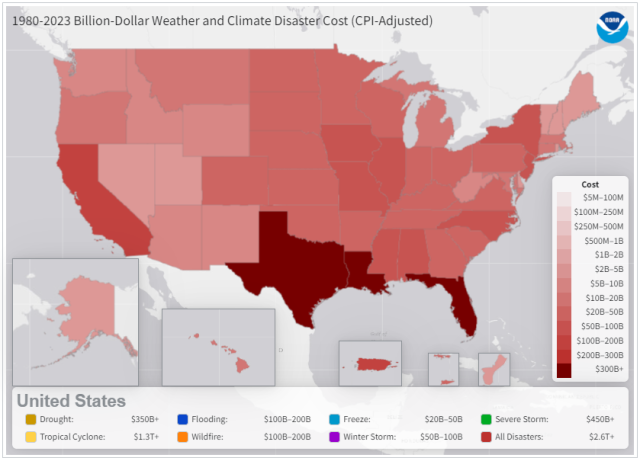
This map depicts the total estimated cost borne by each state from billion-dollar weather and climate events from 1980-2023. (Screenshot from NOAA NCEI Billion-dollar Disasters web mapping tool)
“It’s the perfect storm,” said Louisiana state Rep. Gabe Firment, a Republican. “We just do not have companies willing to write business in Louisiana right now, and you can’t blame them.”
Firment sponsored a measure, enacted this year, repealing a state rule that had blocked companies from dropping long-standing customers. Those dropped can join a state-run plan. Lawmakers hope that — given the ability to cancel the highest-risk policies — insurance companies will remain in the state and avoid massive rate hikes on their remaining customers.
Legislators passed a suite of other laws aimed at the crisis, speeding up the process for insurers to adjust their rates, extending a grant program to help residents fortify their homes and giving companies more time to pay out claims. Firment said the changes are designed to attract more companies back to the state, “but if we get two or three hurricanes this year, all bets are off.”
In California, many major insurers have canceled policies or stopped accepting new applications due to wildfire risk. Regulators there have proposed a rule that would allow companies to incorporate climate change projections into the models they use to set their rates.
“Insurers are not going to continue to write in every market if they can’t price accurately,” said Mark Friedlander, director of corporate communications with the Insurance Information Institute, an industry-backed research group.
Meanwhile, Democratic Gov. Gavin Newsom has put forth a measure that would speed up regulators’ approval of the rate revisions proposed by insurance companies. While seeking to give insurers more flexibility on rates, California leaders also have sought to protect residents by establishing a one-year moratorium on policy cancellations in disaster areas following a wildfire.
Officials at the state Department of Insurance did not respond to Stateline interview requests.
Homeowners’ insurance rates in Texas spiked 23% last year, twice the national average. The state has endured a myriad of disasters in recent years, but consumer advocates fear insurers are weaponizing climate change to jack up rates and demand looser regulations.
“[Insurance companies] are putting a gun to our heads, telling us, ‘Do it our way or we’ll pull up stakes,’” said Ware Wendell, executive director of Texas Watch, a nonprofit advocacy group. “They’re going to cherry-pick the country and only insure parts of the country that have less climate risk.”
The Texas Department of Insurance did not grant a Stateline interview request.
‘Last resort’
In several states, homeowners who can’t find private coverage are joining state-run plans. Originally intended to be a last-ditch option, because they generally offer limited coverage, these plans are seeing more and more residents signing up.
Florida has seen more than 1 million residents join the plan offered by the state-run Citizens Property Insurance Corporation. The plan, which is meant to be a “last resort” option, now stands as the largest in the state.
Insurance rates in Florida have climbed to four times the national average, following hurricanes Ian and Nicole in 2022. The state also has seen an uptick in claims lawsuits that insurance companies characterize as legal abuse.
Legislators changed state law in 2022 to disincentivize such lawsuits, ending homeowners’ ability to collect attorneys fees from insurers in claims disputes. State regulators say insurance rates have stabilized in 2024, and new companies are joining the market. The Florida Office of Insurance Regulation did not grant an interview request.
But some lawmakers say state leaders are eager to help insurance companies while ignoring the underlying issue of climate change.
“Stabilization is important, but [premiums] have stabilized at high rates,” said state Rep. Anna Eskamani, a Democrat. “Floridians can’t afford Florida anymore, and if we’re not taking climate change seriously, then we’re missing the point.”
Eskamani called for leaders to change land-use policies to limit development in high-risk areas.
Even as some Florida homeowners are now shifting from the state-run plan back to the private market, industry experts say the nationwide surge in state-backed policies is troubling. If such plans exhaust their reserves, states impose an assessment on either all insurance companies or all individual policyholders — known in Florida as the “hurricane tax.”
Jones, the former California insurance commissioner, noted that insurers there are worried that growing wildfire risk could force them to bail out the state plan. Nearly 400,000 Californians rely on the state plan for insurance, and state officials have warned that a catastrophic event could wipe out its reserves.
While Californians struggle to find insurance on the private market, Jones called out the insurers that are dropping policies even as they retain financial ties to fossil fuel companies.
“Why are insurers investing in and writing insurance for the very industry that’s making it increasingly challenging for them to write insurance in certain parts of the country?” he said.
In Colorado, lawmakers voted last year to create a state-backed insurance plan like those in more than 30 other states. State Sen. Dylan Roberts, the Democrat who sponsored the bill, said he heard from constituents who were getting dropped by their insurers following the Marshall Fire that swept through Boulder County in 2021.
“We’re going to have more and more Coloradoans every year who are unable to find insurance for their property on the private market,” he said. “To have an insurer of last resort is something we hope isn’t used widely, but it’s something we need to have.”
Some consumer advocates believe states will have to get more involved. Amy Bach, executive director of United Policyholders, a nonprofit that advocates for insurance customers, said governments face the same difficult risk calculations as private companies but are tax-exempt and don’t face the same pressures to return high profit margins to shareholders.
“Publicly supported insurance programs are here to stay,” she said. “It behooves us to build them as smart as we can.”
In Washington state, regulators say they have only a few hundred policies on the state-backed plan, a sign that residents can still access coverage on the private market. David Forte, senior property and casualty policy adviser with the Office of the Insurance Commissioner, said the agency has added actuarial staff to speed up insurers’ rate revision approvals.
He also credited the work of state leaders who have invested millions to reduce wildfire risk. But he cited a 2022 wildfire that nearly swept through the town of Index, before shifting winds changed its direction.
“If that had happened, I think our property market would be different,” he said. “Are we just one bad event away? Probably.”
Iowa Capital Dispatch is part of States Newsroom, a nonprofit news network supported by grants and a coalition of donors as a 501c(3) public charity. Iowa Capital Dispatch maintains editorial independence. Contact Editor Kathie Obradovich for questions: info@iowacapitaldispatch.com. Follow Iowa Capital Dispatch on Facebook and X.
State auditor Rob Sand has not made an appearance on the Iowa Press program since 2022 when he debated Todd Halibur. Sand was on the program one other time earlier in 2022. Then all of 2023 passed by without the state auditor appearing as a guest on Iowa Press even once. You would think being the only statewide elected democrat we have, that it would be a good idea to have that one democrat on the program at least once a year. I complained about the lopsided number between Rs and Ds in 2023 in a post,Iowa Press: Republicans 17 Democrats 9.
If you’re one of many who have sworn off watching Iowa Press because of their obvious disdain for democrats and deferential treatment of Republicans, I declare this one safe for viewing. You’ll enjoy quite a few zingers Sand gets in.
Governor Kim Keynolds: (515) 281-5211 U.S. Capitol Switchboard: (202) 224-3121 Iowa Members of Congress - Rep. Randy Feenstra (R) - Rep. Ashley Hinson (R) - Rep. Mariannette Miller-Meeks (R) - Rep. Zach Nunn (R) Iowa US Senators - Senator Joni Ernst (R) - Senator Charles Grassley (R)

 Great information here.
 The latest episode of Iowa Press featured Iowa Senate Minority Leader Pam Jochum as the guest. Here is my review of the program.



 Action alert from Iowa House Democrats Leader Jennifer Konfrst:
 Big polling news. Two thirds of voters who don’t like Trump or Biden think Trump should drop out of the race.
 States beg insurers not to drop climate-threatened homes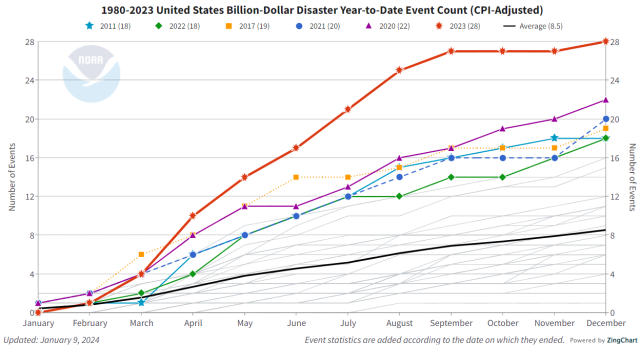
 State auditor Rob Sand has not made an appearance on the Iowa Press program since 2022 when he
  Blog For Iowa