
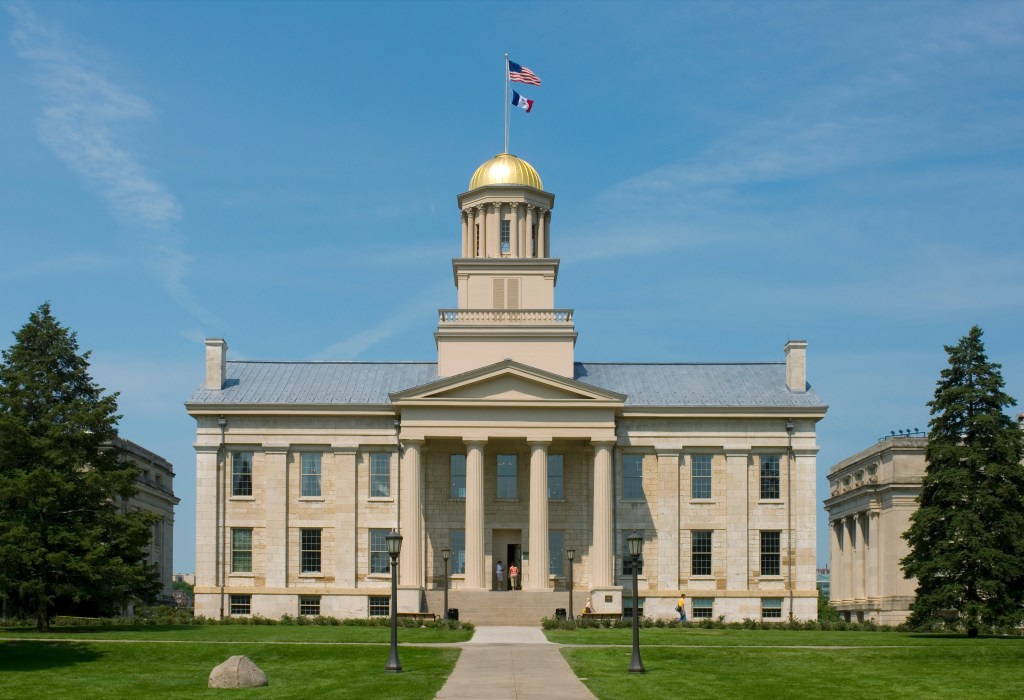
In the spiritual struggle against the sin of liberalism the Republican majority’s sights turned to the regent institutions. This session, a new legislative committee will deal specifically with higher education policy. Leading the effort is Republican Rep. Taylor Collins from Mediapolis. He said to expect “significant reforms to Iowa’s higher education system,” according to the Cedar Rapids Gazette.
Framing his jihad as addressing the workforce shortage in Iowa, Collins is riding a national wave in opposition to diversity, equity, and inclusion programs in education. No worries on the part of administrations at the three major Iowa public universities. They are bowing down to the jihad in advance. The University of Iowa already announced closure of some offending programs, including the gender studies and American Studies programs in advance of the new DEI law going into effect in July. They discuss the possibility of forming a new umbrella school for these and other programs, although that seems uncertain as I write.
Rep. Taylor Collins seeks to refocus Iowa’s higher education system on producing students ready to fill high-need jobs in our state, Iowa House Speaker Pat Grassley said in a statement.
“In his first term, (Rep.) Collins led efforts to dismantle the DEI bureaucracies at the regent institutions and remove political bias from the university presidential selection process,” Grassley told the Cedar Rapids Gazette. “I’m eager to see the work he will continue to do as chair of this new committee. A comprehensive review of Iowa’s entire higher education system is long overdue.”
I am a graduate of the American Studies Program in 1981, although we were a loose consortium of interests rather than an official department. It was a way for me to get an interdisciplinary degree to further my liberal arts education. I had no interest in using the degree to get any job.
I paid very little for my undergraduate (1970-1974) and graduate (1980-1981) degrees from Iowa. Today, the cost of an undergraduate degree from Iowa is $29,219 per year or $116,876 if a student can finish in four years. Now we’re talking real money. I understand one expects something to go with that expenditure and related debt. But a job?
If the legislature’s aim is to turn the regent institutions into a fancied up community college program then count me out. If that’s the case, I’d go one step further and make a modest proposal. Keep key curricula and programs like education and sell off the big pieces for workforce development. Who better to manage the University of Iowa Hospitals and Clinics than a big insurance company like United Healthcare or Kaiser Permanente? Why not sell the agriculture programs to Cargill? Engineering? Maybe Apple, Halliburton, Microsoft, General Dynamics, Alphabet, Meta, or Amazon might buy them and integrate them into their other product offerings. Hell, there are so many potential buyers on that one we could run the sale price way up.
The truth is, Rep. Collins hasn’t said much about this or how Iowa survives as an economic base going forward. He is hacking away at DEI, and everything that means. Last year wasn’t good, and this year isn’t shaping up to be much better.
This will be one to watch and I expect to keep a ring side seat. The 2025 session of the Iowa Legislature begins Jan. 13.
 Blog For Iowa
Per the “modest proposal,” the agricultural programs at ISU are already greatly influenced, to put it gently, by corporate industrial agriculture. For years, ISU’s nickname was “Monsanto U.”
It was very educational to watch the role that ISU played in the development of Iowa farm-pollution politics, and to hear about that role from friends who worked at ISU and tried to avoid the hot zone. Now that Iowa is thoroughly controlled by Republicans who barely pretend to care about water, plus the election of Trump, the triumph of farm pollution is complete. With the exception of certain ISU staffers and students who continue to fight for water-friendly regenerative agriculture, and best of luck to them, ISU can continue on its merry industrial-ag-uber-alles way.
LikeLiked by 1 person