
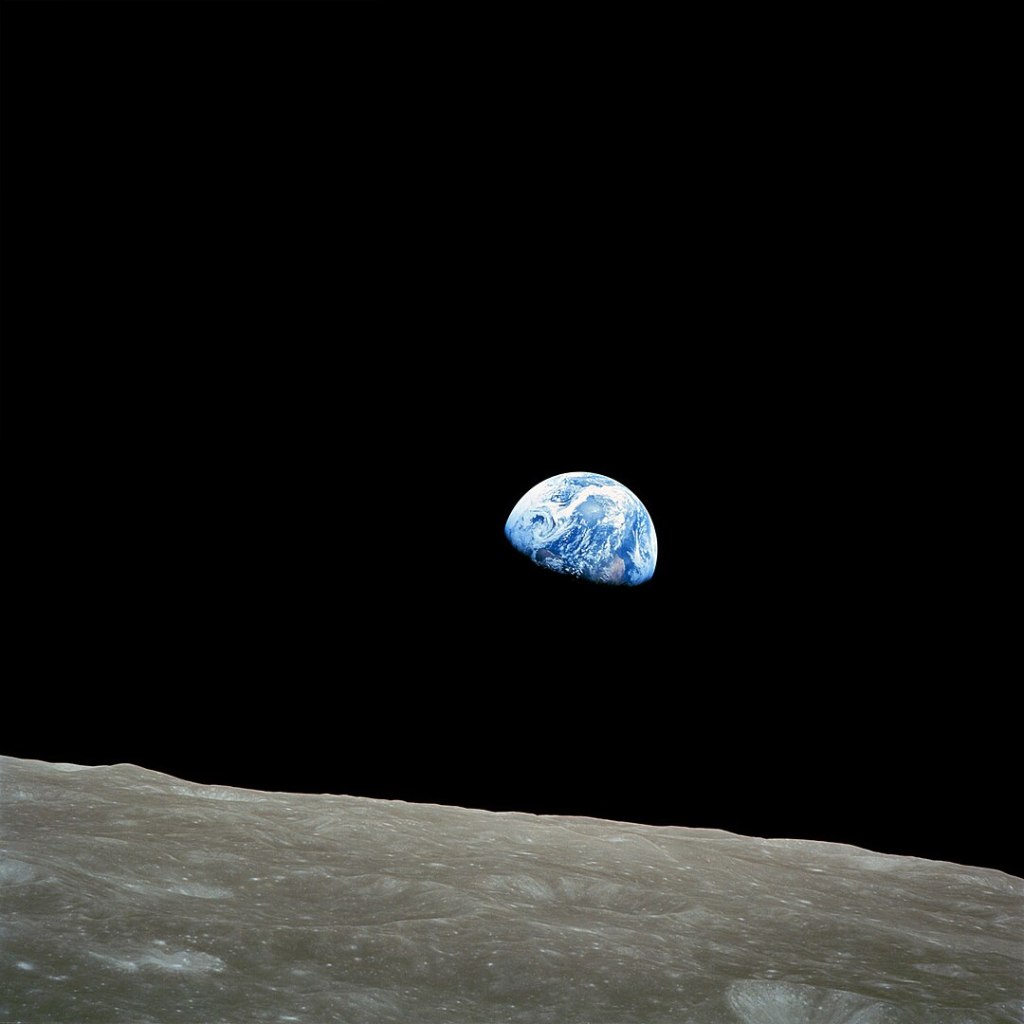
Early Saturday morning news media reported Bill Anders died at age 90 while a plane he was piloting crashed into the sea off Washington State. He was a pilot at the beginning of his career and that’s how it ended.
Anders was widely known for his unplanned photograph Earthrise. He was a lunar module pilot on the Apollo 8 mission when he took it. Anders later described taking this photograph as his most significant contribution to the space program, according to BBC. “We came all this way to explore the Moon, and the most important thing that we discovered was the Earth,” Anders said.
Earthrise inspired most everyone.
Officials said Anders’ plane crashed Friday at around 11:40 a.m. PDT, according to the BBC. The U.S. National Transportation Safety Board (NTSB) said he was flying a Beechcraft A A 45 – also known as a T-34. The agency said that the plane crashed about 80 feet from the coast of Jones Island.
Anders’ story has its roots in being a pilot. On Oct. 8, 1997, he told that story as part of the NASA Johnson Space Center Oral History Project. Here is his answer to the first interview question by Paul Rollins. Read the entire interview on the NASA website.
[Early in my Air Force career as a fighter pilot] I was trying very hard to get into the Air Force Flight Test School. … I … talked to Chuck Yeager and the people running [the school] and Yeager … said “We’re really looking for people with advanced degrees.” This was in [1959]. So, I signed up for the Air Force Institute of Technology masters [degree] program [where I] graduated with honors. [I went back] to Edwards thinking I was a shoe-in and [was told by Yeager], “Oh, well [that] the criteria [had been changed and that advanced degrees didn’t count as much as flying time.] … I was disappointed but I still kept trying to get in and [applied] for the Flight Test Program [anyway]. [In the meantime,] … I was driving my Volkswagen bus, [one Friday afternoon] going home from work [in] Albuquerque [New Mexico] at the Air Force Special Weapons Center, where I was an engineer and an instructor pilot [when] I heard this announcement [over the car radio] that NASA was looking for another group of astronauts. Now one had to be a test pilot for the first two groups [of astronauts] and it didn’t occur to me that they would change that. But [for] this group [the radio announcer] went down the list of things [NASA required. He said the applicants] had to be a graduate of Test Pilot School or have an advanced degree. I remember pulling over to the side, tuning it up, and then waiting for the next fifteen minute [news cast where the “… or advanced degree” message was repeated. By the time I got home] … I had decided that … I was going to put in an application. … I wrote up a letter [that weekend], … mailed it to [NASA on Sunday]. [W]hen I got to work at the Air Base the next [Monday the pilot officers were] told that if … we were interested, [we should fill out some] forms [and] submit them through the channels. … I went to my boss and said [that I] already sent [NASA] a letter [of application.] … [H]e said, “Well, that’s okay, just go do it again [through channels].” …[T]o my surprise [I] was asked to come down for the various physicals and tests [several weeks later]. And, to my increasing surprise, [I] kept surviving [the cuts]. [On October 17] of 1963 [(my birthday), I] was called by Deke [Donald K.] Slayton and asked if I wanted to [fly with them, I accepted immediately]. Two days later, I [received] a call from Chuck Yeager who said, … he was really sorry [and that] I was really a great candidate but I didn’t make [the USAF Test Pilot School]. I made the mistake, in retrospect, of saying, “Well, Colonel I appreciate [your call] … but I [have] a better offer anyway.” “What was that?” [he asked surprised]. I told him I [had received] a call from Deke Slayton [to come to NASA. Yeager] said that’s not possible because we … screened all the applicants and since you weren’t a member of the test pilot school you didn’t go forward. I said, “Well, sir, I put in [another application directly to NASA].” … [He was upset about that and] actually put some energy into that trying to get me kicked out of the [NASA] program… [Fortunately he was not successful.] (Interview with William A Anders by Paul Rollins for the National Aeronautics and Space Administration, Oct. 8, 1997).
Bill Anders died as he lived. May he rest in peace.
 Blog For Iowa