
Click on the image to go to iowaenvironmentalfocus.org
KC McGinnis | May 3, 2016
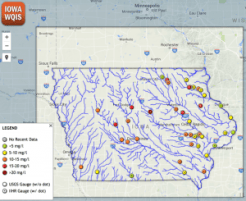
Data from the Iowa Water Quality Information System (IWQIS) shows that more than half of Iowa’s waterways being recorded currently exceed the nitrate threshold of 10 mg/l, with several outpacing levels from previous years.
Weeks of warm spring temperatures followed by a week of consistent rain throughout the state last week may have contributed to a spike in nitrate in Iowa’s waterways as it was washed out of fields where it had previously been applied in fertilizers, either as part of the planting process or in the form of anhydrous ammonia in the fall. Nitrate is a pollutant that must be removed at water treatment plants before the water can be suitable for drinking, sometimes at great cost to the plants. Excess nitrate can also cause the spread of toxic algae in lakes and ponds and contributes to a lack of oxygen in the Gulf of Mexico, causing what’s known as a Dead Zone.
Nitrate levels are well ahead of where they were in previous years by this time. Annual data available through IWQIS shows that the Daily Accumulated Yield (the amount of nitrate per watershed acre) in the North Raccoon River is at a level not reached until late May of 2015 and not until late September of 2014. Similar progress can be seen at the South Fork Iowa River in north central Iowa, where nitrate levels are currently the highest in the state at about double the drinkable limit.
The Iowa Water Quality Information System, developed by the University of Iowa IIHR—Hydroscience & Engineering, has a wealth of data available to the public on Iowa’s water quality. Click here to go to their website and view a tutorial on how to use the system.
 Blog For Iowa