
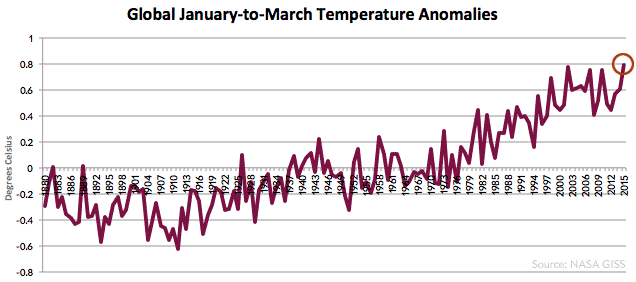
Warmest 12 Month Period Were The Last 12 Months.
In case you missed it, climate change has not gone away. Here in Iowa we have been spared much of the anguish of the effects of climate change, except for the drenching rains followed by long dry spells. However, reality is setting in elsewhere. Scientists tracking the climate tell us the past rolling 12 month period have been the hottest 12 months on record. It looks like as each month passes the record just keeps going.
This story comes with a couple of scary paragraphs of what may be in the offing:
Besides El Niño, a more worrying, longer-term trend is also taking shape. The Pacific Decadal Oscillation (PDO) is a decades-long periodic warming of the Pacific Ocean that tends to favor bursts of accelerated global warming. As I wrote last October, the Pacific appears to be in the midst of a shift into a new warm phase that could last 20 years or so.
The PDO—or, “the blob” as it’s been referred to recently—is starting to freak out some scientists. There are emerging signs of a major shift in the Pacific Ocean’s food chain, including a dearth of plankton, tropical fish sightings near Alaska, and thousands of starving sea lion pups stranded on the California coast. As Earth’s largest ocean, what happens in the Pacific affects the weather virtually planet-wide, and that means an “imminent” jump in global warming may have already begun—spurred on by the PDO.
The PDO has skyrocketed to record-high monthly levels over the past four months. In fact, there have only been four other similarly warm four-month bursts of the PDO in the last 115 years (in 1940, 1941, 1993, and 1997). A quick look at the historical record (for both 15 years prior to and 15 years after the bursts) shows that global temperatures rose at twice the rate of the 20th century average immediately after these bursts.
CEOs Urging Action in 2015 on Global Climate
In an open letter released on Thursday evening, 43 chief executive officers from leading global companies called on governments around the world to take bold action at the pivotal UN climate meeting set for later this year. The CEOs are listed in a full-page ad appearing in Friday’s issue of Financial Times (see image below), in conjunction with the spring meetings of the World Bank Group and International Monetary Fund. The signatories to the letter include David Kenny, chairman and CEO of The Weather Company, the umbrella organization that includes Weather Underground. “Climate change is one of the biggest global challenges that will shape the way we do business now and in the coming decades,” the CEOs stated. “We extend an open offer to national governments to meet and co-design tangible actions as well as ambitious, effective targets that are appropriate for their different jurisdictions.”
Looking toward a post-Kyoto climate deal
Representatives from around the world will meet in Paris this December for the 21st UN Conference of Parties (COP21), a product of the 1992 UN Framework Convention on Climate Change that was signed by U.S. President George Bush and the heads of 164 other nations. Delegates in Paris will be working toward a new global agreement on carbon emissions to succeed the Kyoto Protocol, whose initial phase expired in 2012. The CEOs’ open letter outlines their shared vision for a successful climate deal at COP21, as well as their companies’ commitments to reduce their environmental and carbon footprints, serve as climate action ambassadors, manage climate risks, and help strengthen societal resilience to climate change.“Hastening the shift to a low-carbon economy in an economically sustainable manner will generate growth and jobs in both the developing and developed world. Delaying action is not an option–it will be costly and will damage growth prospects in the years to come,” states the open letter. “The CEO Climate Leaders call on government leaders and policy makers to align on global measures, to be consistent in policy-making and to develop helpful innovation frameworks. A comprehensive, inclusive and ambitious climate deal in Paris on mitigation, adaptation and finance–in combination with a strong set of clear policy signals from the world’s leaders–is key to accelerating this transition. This opportunity should not be missed.”

 Blog For Iowa