
 Book Review: Baseball as multinational and players as union
by Mike Matejka
Grand Prairie Union News, Bloomington, Illinois
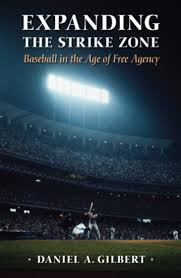
Expanding the Strike Zone: Baseball in the Age of Free Agency by Daniel Gilbert, U. Mass Press
As this year’s U.S. World Series fades from memory and baseball fans’ hope turns to 2014, we often forget two things: 1) baseball is a business, and 2) baseball is not just the “All-American” game.
In a new book that weaves together baseball unionism, players’ rights and the international reach of America’s past-time, Daniel Gilbert’s Expanding the Strike Zone: Baseball in the Age of Free Agency examines the sport from multiple levels.
First, there is workers’ rights. Gilbert traces how players established a union and with the leadership of the Cardinal’s Curt Flood, challenged baseball’s reserve system, where players could be traded without any input. Although Flood lost his 1969 court case after he was traded to the Philadelphia Phillies, his battle was won with the establishment of the Major League Players Association (MLPA).
The great break through for the MLPA was their hiring of Marvin Miller, a United Steel Workers economist, as their director. The MLPA was started in 1946, restarted in 1954, and became the premier sports union after Miller was hired in 1966.
Players saw the multimillion dollar deals being made for television, but had little bargaining power. Plus, the reserve clause meant they could be traded at any point.
Miller channeled those frustrations and built a united front, striking in 1981 and winning not only free agency, but also greater control for players over their image and its use.
Gilbert deftly places this organization in the context of 1960s civil rights and other efforts. Stars like Curt Flood entered the League when spring training housing was still segregated; in June 1965, the Baltimore Afro-American ran a statistical report that two-thirds of players hit by pitchers were African-American. In 1962, Flood participated in an NAACP rally in Jackson, Mississippi. With these experiences, it’s no wonder Flood equated the reserve clause with slavery.
Thanks to Miller and player solidarity, baseball players not only forged a strong union, but also gained a financial share in how their image is sold.
The other fascinating story here is how international major league baseball is.
When the major leagues expanded, then Vice-president Richard Nixon saw baseball as a positive U.S. influence, calling for major league affiliates in Havana, Montreal and Mexico City. The Canadians soon won franchises, but U.S. baseball has not expanded further.
When Jackie Robinson broke baseball’s color line in 1947, not only did African-Americans gain big league opportunities, so did players from Japan, the Caribbean and Latin America.
The 1964 San Francisco Giants not only boasted African-Americans Willie Mays and Willie McCovey, but Orlando Cepeda (Puerto Rico), Masanori Murakim (Japan), and from the Dominican Republic, Jesus Alou and brothers Juan and Mateo Marichal.
The L.A. Dodgers in 1981 featured Mexican Fernando Valenzuela and the 2001 Seattle Mariners succeeded with Japanese star Ichiro Suzuki.
Gilbert does more than trace the transnational careers of these baseball stand-outs. He documents the business relationships Major League Baseball has made with leagues in other countries.
Baseball players is a leading export of the Dominic Republic, where impoverished youngsters vie for spots in baseball camps, some run by U.S. teams, Just as U.S. companies have run off-shore for cheaper labor, is baseball doing the same in the Caribbean?
Professional baseball is more than sport — it’s entertainment and a business with a transnational reach. Gilbert’s book thoroughly explores both topics and leaves one wondering at the end — will there ever be a real “world” series?
 Blog For Iowa