
 by Ralph Scharnau
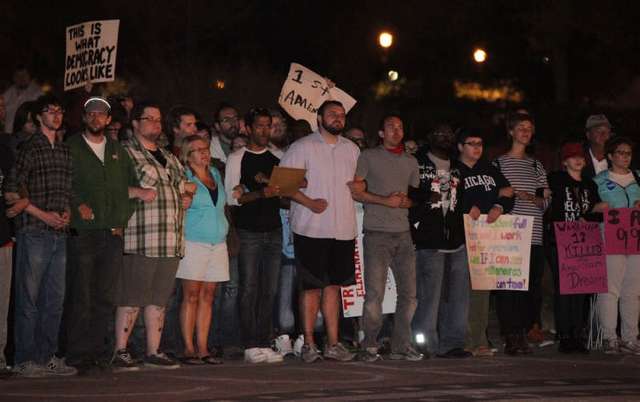
The protest movement that began in Tunisia in January has spread to Egypt, Libya, and Syria; Spain, Greece, and Italy; and Chile, Israel, and China. The global protest reached the United States on September 17, 2011, bursting forth in New York City and taking the name Occupy Wall Street (OWS). Since then it has sparked occupations in Chicago, Seattle, Portland, Minneapolis, Atlanta, Denver, Albuquerque, San Francisco, Los Angeles, and hundreds of other cities and towns.
Young people, most under age 30, have provided the primary energy for this grass roots movement. But the movement has crossed class, gender, political party, and age lines, attracting unions and social justice groups, students and professionals, veterans and techies, as well as unemployed and homeless people.
Instead of protesting at the Capitol, the occupiers camped at the centers of financial and economic power. Instead of a one-time massive mobilization, they provide a continuing presence. Instead of leadership by a charismatic figure, they give all a chance to share and participate.
The occupiers operate as an independent movement, not beholden to political parties or financial patrons. They use consensus for decision making and have usually displayed a disciplined commitment to non-violence, even in the face of excessive police force. Occupiers take pride in and see themselves as descendants of the movements for equal social, racial, gender, and economic rights.
The OWS movement identified the nation’s extreme inequality and branded it a moral problem. Today in America the rich have become the mega-rich and the middle and working classes have steadily lost ground, unemployment continues to devastate people’s lives and poverty rates climb. Meanwhile, our political system seems unable to take the bold action necessary to make a real difference.
In Congress and statehouses, we see politicians put money ahead of people by shifting the tax burden to the non-rich, privatizing government services, attacking unions, rolling back environmental regulations and consumer protections, and deregulating businesses, banks, and financial institutions.
The foundation of our democratic society is under attack when we have a government for the few at the expense of the many. The markers of a democratic and humane society–minimum wages, child labor laws, workers’ safety and health standards, pure foods and safe drugs, Social Security, Medicare, Medicaid–are threatened by a rising plutocracy where the rich use their money to control political power and protect their wealth.
The OWS movement reflects a passion for freedom and justice in an open and patriotic manner. It takes aim at corporate greed and corruption. When millions of Americans experience dropping wages, they lack effective purchasing power, and our whole consumption-driven economy suffers.
One of the movement’s most creative projects was the “move your money” campaign. About a month ago, 70,000 people from across the country pledged to transfer their money from the “too big to fail” banking titans to local community banks or credit unions.
Will the OWS’s demands for political and economic institutions and policies that work to benefit all, not just the privileged few, reshape the political landscape? It really is too early to tell. But at least OWS has clearly changed the national conversation about the economy.
Perhaps a new politics will emerge that, like the labor movement of the 1930s, the civil rights and antiwar movements of the 1960s, and the environmental movement of the early 1970s, forces a transformation in both parties. What started with the Wall Street protests may or may not become a political force with a specific legislative agenda, organizational structure, and identifiable leaders, but it has struck a response cord with a large swath of Americans. And, economic justice, after all, will require a long term struggle.
Ralph Scharnau teaches U. S. history at Northeast Iowa Community College, Peosta. He holds a Ph.D. from Northern Illinois University. His publications include articles on labor history in Iowa and Dubuque. Scharnau, a peace and justice activist, writes monthly op-ed columns for the Dubuque Telegraph Herald.
 Blog For Iowa