
Iowans Fight Back Against GOP Assault On Labor
 by Tracy Kurowski
photos by Dick Fallow
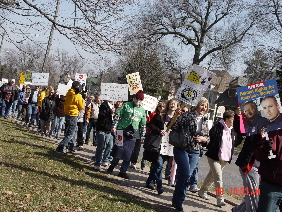
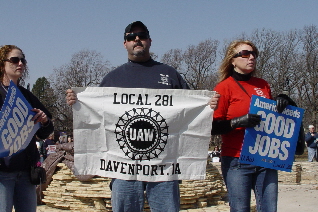
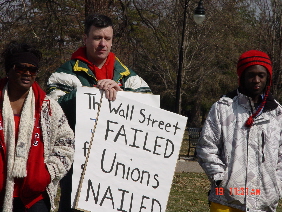
Davenport, IowaOn Saturday, March 19, 2011, over 400 people attended a labor
rally in Davenport, Iowa, to stand up for working people in Wisconsin
and Iowa. In these and many other states, Republican Governors and
legislatures have proposed and/or passed legislation that guts
collective bargaining rights, bans union-friendly policies such as
Project Labor Agreements, and have taken steps to limit access to the
polls.
The AFL-CIO has been keeping tabs on the rallies, and
since February 22, 2011, no less than 400 rallies, demonstrations, and
protests have taken place in cities across the country. Not including
the people who have made Madison labor’s Mecca over the past month, more
than 200,000 people have attended these events. The majority of
pro-labor rallies have taken place in Wisconsin, but workers in dozens
of other states have attended events, including Iowa, and even in
the traditionally non-union states like Texas, Indiana, Florida, Idaho,
Georgia, Colorado, New Mexico. The anti-union bastion of Mississippi
managed to turn out 85 people for a pro-union press conference at their
state capitol on February 28th.
The people of Wisconsin and across the country are responding to a coordinated GOP attack against workers’ rights. This assault against workers and unintended uprising has occurred near the anniversaries of Dr. Martin Luther King’s birthday and assassination.
When King was gunned down in Memphis on April 4, 1968, he was there to support underpaid city garbage workers who were fighting for their right to form a union, fighting for the very rights that Governor Walker and Republicans across the country now want to take away from workers. King fought for the rights of workers because he realized civil rights meant nothing without labor rights. That without economic justice, true democracy is not possible.
–
So-called “right to work” legislation, that creates state-wide bans on
collective bargaining rights, has been introduced in Alaska,
Connecticut, Hawaii, Indiana, Maine, Maryland, Michigan, Minnesota,
Missouri, New Hampshire, New Mexico, Pennsylvania, Rhode Island,
Tennessee, Washington and West Virginia. More are expected in Montana,
Ohio and Wisconsin. [Iowa is already a “right to work” state.]
Governor Terry Branstad forbid Project Labor Agreements for any
government entity in the state by signing this executive order within
hours of being sworn in as Governor. Other states where Project Labor
Agreements are jeopardized include Arizona, Indiana, Kentucky, Maryland,
Missouri, New Jersey and West Virginia.
–
“Paycheck Deception” – legislation that sets up bureaucratic road
blocks for union dues collection through the workplace. Alabama already
passed a form of this, and legislation has been introduced in Arizona,
Florida, Idaho, Kansas, Mississippi, Missouri, New Jersey, Oklahoma,
South Dakota, Tennessee and Texas.
– Prevailing Wage
legislation asks that projects funded with public dollars pay what is
the median wage in a given geographic area. Yet even this
middle-of-the-road standard is under attack in Illinois, Indiana,
Maryland, Michigan, Missouri, New Jersey, and Wisconsin.
Which brings us back to the attacks on the Public Sector, the opposition to which started the great worker uprising of 2011.
According to the AFL-CIO:
attacking collective bargaining rights have been introduced in Arizona,
Colorado, Florida, Idaho, Illinois, Indiana, Iowa, Kansas, Michigan,
Minnesota, Nebraska, New Hampshire, Nevada, New Jersey, Ohio, Oklahoma,
Oregon, Tennessee, and Washington. In Wisconsin, Governor Walker signed
into law legislation on 3/11 that takes away nearly all collective
bargaining rights for public sector workers.
In
Ohio, SB 5 has passed the Senate and hearings are being held in the
House. In Michigan, the Governor eliminated collective bargaining
rights on 3/1 for almost 20,000 subsidized home based child care
providers. In Idaho, legislation that removes most collective
bargaining rights for teachers was signed into law by the Governor. The
Oklahoma House voted to repeal MECBA (the state law that requires
collective bargaining for non-uniformed workers), and the bill heads
next to the Senate. In New Hampshire, a bill to repeal public sector
card check, passed the House on 3/15 and is now headed to the Senate.”
In
New Jersey, the press has started to hold Governor Christie accountable
for his refusal to bargain over health care after he said that he would
negotiate over the issue. He is pushing to have the legislature pass a
bill that would require public workers to pay 30 percent of the costs
of their health benefits.
On the positive side of the ledger:
– a Georgia bill attacking public sector collective bargaining has been held up in the House;
– a union-busting bill in Iowa has been declared dead for the remainder of the session.
– In Oklahoma, the House defeated a bill that would have ended binding arbitration for firefighters and police officers.
– in Vermont, a bill is moving that would give 10,000 child care workers collective bargaining rights.
 Public Employee Pay and Benefits
–
Legislation has been introduced in Kansas that would cut state employee
pay by 7.5 percent, and a legislative referral to the ballot has been
introduced that would mandate a 5 percent cut in pay for public sector
workers.
– The GOP-led legislature in Minnesota has introduced
legislation to freeze state employee wages and salaries, as well as
legislation that would make it easier to privatize government services.
–
Pennsylvania’s Governor Tom Corbett is pushing to privatize the state
owned and controlled liquor store system, which would result in the loss
of 4,500 union jobs. Other agencies in the state are also in jeopardy.
– Florida’s public hospitals, prisons and other critical services have all been discussed as areas to be privatized.
–
Legislation is moving in Georgia that would set up a committee to
review all state agencies and decide whether to eliminate or privatize
them.
– In Montana, a bill will be heard in a House committee
next week that would allow the state’s infrastructure and transportation
systems to be privatized.
– Ohio Governor John Kasich
released his budget this week, which includes proposals to sell five
state prisons, cut funding for local governments by 25% and privatize
the state-run liquor stores.
– A bill has been introduced in
Arizona that would establish a two tier pension system, with new hires
being forced into a defined contribution system.
– Legislation
has been introduced in Florida that would close defined benefit plans to
new members under the state retirement system. The legislation would
also require local pension plans to be defined contribution plans after
July 1, 2011.
– In New Hampshire, major pension reform bills are moving – one bill has already passed the House and is moving to the Senate.
There
is also a possible effort at the federal level to allow states to
declare bankruptcy, which would give states the ability to rip up their
union contracts.
State Revenues and Services
States’
ability to raise revenues and provide services will also be under
attack. States continue to experience massive budget shortfalls, and in
many states, spending caps and tax caps will be proposed.
– In
Illinois, legislation has been sponsored by Democratic House Speaker
Michael Madigan that would set spending limits in the state
constitution.
– New York’s Governor Andrew Cuomo is expected
to propose a state constitutional spending cap and to call for local
property tax caps.
– A TABOR constitutional amendment has been introduced as a legislative referral to the ballot in North Carolina.
– In Florida, the Senate passed legislation that would refer a TABOR constitutional amendment to the November 2012 ballot.
–
Minnesota’s legislature has introduced legislation that would cut the
corporate income tax in half, and legislation that would phase out the
corporate franchise tax.
– In Arizona, legislation reducing
the individual tax rate to a flat tax of 2.08% just passed the House and
is headed to the Senate.
Emergency Managers
–
In Michigan, Governor Snyder signed legislation allowing “emergency
managers” to be appointed for localities under “financial distress” and
allows them to remove locally elected officials, terminate collective
bargaining, and force consolidation of schools, townships, cities and
counties – all without seeking authority or approval from any elected
body or from the people.
 Corporate Hegemony
When you think about the GOP's assault on working people here, and the disaster in Japan, you
realize the two events are tied together intrinsically by the same
corporate power structures – and that by working against corporate
hegemony, one can help prevent future nuclear disasters and support
democracy movements at the same time.
The nuclear energy
industry is subsidized heavily by governments, despite their enormous
profit margins. And at least in the U.S., these corporations are
indemnified against damages so that, like the big banks, they’ve
privatized profit and socialized loss. Neither do nuclear energy
corporations worry about the radioactive waste created through fission –
“spent fuel rods”. These deadly metal tubes will emit radiation
forever, and so far mankind has no idea what to do with this permanent
garbage that must be kept cool in ponds forever –and ever. We’ve
proposed burying the waste in a mountain or shooting it into outer
space. Both great ideas, and so far, impossible realities.
So
resolve to fight both assaults by expanding democracy in the workplace
and in our communities, and fighting against corporate hegemony.
Tracy
Kurowski is currently AFL-CIO Community Services Liaison at the United
Way of the Quad City Area. She has been active in the labor movement
for ten years.
 Blog For Iowa