
“Rebooting The American Dream” by Thom Hartmann: Creating A New Narrative
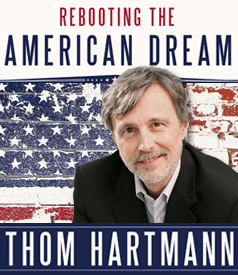 Thom Hartmann, America's most popular progressive radio host, prolific writer, and much more, has made his most recent work, Rebooting the American Dream available free exclusively on Truthout.org.
If you have not heard of Thom Hartmann it could be because his #1 in America progressive talk radio program is not available over the airwaves anywhere in Iowa.
Why not? Because virtually all of the talk radio stations in Iowa broadcast exclusively right-wing talk, for multiple hours per day with no progressive alternative programming, the only exceptions that we know of being the Fallon Forum and Alan Colmes on the air (not in prime time) in Ottumwa. Some Iowa communities, such as Burlington, have two stations and both stations broadcast only conservative talk for a total of 19 hours daily. Seven stations around Iowa broadcast 12-14 hours per day of conservative talk. Nine other stations in Iowa broadcast from 3-9 hours daily of conservative talk. LINK
The minds of people you know, friends, family, otherwise seemingly normal individuals in our state are going off the deep end in a sea of right wing propaganda, and it is affecting elections and public policy – and not in a good way.
If you would like to know the story as to why it is that talk radio listeners over the entire state of Iowa are deemed to only be interested in Limbaugh, Hannity, Beck, Savage and their like, in a state with a broad range of political views, see BFIA's previous writing on this subject. And no, it is not because of popular demand or free market.
But that's another story. For now, check out Thom Hartmann's book free online at Truthout. You can also stream Thom's amazing progressive talk show at thomhartmann.com and other places, just Google it.
Here's an excerpt from Rebooting the American Dream, Chapter 3.
Thom Hartmann | Stop Them From Eating My Town
There is a huge difference between a mall full of chain stores or a big-box retailer, and a downtown area full of small, locally owned businesses. The transition from the latter to the former is what’s destroying local communities on the one hand and creating mind-boggling wealth for a very few very large corporations and multimillionaire CEOs on the other. Here’s how it works.
As I noted in my book Unequal Protection, when I shop in downtown Montpelier, Vermont, and buy a pair of pants, for example, at the Stevens Clothing Store on Main Street, at the end of the day the store’s owner, Jack Callahan, takes his proceeds down to the Northfield Savings Bank and deposits them. From Stevens, I walk next door to Bear Pond Books and buy today’s newspaper, a magazine, and a copy of Thomas Paine’s Rights of Man, a book that is as fascinating today as when it was first written in 1791.
At the end of the day, Bear Pond’s manager, Linda Leehman, will take my money down to the Chittenden Bank and deposit it.
From Bear Pond I go to one of the dozen or so local restaurants and exchange some of my cash for a good meal. At day’s end that cash, too, will end up in one of Montpelier’s local banks.
The next day Montpelier’s banks are richer by my purchases, as are Stevens, Bear Pond, and the restaurant. If my daughter, a Web designer, wanted to start her own design firm in an office on Main Street (or from her home), she could visit one of those banks, and, if her credit was good, they could loan her some of the money that was deposited with them the night before from the townspeople’s purchases. Thus, by keeping money within the community, the community grows. This is how communities in America and most of the rest of the world have historically grown.
Consider, though, if my shopping trip had been to a mall full of chain stores or to a national superstore. Strict management of cash flow is the name of the game for such businesses, and some of them make deposits several times a day. But the money stays in town for only a day at best.
Every night, all around America, buttons are pushed that – like vampires draining blood from sleeping people – drain cash away from local communities, most of it never to be seen in town again.
At McDonald’s, Wal-Mart, Chili’s, Home Depot, and a hundred other national and international chains, local branches spend the entire day selling products made or grown far away and shipped over land or sea. Local customers who earned money locally buy these products every day. Although the companies pay a small amount of their revenue back in local taxes and payroll and services, most of it is sucked up nightly into each company’s headquarters bank in Chicago or Little Rock or New York or wherever it may be. And most of that money never returns to the local community.
This is how you destroy local communities; it’s the opposite of a healthy economy.
This homogenization of stores and restaurants and banks across America is a recent phenomenon; it was not the case for the first 200 years or so of our nation’s history.
Other countries are wary of making such stupid blunders.
(click here to read the entire chapter at Truthout.org)
(click here for all chapters)
Hartmann is the four-time Project Censored Award-winning, New York Times best-selling author of nineteen books currently in print in over a dozen languages on five continents. Thom
Hartmann's most recent books are Screwed: The Undeclared War Against
the Middle Class, The Edison Gene, The Last Hours of Ancient
Sunlight, Unequal Protection: The Rise of Corporate Dominance and the
Theft of Human Rights, We The People: A Call to Take Back America,
and What Would Jefferson Do?
A recurrent theme in Hartmann’s work is that all true and lasting cultural change begins with new insights propagating through enough people to reach a critical mass. History demonstrates, he says, that “when stories change,the world changes.”
 Blog For Iowa