
Why Facts No Longer Matter: Emotional Exploitation and Public Policy
 Center for Media and Democracy
PR Watch.org
This is an excerpt from an article by Ann Landman, on a PR Watch blog at the Center for Media and Democracy. The entire article is well worth the time. It describes how entire industries exploit emotions to influence public policy. You already knew they were doing this. Well, this is how they do it.
Here is the article's first example:
“..To influence the election [a measure to raise cigarette taxes in California], Tobacco Institute consultants did careful studies using focus groups to find specific themes that resonated with specific blocks of voters. In an internal strategy memo, an Institute consultant discusses how to influence gay and lesbian voters in California to oppose Proposition 10. The consultants knew this would be difficult because leaders of gay and lesbian groups often opposed the tobacco industry. Nevertheless the memo indicates strategists planned to do an “end-run” around the gay/lesbian leadership:
“Messages that resonate” means finding themes that have strong emotional pull among the targeted groups, in this case gays and lesbians. Weaving anti-tax messages in with these themes would enable the tobacco industry to push people's emotional buttons and persuade them vote against the tax. The memo singled out several themes of importance to the gay and lesbian community that were ripe for exploitation:
Accordingly, industry consultants crafted messages designed to manipulate the emotions of gay and lesbian voters to convince them to oppose the cigarette tax. One of the themes they developed was the following:
“Wrapped in a cloak labeled 'health,' this initiative tries to legislate a change in behavior by encroaching on an individual's freedom of choice. This argument will appeal to … gay/lesbian groups concerned about politicians trying to achieve 'social engineering' through a tax.”
Corporations, PR people and political strategists have found that influencing emotions allows them to exert control over an audience. The stronger the emotions they can generate the bigger the clout they can wield.
The technique, now in widespread use, explains a lot of the crazy public discourse of late:
Messages that President Obama is a “socialist” and a “Marxist” influence people to believe the President is inherently evil. It doesn't matter that card-carrying socialists have completely dismissed the proposal that Obama is a socialist. It doesn't matter whether he is or not. The mere words “Obama” and “socialist” together stimulate strong negative feelings, and thus generate strong general opposition to the President – a goal of those spreading the message [italics BFIA's].
The wacky claims spread by Betsy McCaughey, Sarah Palin, Senator Chuck Grassley (R-Iowa) and others that health care reform legislation would lead to government “death panels” is a good example of a highly emotional message dominating over sane and logical discourse, no matter how bizarre the claim.
Industrial-Strength Emotional Exploitation Rules the Day, Unless You Think
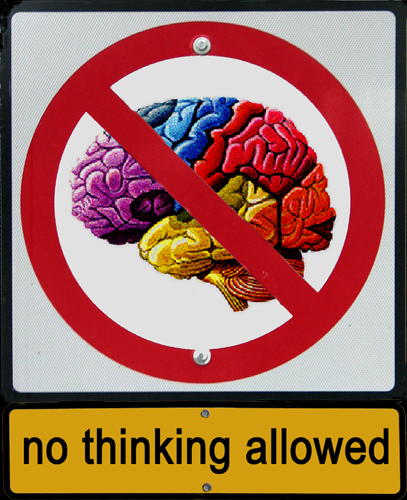
Some legislators still try to use facts, reason and truth in public discourse, but there are now so many strident, paid corporate and political messaging efforts going on that stimulate people to react from their gut and not think, that reason, truth and facts are now weak public voices by comparison.
How to Defeat Manipulation
Emotional manipulation cannot exist in a culture where people ask questions and delve beyond the superficial. We at PRWatch urge you to be wary and observant of attempts to emotionally manipulate audiences. Be skeptical of messages and marketing techniques that try to get you to feel and not think. Insist on investigating any entity delivering an emotionally-loaded message before you buy into it. Ask questions about cause marketing campaigns, too, since they are designed to manipulate as well.
Democracy depends on an inquisitive and informed public that resists being hoodwinked.
 Blog For Iowa