
Normal
0
false
false
false
EN-US
X-NONE
X-NONE
/* Style Definitions */
table.MsoNormalTable
{mso-style-name:”Table Normal”;
mso-tstyle-rowband-size:0;
mso-tstyle-colband-size:0;
mso-style-noshow:yes;
mso-style-priority:99;
mso-style-qformat:yes;
mso-style-parent:””;
mso-padding-alt:0in 5.4pt 0in 5.4pt;
mso-para-margin-top:0in;
mso-para-margin-right:0in;
mso-para-margin-bottom:10.0pt;
mso-para-margin-left:0in;
line-height:115%;
mso-pagination:widow-orphan;
font-size:11.0pt;
font-family:”Calibri”,”sans-serif”;
mso-ascii-font-family:Calibri;
mso-ascii-theme-font:minor-latin;
mso-fareast-font-family:”Times New Roman”;
mso-fareast-theme-font:minor-fareast;
mso-hansi-font-family:Calibri;
mso-hansi-theme-font:minor-latin;}
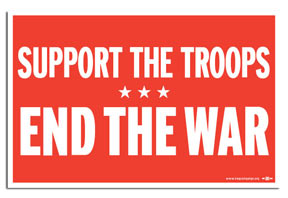
Iowans Support the Troops, So End the Wars
“After
my comment, their eyes turned to me. What I meant was that we too often
forget
that soldiers have a responsibility for perpetuating war. We all do.”
There is no more decent impulse to serve the common good
than to enlist in the United States Armed Forces. When I enlisted in the Army,
there was some doubt that an all volunteer military would be viable. In 1976,
when I considered the motley crew of us in basic training, we had our doubts.
When I arrived in Europe, our military unit was plagued by
drug abuse, prostitution rings being run by some of our non-commissioned
officers and black marketing of items sold in the Post Exchange. We spent a lot of our time working through these issues, which detracted from the overall combat readiness of our unit. The all
volunteer Army, or “VOLAR” as we called it, had more than its share of
problems.
When friends rotated back to the states, some were assigned
to recruiting duty because the staffing needs were critical. There were
recruiting shortfalls back then, and because of a perceived need to upgrade the
quality of the military, recruiting standards were improved, requiring high
school graduation. This was despite the shortage of qualified applicants. The
all-volunteer military has come a long way since the Post-Vietnam era.
This environment gave rise to the idea that some military
positions could be outsourced to the private sector. The idea was to hire cooks
and truck drivers from military contractors so that those soldiers who were
recruited could serve closer to the battlefield and thus address the recruiting
shortfall. We see this today in the government engagement of many highly paid “contractors.”
The military complex and the practices of our government have
become such fundamental and accepted parts of our economy and society that we
forget our personal responsibility in perpetuating them. Men and women join the
military, with support from their community, and we “check off” our
responsibility with the nostrum “support the troops.” Support the troops?
Check.
Society accepts military service as a worthy ambition and to
the extent that recruits seek to give back to the society that provides so many
opportunities, we should be supportive. What military recruits don’t always
understand is that their service may be to provide security for convoys of
highly paid contractors.
What would be the impact of firing the contractors and
recruiting our citizens to perform all military functions? Maybe it would be
less expensive. Maybe it would reduce the rate of unemployment. Maybe the
impact of war would be felt with more intensity in our communities and we would become better
supporters of ending our wars in Afghanistan and Iraq. We often forget who it
is that seeks to engage in these wars. It is not some anonymous “them.” It is
each of us.
Last Wednesday, a group of eleven veterans met at a
local grocery store. We had no specific purpose, except to get together as
veterans, drink coffee and talk about progressive issues. Someone bought donuts. We decided to meet
again, at least one more time. There were veterans from the Army of Occupation
in Japan, the Korean War, Vietnam, the Cold War and the First Gulf War. Meetings
like this go on across Iowa and the nation.
During the conversation I challenged the idea that we should
“support the troops.” The men and women who enlist in the military have some
culpability for perpetuating the wars and that aspect of military service is
often missed. We say “support the troops” like it is a placeholder in the books
of our lives: one more thing to say in a world of political correctness. After
my comment, their eyes turned to me. What I meant was that we too often forget
that soldiers have a responsibility for perpetuating war. We all do.
I am not sure how well I made my point, but I found the video
clip below from the 1960s which does better than I could. Where do we go from here? Perpetuation of our wars is a personal
responsibility. Let’s support the troops by urging our elected officials to end the wars.
~Paul
Deaton is a native Iowan living in rural Johnson County and weekend
editor of Blog for Iowa. He is also a member of Iowa Physicians for
Social Responsibility and Veterans for Peace. E-mail Paul
Deaton
 Blog For Iowa