
Milestones on the Road to Nuclear Disarmament
 by President
Barack Obama
“In recognition of the fact that President Obama is
consistently, diligently working to
improve the national
security posture of the
United States, Blog for Iowa will publish major addresses by the
administration concerning its policy towards nuclear disarmament. Our
intent is to be a voice to get the message out to Iowans, something the
corporate media seems uninterested in.”
Announcement
of New START Treaty,
March 26, 2010 Good morning. I
just concluded a productive phone call with President Medvedev. And I’m pleased
to announce that after a year of intense negotiations, the United States and
Russia have agreed to the most comprehensive arms control agreement in nearly
two decades.
Since taking office, one
of my highest national security priorities has been addressing the threat posed
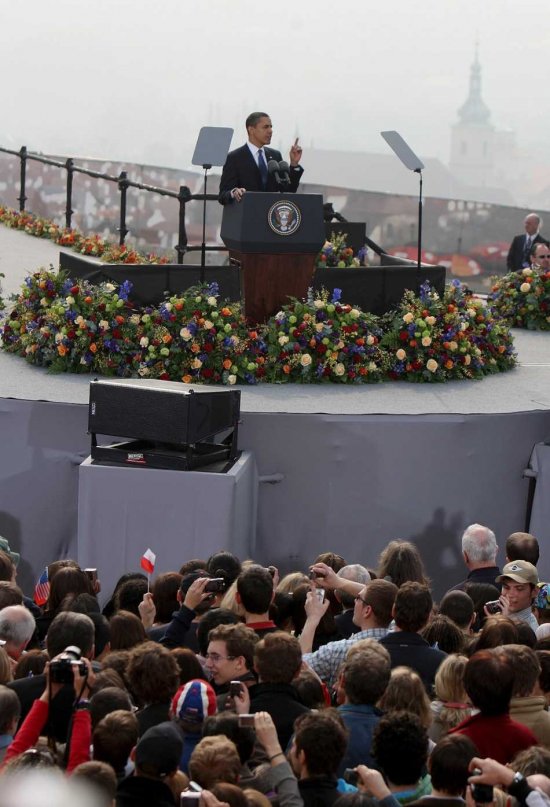
to the American people by nuclear weapons. That is why – last April in Prague –
I stated America’s intention to pursue the peace and security of a world
without nuclear weapons, a goal that has been embraced by Presidents like John
F. Kennedy and Ronald Reagan.
While this aspiration
will not be reached in the near future, I put forward a comprehensive agenda to
pursuit it – to stop the spread of these weapons; to secure vulnerable nuclear
materials from terrorists; and to reduce nuclear arsenals. A fundamental part
of that effort was the negotiation of a new Strategic Arms Reduction Treaty
with Russia.
Furthermore, since I took
office, I have been committed to a “reset” of our relations with Russia. When
the United States and Russia can cooperate effectively, it advances the mutual
interests of our two nations, and the security and prosperity of the wider
world. We have worked together on Afghanistan. We have coordinated our economic
efforts through the G-20. We are working together to pressure Iran to meet its
international obligations. And today, we have reached agreement on one of my
Administration’s top priorities – a pivotal new arms control agreement.
In many ways, nuclear
weapons represent both the darkest days of the Cold War, and the most troubling
threats of our time. Today, we have taken another step forward in leaving
behind the legacy of the 20th century while building a more secure
future for our children. We have turned words into action. We have made
progress that is clear and concrete. And we have demonstrated the importance of
American leadership – and American partnership – on behalf of our own security,
and the world’s.
Broadly speaking, the new
START Treaty makes progress in several areas. It cuts – by about a third – the
nuclear weapons that the United States and Russia will deploy. It significantly
reduces missiles and launchers. It puts in place a strong and effective
verification regime. And it maintains the flexibility that we need to protect
and advance our national security, and to guarantee our unwavering commitment
to the security of our Allies.
With this agreement, the
United States and Russia – the two largest nuclear powers in the world – also
send a clear signal that we intend to lead. By upholding our own commitments
under the Nuclear Non-Proliferation treaty, we strengthen our global efforts to
stop the spread of these weapons, and to ensure that other nations meet their
own responsibilities.
I am pleased that almost
one year to the day after my last trip to Prague, the Czech Republic – a close
friend and ally of the United States – has agreed to host President Medvedev
and me on April 8th, as we sign this historic Treaty. The following
week, I look forward to hosting leaders from over forty nations here in
Washington, as we convene a Summit to address how we can secure vulnerable
nuclear materials so that they never fall into the hands of terrorists. And
later this spring, the world will come together in New York to discuss how we
can build on this progress, and continue to strengthen the global
non-proliferation regime.
Through all of these
efforts, cooperation between the United States and Russia will be essential. I
want to thank President Medvedev for his personal and sustained leadership as we
worked to reach this agreement. We have had the opportunity to meet many times
over the last year, and we both agree that we can serve the interests of our
people through close cooperation.
I also want to thank my
national security team, who did so much work to make this day possible. That
includes the leaders with me here today – Secretary Clinton, Secretary Gates,
and Admiral Mullen. And it also includes a tireless negotiating team. It took
patience. It took perseverance. But we never gave up. And as
a result, the United States will be more secure, and the American people will
be safer.
Finally, I look forward
to continuing to work closely with Congress in the months ahead. There is a
long tradition of bipartisan leadership on arms control. Presidents of both
parties have recognized the necessity of securing and reducing these weapons.
Statesmen like George Shultz, Sam Nunn, Henry Kissinger, and Bill Perry have
been outspoken in their support of more assertive action. Earlier this week, I
met again with my friends John Kerry and Dick Lugar to discuss this Treaty, and
throughout the morning, my Administration will be consulting Senators from both
parties as we prepare for what I hope will be strong, bipartisan support to
ratify the new START treaty.
To read President Obama's
speech on April 5, 2009 in Prague, Czech Republic,
here. ~Paul
Deaton is a native Iowan living in rural Johnson County and weekend
editor of Blog for Iowa. He is also a member of Iowa Physicians for
Social Responsibility and Veterans for Peace. E-mail Paul
Deaton
 Blog For Iowa