
Labor Update: Time for President Obama to Make Recess Appointments
 by Tracy Kurowski
“I hope that we can get more cooperation here. I have been someone…. who has tried hard not to have the president do recess
appointments. But what alternative do we have? What alternative do we
have?” – Harry Reid
Senator Scott Brown was sworn in earlier than scheduled last Thursday, marking the end of the Democrats' heralded 60 vote cloture proof majority in the Senate. The 60 vote majority was an illusion. The Democrats never had total control over all sixty Senators in their caucus – give me a break, Lieberman and Kucinich in the same camp?
The Massachusetts Senator-elect, had agreed to be sworn in on February 11th when the Obama Administration assured the GOP that the Democrats would not attempt to rush through any health care vote before Brown was seated. But then, Brown demanded to be sworn in early, on February 4, so he could effectively block votes concerning National Labor Relations Board appointee Craig Becker, former SEIU lawyer whose comments concerning strengthening labor laws in favor of workers have raised red flags among conservatives.
We should be thankful, at least, that Patricia Smith’s appointment as Solicitor General made it past the cloture hurdle before Brown barged in, because there are nearly a hundred Obama appointments that have yet to be approved by the Senate – Republican obstructionism has prevented even this most basic of operations.
It is now long past the time for the Obama Administration to undam those operations and start making recess appointments – especially after GOP Senator Richard Shelby made the scandalous announcement last week that he was going to block all appointments unless his district gets some pork.
Despite the howls that are surely to erupt by conservatives when Obama finally does the right thing and starts making recess appointments, the power of the President to do this is vested by the Constitution. Cloture votes and filibustering are not – those are manipulations of parliamentary procedure – rules, not laws. In fact, the cloture rule wasn’t implemented until 1917.
Senator Harry Reid, aware of the urgent need to overcome GOP obstructionism, announced in a bold statement last week that Obama will have no choice but to make recess appointments. “I hope that we can get more cooperation here. I have been someone, Madam President, who has tried hard not to have the president do recess appointments. But what alternative do we have? What alternative do we have?”
History of Recess Appointments
The use of recess appointments goes back to the 1st president, when President George Washington appointed John Rutledge as Chief Justice of the United States. People complained Washington exceeded his reach, and the appointment served just until the next congress – the way the law is spelled out in case of unpopular or unjust appointments. But this initial use has been repeated hundreds of times since. In fact, fifteen Supreme Court Justices began their tenure with a recess appointment, and nearly every president since that time made recess appointments.
Obama has yet to use it.
Though some have argued that making recess appointments to overrule a Senate block is not what the Constitution intended, President Truman spelled out that his use of this power was because the Senate wouldn’t move on his choice for ambassador. “I find no reason in the record of the hearings to change my high opinion of Mr. Jessup's qualifications for this post. I consider him particularly qualified to serve as a representative of the United States to the General Assembly of the United Nations. Accordingly, I am giving him a recess appointment.”
When Obama had criticized Bush’s appointment of John Bolton as US Ambassador to the UN, it was not because he thought it was an abuse of presidential power, but because Bolton was no diplomat. Obama said at the time, “John Bolton is the wrong person for the job. The president is entitled to take that action, but I don't think it will serve American foreign policy well.” Bolton had said this of the UN “The Secretariat Building in New York has 38 stories. If you lost 10 stories today it wouldn’t make a bit of difference. The United Nations is one of the most inefficient inter-governmental organizations going. UNESCO is even worse.”
The kind of gridlock we are seeing imposed by the Republican majority over the effective functioning of our government was foreseen by the Forefathers at the Constitutional Convention when drafting the Constitution and the clause to empower recess appointments passed with little opposition. “The Recess Appointments Clause was adopted by the Constitutional Convention without dissent and without debate regarding the intent and scope of its terms.” One framer put it this way: “Though the Senate is to advise [the president] in the appointment of officers, &c., yet, during the recess, the President must do this business, or else it will be neglected; and such neglect may occasion public inconveniences.”
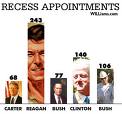
All modern Presidents have made recess appointments both during the shorter breaks within a session of Congress as well as during the longer recess between the two sessions. In fact, the last five Presidents used it with frequency: George W Bush 171 times, Clinton 139, HW Bush 77, Reagan 242 and Carter 68. Presidents Jackson, Taylor, and Lincoln made hundreds of recess appointments during their terms.
President John F. Kennedy appointed our nation’s first black Supreme Court Justice, Thurgood Marshall to the 2nd U.S. Circuit Court of Appeals in October 1961, getting around opposition from Southern senators. President Dwight Eisenhower made three recess appointments to the Supreme Court: Chief Justice Earl Warren (1953) and Associate Justices William Brennan (1956) and Potter Stewart (1958). Each later received Senate confirmation. On one day alone, President Reagan made a record forty-six recess appointments.
With the next Senate recess approaching over President’s day holiday, and with nearly a hundred qualified nominees waiting in the sidelines, Obama needs to wield his Constitutionally-sanctioned power to make recess appointments. Hopefully he’ll do so before another appointee withdraws his name due to political contention.
TracyKurowski
is currently AFL-CIO Community Services Liaison at the United
Way of the Quad City Area. She has been active in the labor movement
for ten years, first as a member of AFSCME 3506, when she taught adult
education classes at the City Colleges of Chicago. She moved to the
Quad Cities in 2007 where she worked as political coordinator with the
Quad City Federation of Labor, and as a caseworker for Congressman
Bruce Braley from 2007 – 2009.
Tracy Kurowski writes a labor update every
Monday on Blog for Iowa
 Blog For Iowa