
Martin Luther King's Dream and Labor Movement Intertwined
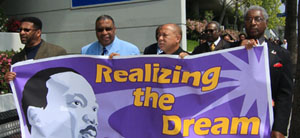 by Tracy Kurowski
When Dr. Martin Luther King, Jr. was slain on April 4, 1968, he was in Memphis, Tennessee supporting striking sanitation workers who had been in a long and violent struggle to form a union and pull themselves out of poverty.
Economic justice was as essential as civil rights to Dr. King and the sanitation workers. The signs they carried said simply, “I am a man.” And a man who can vote but not eat is half a man.
Here is some of what Dr. King had to say about labor that could have been written as easily today. What automation was to his era, globalization is to ours.
Dr. King was acutely aware of the common struggles of both groups for a dignified life: “It is natural for Negroes to turn to the Labor movement because it was the first and pioneer anti-poverty program,” he told the Teamsters and Allied Trade Councils a year before his death. At the time of his death he was planning a Poor People’s March on the capital. He was realizing more and more that the evolution of the struggle for civil rights inevitably leads to economic and social justice movement. These movements live on, and we are as indebted to Dr. King as ever in our current struggle for Employee Free Choice Act, and other labor legislation.
“Negroes are almost entirely a working people. There are pitifully few Negro millionaires, and few Negro employers. Our needs are identical with labor's needs — decent wages, fair working conditions, livable housing, old age security, health and welfare measures, conditions in which families can grow, have education for their children and respect in the community. That is why Negroes support labor's demands and fight laws which curb labor. That is why the labor-hater and labor-baiter is virtually always a twin-headed creature spewing anti-Negro epithets from one mouth and anti-labor propaganda from the other mouth.” AFL-CIO Convention, December 1961
“I look forward confidently to the day when all who work for a living will be one with no thought to their separateness as Negroes, Jews, Italians or any other distinctions. This will be the day when we bring into full realization the American dream—a dream yet unfulfilled. A dream of equality of opportunity, of privilege and property widely distributed; a dream of a land where men will not take necessities from the many to give luxuries to the few; a dream of a land where men will not argue that the color of a man's skin determines the content of his character; a dream of a nation where all our gifts and resources are held not for ourselves alone, but as instruments of service for the rest of humanity; the dream of a country where every man will respect the dignity and worth of the human personality. That is the dream…” AFL-CIO Convention, December 1961
“New economic patterning through automation is dissolving the jobs of workers in some of the nation's basic industries. This is to me a catastrophe. We are neither technologically advanced nor socially enlightened if we witness this disaster for tens of thousands without finding a solution. And by a solution, I mean a real and genuine alternative, providing the same living standards which were swept away by a force called progress, but which for some is destruction. The society that performs miracles with machinery has the capacity to make some miracles for men—if it values men as highly as it values machines.” UAW 25th Anniversary dinner, April 27, 1961
“As I have said many times, and believe with all my heart, the coalition that can have the greatest impact in the struggle for human dignity here in America is that of the Negro and the forces of labor, because their fortunes are so closely intertwined.” Letter to Amalgamated Laundry Workers, January 1962
“It is in this area (politics) of American life that labor and the Negro have identical interests. Labor has grave problems today of employment, shorter hours, old age security, housing and retraining against the impact of automation. The Congress and the Administration are almost as indifferent to labor's program as they are toward that of the Negro. Toward both they offer vastly less than adequate remedies for the problems which are a torment to us day after day.” UAW District 65 Convention, September 1962
“At the turn of the century women earned approximately ten cents an hour, and men were fortunate to receive twenty cents an hour. The average work week was sixty to seventy hours. During the thirties, wages were a secondary issue; to have a job at all was the difference between the agony of starvation and a flicker of life. The nation, now so vigorous, reeled and tottered almost to total collapse. The labor movement was the principal force that transformed misery and despair into hope and progress. Out of its bold struggles, economic and social reform gave birth to unemployment insurance, old age pensions, government relief for the destitute, and above all new wage levels that meant not mere survival, but a tolerable life. The captains of industry did not lead this transformation; they resisted it until they were overcome. When in the thirties the wave of union organization crested over our nation, it carried to secure shores not only itself but the whole society.” Illinois AFL-CIO Convention, October 1965
“The South is labor's other deep menace. Lower wage rates and improved transportation have magnetically attracted industry. The wide-spread, deeply-rooted Negro poverty in the South weakens the wage scale there for the white as well as the Negro. Beyond that, a low wage structure in the South becomes a heavy pressure on higher wages in the North.” Illinois AFL-CIO Convention, October 1965
“In the days to come, organized labor will increase its importance in the destinies of Negroes. Automation is imperceptibly but inexorably producing dislocations, skimming off unskilled labor from the industrial force. The displaced are flowing into proliferating service occupations. These enterprises are traditionally unorganized and provide low wage scales with longer hours. The Negroes pressed into these services need union protection, and the union movement needs their membership to maintain its relative strength in the whole society.” Where Do We Go From Here: Chaos or Community? 1967
“Today Negroes want above all else to abolish poverty in their lives, and in the lives of the white poor. This is the heart of their program. To end humiliation was a start, but to end poverty is a bigger task. It is natural for Negroes to turn to the Labor movement because it was the first and pioneer anti-poverty program. It will not be
easy to accomplish this program because white America has had cheap victories up to this point. The limited reforms we have won have been at bargain rates for the power structure. There are no expenses involved, no taxes are equired, for Negroes to share lunch counters, libraries, par
ks, hotels and other facilities. Even the more substantial reforms such as voting rights require neither monetary or psychological sacrifice. The real cost lies ahead. To enable the Negro to catch up, to repair the damage of centuries of denial and oppression means appropriations to create jobs and job training; it means the outlay of billions for decent housing and equal education.” Teamsters and Allied Trade Councils, New York City , May 1967
“When there is massive unemployment in the black community, it is called a social problem. But when there is massive unemployment in the white community, it is called a Depression. We look around every day and we see thousands and millions of people making inadequate wages. Not only do they work in our hospitals, they work in our hotels, they work in our laundries, they work in domestic service, they find themselves underemployed. You see, no labor is really menial unless you're not getting adequate wages. People are always talking about menial labor. But if you're getting a good (wage) as I know that through some unions they've brought it up…that isn't menial labor. What makes it menial is the income, the wages.” Local 1199 Salute to Freedom, March 1968
“You are demanding that this city will respect the dignity of labor. So often we overlook the work and the significance of those who are not in professional jobs, of those who are not in the so-called big jobs. But let me say to you tonight that whenever you are engaged in work that serves humanity and is for the building of humanity, it has dignity and it has worth.” AFSCME Memphis Sanitation Strike, April 3, 1968
Quotes and timeline researched by AFSCME and are available online at: afscme.org
Kurowski is currently AFL-CIO Community Services Liaison at the United
Way of the Quad City Area. She has been active in the labor movement
for ten years, first as a member of AFSCME 3506, when she taught adult
education classes at the City Colleges of Chicago. She moved to the
Quad Cities in 2007 where she worked as political coordinator with the
Quad City Federation of Labor, and as a caseworker for Congressman
Bruce Braley from 2007 – 2009.
Tracy Kurowski writes a labor update every Monday on Blog for Iowa
 Blog For Iowa