
Labor, Progressives, Protest Outside Grassley's Davenport Office
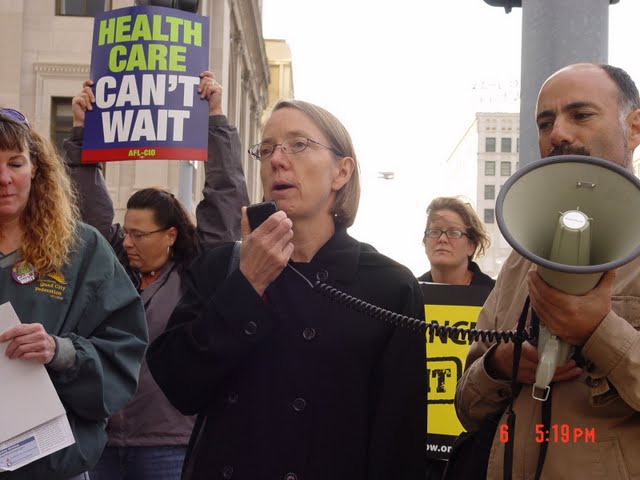 [Photo: BFIA's own Alta Price, M.D., making sure the progressive voice is heard as she hits the streets of the Quad Cities with labor activists, progressive activists and citizens fighting for health care reform]
by Tracy Kurowski Davenport, Iowa – More than fifty people from the Quad City Area rallied to show support for health care reform and advocate for the public option in front of Senator Grassley’s Davenport office on October 6, 2009.
Senator Grassley is the only member of the Quad City Congressional delegation who is opposed to the public option. Senators Burris and Durbin in Illinois support it, along with Senator Harkin in Iowa, and Congressman Phil Hare (IL 17th), and Congressman Bruce Braley (IA 1st).
Picketing began at 4:30 p.m. with union members from IBEW, SEIU, USW, AFSCME, CWA, IAM, Workers United, and UFCW. Community organizations like Sisters of the Congregation of the Humility of Mary, Iowa Citizens Action Network, Democracy for America, and Progressive Action for the Common Good also attended and spoke in favor of the public option.
The rally was moderated by Sue Frembgen, the Iowa Vice President, Quad City Federation of Labor. Sister Pat Miller opened with a prayer for our greater humanity and that all people should have access to health care. She then addressed the myths about reform, noting that despite Senator Grassley’s comments, nothing in the bill would ration care or “pull the plug” on our nation’s sick, frail or elderly population.
Joyce Hermanstorfer, from the Alliance for Retired Americans, presented a letter to Senator Grassley, calling his letter in support of Humana’s lobby efforts to Iowa ’s seniors a “shameful attempt to protect [Humana’s] corporate profits and a tool for spreading misinformation about health insurance reform.”
Bev Strayhall, a former nurse and social worker, described her experiences working with patients who could not afford to follow up on their needed care due to the costs. Dr. Alta Price, a pathologist, spoke from the perspective of a practicing medical professional who already encounters a public option in health care – Medicare. She noted that the American Medical Association has already endorsed HR 3200 which includes the public option.
Karen Kinney, President of Workers United, the union that represented the workers at the now-closed Seaford Plant in Rock Island, Illinois talked about the “Seaford Survivors” the mostly single mothers who are now struggling to find adequate employment. Some have found work at McDonalds or at the county nursing home – but this is part-time, minimum wage employment. Even with the COBRA subsidy available for nine months as part of American Recovery and Reinvestment Act of 2009 (ARRA), families still have to pay over $250 a month for health insurance. This amounts to thirty percent of their unemployment benefit, leaving little left over for food, rent, utilities and other necessities.
Skip McGill, President of USW 105 which represents Alcoa employees, noted how bargaining used to focus on wages and benefits like sick time, vacation pay and working conditions. Now most of the money negotiated must go to maintain health premiums at prices families can afford. He added that many of the hundreds who have been laid off this year can only afford COBRA benefits due to the ARRA’s sixty-five percent subsidy of the total cost. After the ARRA expires, if the steelworkers aren’t back at work, Skip asked how they’ll afford to pay for health care coverage.
If you haven’t already done so (even if you have), use HCAN’s toll-free number below to contact your senators and let them know you support a robust public option in the final health care bill:
Call your Senator at 1-877-264-HCAN and say:
Do the 4 things we need for affordable health care:
1 – Make health care affordable at work
Require all but the smallest employers to help pay for their employees’ health coverage.
2 – Make health care affordable for those not at work
Be sure that people who don’t get health coverage at work can afford their premiums and have reasonable out-of-pocket costs.
3 – Give us the choice of a public health insurance option
We need a public health insurance option to compete with private health insurance and force them to lower their premiums.
4 – Don’t tax health our health coverage
There’s a better way to pay for health care reform than taxing health care benefits. Taxing benefits will raise premiums and out-of-pocket costs and lower wages.
Visit Blog for Iowa every Monday for Tracy Kurowski's update on labor activities in Iowa.
 Blog For Iowa