
An Iowa Nuclear Disarmament Primer, Part 2
 by Paul Deaton
We don’t talk much about the legacy of the “greatest generation” when it comes to their creation and deployment of nuclear weapons. We grew up in an environment of “duck and cover” exercises at school, neighbors building bomb shelters and the worry of mutually assured destruction between the former Soviet Union and the United States. Thanks a lot folks! Neither does the threatening nature of this inheritance come through in Tom Brokaw’s sepia toned version of the citizens who grew up in the depression and fought and won World War II. In dropping the only two nuclear weapons ever deployed, on Hiroshima and Nagasaki, the United States created a horror that, to many, was unthinkable.
We initiated discussion of how to control nuclear weapons after the end of World War II hostilities. It was a member of the greatest generation, President John F. Kennedy, who took first steps to reduce the threat of nuclear weapons by signing the Partial Test Ban Treaty, also called the Limited Test Ban Treaty in 1963.
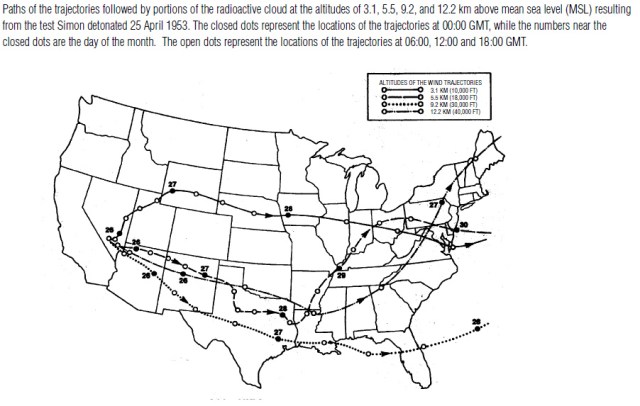
As you can see from the illustration, we are all downwinders of nuclear explosions. At the time, the Eastman Kodak Company, a manufacturer of photographic film located in Rochester, New York, asked the federal government for several days advance notice of nuclear testing at the Nevada site so they could cease production of film. The plume of radioactivity compromised their film making. During this era, the presumption was that nuclear weapons development would continue and that we merely had to adjust how we proceeded with testing.
After the Limited Test Ban Treaty was signed and ratified, there were few developments in nuclear disarmament. The Comprehensive Nuclear Test Ban Treaty (CTBT) developed in the early 1990s has not gone into force. The parties to the treaty agree to ban all nuclear weapons testing.The CTBT is a step towards global nuclear disarmament. It will enter into force 180 days after the 44 states listed in Annex 2 of the treaty have ratified it. These “Annex 2 states” are those that participated in the CTBT’s negotiations between 1994 and 1996 and possessed nuclear power reactors or research reactors at that time. As of today, all but nine of the Annex 2 states have ratified the treaty: China, Egypt, Indonesia, Iran, Israel and the United States have already signed the Treaty and have not ratified. India, North Korea and Pakistan have not yet signed it. The CTBT represents a viable next step towards nuclear disarmament. For the treaty to go into force, the United States must take an active leadership role.
During the George W. Bush administration, little was done to advance the CTBT, and a case can be made that the danger of nuclear proliferation escalated as a result of his administration’s actions and inactions. One of today’s discussions is about the nuclear intentions of North Korea. When we consider nuclear weapons retaliation against North Korea, we can see that the radioactive isotopes resulting from our blast would find their way across the Pacific Ocean to Alaska, Oregon, Washington and California. In a literal way, dropping a nuclear bomb on North Korea would be like dropping one on ourselves. Let’s hope we don’t initiate such an endeavor, even if North Korea goes first. Inaction on the part of the Bush administration regarding Korea and the other states that have not ratified the CTBT has let the nuclear issue fester.
So what can we do to make up for the time lost during the Bush years? That will be the topic of next week’s post. In the meantime, if you have not already, you can view President Obama's Prague Speech where he outlines his nuclear disarmament policy.
~Paul Deaton is a native Iowan living in rural Johnson County. Check out his blog, Big Grove Garden. E-mail Paul Deaton
 Why should 94% of talk radio be conservative? (Up 3% since 2007)
Click here to help get fair and balanced talk radio on the air in Iowa
 Blog For Iowa