
Iowa GOP Gubernatorial Debate
 by Paul Deaton
The drive to Des Moines was as typical as any summer afternoon in Iowa I can remember, with warm temperatures, cumulus clouds against an azure sky, vast stands of field corn in tassel and patches of Queen Anne’s Lace, purple coneflowers, black-eyed Susans, daisies, horsemint and cattails everywhere in the spaces between row crops and Interstate 80 leading to the IowaPolitics.com GOP Gubernatorial Debate on July 22 at Drake University. As a progressive Democrat, I have been following the re-organization of the Iowa Republican Party and was curious to see their direction as evidenced by the gubernatorial candidate debate.
When Kim Lehman, President of the Iowa Right to Life Organization, was elected to represent Iowa on the Republican National Committee last summer, she said, “I think that this is an opportunity for the Republican Party to rebuild.” She outlined the state of the Republican Party as follows, “I don't know that the party is taking a new direction. All of the conservatives that are pro-life, pro-family are very fiscally conservative as well. I don't think that the party has changed its view or the platform has changed its view. I think starting with Ronald Reagan the party became very pro-life, pro-family and nothing has really changed.”
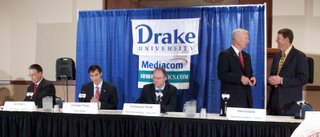 There was not much in the candidate answers to the IowaPolitics.com questions to contradict Ms. Lehman as to the direction Republicans are going this election cycle. The message is clearly social and fiscal conservatism and in this, Republican candidates for governor seem united. During answers to the question of whether former Republican Governor Terry Branstad should enter the race, there was consensus that his entry and the entry of other candidates would enhance the discussion and would be good for the Republican Party. As Representative Rants indicated, the primary race would be a “chance to talk about the future.” For this observer, the future of the Republican Party looks much like the past.
There are presently six Republican candidates for governor: Jerry Behn, State Senator from District 24, Cedar Rapids businessman Christian Fong, Paul McKinley, State Senator from District 36, Representative Christopher Rants, House District 54, Representative Rod Roberts, House District 51 and Bob Vander Plaats, president and CEO of MVP Leadership, Inc. They will face off during the Republican primary in June 2010. All but Senator McKinley participated in the debate.
Where the candidates agreed, there were no surprises. Democrats are spending too much money. The State’s payroll is growing too quickly, with the AFCSME contract leading the way. We need to re-affirm Iowa’s “right to work” status to attract new businesses to the state. The tax structure in Iowa is a “job killer.” We need to defend the “traditional family.” There are enough casinos in Iowa. We do not favor campaign finance reform or limiting contributions to individual candidates. They do not support SF 293, the Medical Marijuana Act. Where the candidates differed is more interesting from a Democrat’s perspective.
When we consider the question “which Republican can beat Chet Culver in the 2010 gubernatorial election” none of the five candidates in the debate seems a likely contender. Governor Culver has won three state-wide races, Democratic voter registrations outnumber Republican voter registrations by a substantial margin and despite comments of pundits and pollsters that Culver may be “vulnerable,” even subject to a primary challenge, he is campaigning from a position of substantial strength. It seems unlikely that Iowans will fail to re-elect this incumbent governor to office.
Of the five participants in the IowaPolitics.com debate, the one worth watching is Rod Roberts, for a couple of reasons.
While Bob Vander Plaats is leading in current polling data, as Republican leader Doug Gross said on his May 22, 2009 appearance on Iowa Press, “I don't think Bob Vander Plaats will be our nominee. Bob leads with sort of the Christian social message. That's fine but if you lead with that it's likely you can't be a competitive candidate frankly in a general election in Iowa.” Republicans should know best in this case.
The other panelist with name recognition in Iowa is Chris Rants, former speaker of the Iowa House. Representative Rants spent a significant amount of his time outlining his position on property taxes in Iowa. He suggested that the current governor, with the legislature, is shifting the tax burden in Iowa to property taxes and that this is bad for business. As a former businessman and legislator, he could be expected to be a “pro-business” candidate, and that could have some traction in Iowa. Because of his high visibility in the Iowa House, Rants is a known commodity and because of that, independent Iowans seem likely to pick the incumbent in the general election.
Neither Christian Fong nor Jerry Behn differentiated themselves from the other panelists, although they may yet.
The potential threat to Governor Culver is in Rod Roberts. When asked how his candidacy differentiates him from the field, Representative Roberts answered, “I have had a variety of leadership positions in government and in Christian churches. I have the temperament, personality and leadership to be governor.” Roberts even temperament was evident throughout the debate, and is the kind tha
t is attractive to independent Iowans.
Roberts has clear Republican credentials. He was first elected to the Iowa House of Representatives in 2000 and has been Executive Director, Christian Churches/Churches of Christ in Iowa. These credentials solidify his position with his base. His answer to the question on support for capital punishment differentiated him. He said, “We have life in prison without parole. It is a serious punishment.” His opposition to capital punishment enables him to solidify part of the Republican base that believes in “right to life” at all stages of life. The other candidates favor capital punishment and their doctrinaire position would be a deficit with this group in a statewide race.
Where Roberts could gain support among independent voters was found in his pragmatic approach to controversial problems. His answers to a question about repealing the Smokefree Air Act show this approach. He referred to the “significant and spirited debate” in which he participated in the 2008 House session that produced this law. He said that the matter is “settled” and that there is “no reason to repeal the law.” This unequivocal response set him apart from the other panelists and could be appealing to voters who want to move on from the partisan nature of politics as usual. Pragmatism does not overcome the problems with the Republican positions he supports, but it could go a long way towards gaining support among moderates.
While it may seem unusual for a lifelong Democrat to be interested in Republican Party politics, it is important to hear both sides. If Democrats expect to retain a position of strength in American politics, we must be aware of what the other party is doing. They may be down and out now, and are most certainly unlikely to defeat Governor Culver.
Democrats should spend some time listening to Republicans and avoid acceptance of the caricatures of them that appear in the mainstream media. Building alliances with opponents can be part of a path to advance the progressive agenda, something in which we all should be interested. ~Paul Deaton is a native Iowan living in rural Johnson County. Check out his blog, Big Grove Garden. E-mail Paul Deaton
 Blog For Iowa