
Grassley Challenger Krause Talks to BFIA about Health Care, Media Reform, and RAGBRAI
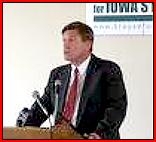 Blog for Iowa spoke with Grassley challenger for U.S. Senate Bob Krause at length in June. Today in the last of our three-part series, we discuss with the candidate his views on media reform, the economy, and education, as well as RAGBRAI and the Beatles. Click here for Part I (Sotomayor, Going Green, Campaign Strategy). Click here for Part II (Veterans, Gay Rights, Progressivism).
The campaign has issued position statements and press releases on several topics, including health care (supports public option). Readers can go to Krause for Iowa's Future for complete information on the candidate's views on health care.
BFIA: Your campaign has already issued several public statements that are all available on your campaign website, but what is your view on how best to reform the health care system?
BK: I see the expensive ads on TV now for the private provider option, and I know that they are there to 'buck-up' Grassley and make his position more tenable. I think that we have to come out strongly that the private provider option is an expensive, big lie that enriches vested interests in Washington D.C. without addressing the needs of the taxpayer for … quality service at low cost. The pure private provider option will continue to enrich large drug companies that would rather buy up [smaller] drug companies [that have] new ideas than create their own new drugs.
BFIA: Blog for Iowa, as you know, started five years ago during the transformation from the Dean for America presidential campaign to Democracy for America. A major Dean campaign theme was taking back the media from corporate control and infusing it with the voice of the people. In fact, Dean said on national television during the campaign, that his first act as president would be to break up the media conglomerates. At Blog for Iowa, we try to give voice to alternative points of view, to correct misinformation or distortions of the mainstream media. And we try to expose the corporate control, how the media is affected by FCC regulations and ownership rules, which have led to an overly magnified conservative voice on radio and TV. President Obama has even said that Fox News cost him 2% of the vote. Congressman Loebsack, for example, has co-sponsored bills that have helped to create community low power FM radio stations. What do you see as your role, should you be elected, in enabling media reform? What do you feel are the problems in media that need to be corrected, and what would be the avenue that you think would be most effective in making progress?
BK: I'll start with an anecdote about a small sports news network that started up in Dyersville, Iowa, probably ten years ago or better now, a different era. An entrepreneur put a great deal of money in putting a national radio sports network together. When he got it up and running, he discovered that the market had changed. Instead of going to multiple small town radio program buyers, like he had been accustomed to, there had been a sea change. The FCC had allowed ownership shares to be revised upwards so that the Clear Channels could buy up and consolidate the market, as they have. Instead of having a few hundred potential sales opportunities, he wound up with just a handful and it put him out of business. It was a great opportunity that Dyersville and America lost, to have an entrepreneurial sports channel here.
So [consolidation] has affected not just the hard news element of the media industry, but it has affected the advertising industry – any aspect of programming within the media industry – and it has reduced the small town access to news – and Iowa is nothing if it is not a small town universe and a small town market for news. If you look back you can see small town radio [in] Iowa has lost a great deal of their ability to report local news. If it does, it comes from a few news sources. You know, Radio Iowa has its news network, and that's about it. Even some of the big ones like WHO have dramatically cut back on their news, and so what's gotten hurt is our local discussions of our state legislators or mayors or city councils or boards of supervisors. These things have really been taken away from us by consolidation. Instead of having newsrooms scattered across small town America, there are one or two newsrooms in Houston, Texas, and other places like that, and they govern what we all hear. It's like in America today, thanks to these monopolistic practices, everybody gets vanilla – nobody can have chocolate and that's a sad commentary on America, that we've allowed this.
This is a pattern all across America. You have consolidation in the banking industry, the media industry, retail, with the Wal-Marts, and I think it's not only the duty of Congress to come and do something through the FCC to reduce ownership share, but it's also the responsibility of Congress to go after other monopolies that have been allowed to form in America, in spite of the law, because of weak-willed enforcement. And I think where Teddy Roosevelt was one of the great Republicans that vigorously pursued and actually helped to create a lot of the anti-monopoly legislation that made America entrepreneurial – made America a great place where anybody with an idea could make it happen – we need to go back to that great Republican philosophy of anti-monopoly, and we need to more vigorously enforce it, not only in relation to the media, but certain other key elements within our industrial and our service fabric.
BFIA: In general, what are the most serious problems facing Iowa that the federal government has a role in, and what would be your preferred strategies for addressing those problems?
Where do you start? As you know, the economy is probably the thing for Iowa as well as the nation. Unless we get the engines of commerce rolling again, and people buying again, it will be too hard to balance the budget, educate the children of Iowa, pave our roads, and the harder it will be to compete nationally and internationally. Priming the pump, getting confidence back into the system, restoring credit to people and industries, these are things that we're going to have to do to create mechanisms to fail-safe our financial systems – the lessons are still very recent.
We've seen what consolidation can do to our country. It's been estimated that the group of people that made the decisions that caused the bubble and the bust in America is about 5,000 people, strategically located on the east coast. So we need to be aware that those things happen, but also aware that there's a way out, that confidence can be rebuilt. We need to diversify the decision making points within the industrial and service economies.
Beyond that, education is obviously a key thing. Iowa has historically been on the top in terms of the quality of our graduates, but that has been slipping somewhat over the last few years. Instead of being perennially number one, we are comparable with states in the upper midwest, generally. I know from my time as a member on the Waterloo school board that the most accurate predictor of academic success by a child is their socio-economic status.
I think that one of the ways that we can help with the education of our children is to deal with income. Not only get the wheels of industry going, but also make sure that the jobs we get pay well. We need to look at the floors maybe as much as the ceilings. We talk about the bonuses at AIG and executives – very important, but let's talk about the people at the bottom, ensuring they're making enough that they can support their families well enough that, overall, the academic achievement of the children goes up. And we're dealing with a new generation of youth in the state of Iowa that statistically is probably different than twenty or thirty years ago – it's more ethnically diverse, it's probably poorer in many ways, and we need to adapt to the mixtures that we're finding and actively reach out to those children that are in academic danger because we don't have the right income strategy.
BFIA: So, you're saying that the economy and education are woven together.
BK: Yes, very much. It is the most accurate predictor – if we can get the average incomes up, a lot of the crisis points that you see in academia will take care of themselves. In Waterloo, we had a mix – we had poor single parents, usually mothers, but sometimes fathers, who would have a hard time making ends meet and would go from job to job trying to keep things together, and those children that had to move in response to those economic crises were generally troubled, and it caused a great deal of difficulty for them academically at the time of the crisis and also afterwards, because they would fall behind, and so I think you have to look at that.
And we have, to some extent. We have breakfast programs in the schools for the simple reason that kids coming to school hungry won't be able to think very well – I know I can't think very well if my stomach is empty. So those are some of the things we have to look at. It's like a long-term investment. You look at the cost, but then you also look at the cost of having an adult in our society who can't read or do simple math. So you put food on the breakfast table of a child, well maybe that's just an act of giving that you have to do, but it's probably another of those watering incidents. You water now and twenty years later you probably will get a much better citizen because of what you've done, and that will be a tax-paying citizen. So if you are someone who disagrees with that, think of your own children because their tax burden will probably be lessened because those children who receive a break now will be better tax payers some day.
BFIA: In your bio, it says your day job is working for a defense contractor. Can you explain to BFIA readers what you do exactly?
BK: It's VFD Corporation. We have a contract with the Army Reserve to go out and modify military equipment – vehicles, weapons. When the engineers come up with new ideas or new safety features, rather than buy something new, they put together a modificaiton kit and people like me will take that modification kit to the field and – not actually install it myself – but ensure that it's installed. I have a territory that goes from Texas to Minnesota, and that's what I do. I identify these through a lot of data bases and then just try to make sure people put them on MWO – I'm a Modification Work Order Coordinator.
BFIA: Your website says that you will have a team on RAGBRAI. Are there any planned activities?
BK: Well, it's still in its infancy, we've got a young fellow by the name of Eric Risban who is going to be our leader and we've got one school bus but we'd always like another, and anyone that would care to fall in on it, we'd be happy to have them.
BFIA: Have you painted the school bus yet?
BK: I think it's just a regular school bus, we'll probably use a little water color paint on it, something like that.
BFIA: It's not going to have flames painted on the sides and kegs of beer on the top?
BK: (laughter) I'm just going to be innocent about it.
BFIA: Are you going to be riding all week with the team?
BK: Probably not all week. I'm going to ride a day or so, either when it's around Fairfield and Ottumwa, or up near Des Moines, I'm not sure which. I've got to work during the week and I can't use up all my vacation days. I'll be with them a day and that'll be about it. But it should be a fun time and I'm sure all the enthusiasts will be out there and it should be some very good camaraderie.
We're going to have a note on the website about how to register so you can get information on it. So just keep checking our website, www.krauseforiowa.com and as the date gets closer, there should be a place where you can put in your name and general information will be shot out to you.
BFIA: Last question: Which Beatles song are you?
BK: Well, let's see, Eleanor Rigby, Octopus' Garden, some of the songs are extremely thoughtful. I knew all the songs – we had the White Album, Sgt. Pepper's.
BFIA: But have you taken the Which Beatles Song Are You? Facebook Quiz, where you answer the questions and the quiz answers reveal which Beatles song you are most like?
BK: I never do the Facebook things.
[After BFIA pressed, Bob was a good sport and agreed to take the quiz and release the results].
BK: It is “Hey, Jude!” Not actually my favorite, but one that I guess fits my personality.
[“Hey, Jude” people are “all about making life a bit brighter, no matter what has happened before.”]
BFIA: Final thoughts?
BK: It should be a joyful campaign. Besides being serious and besides being challenging, politics should be fun. People should enjoy it and I hope that we can make this interesting, spirited campaign enjoyable not only to our supporters but to the voters of Iowa.
 Blog For Iowa