
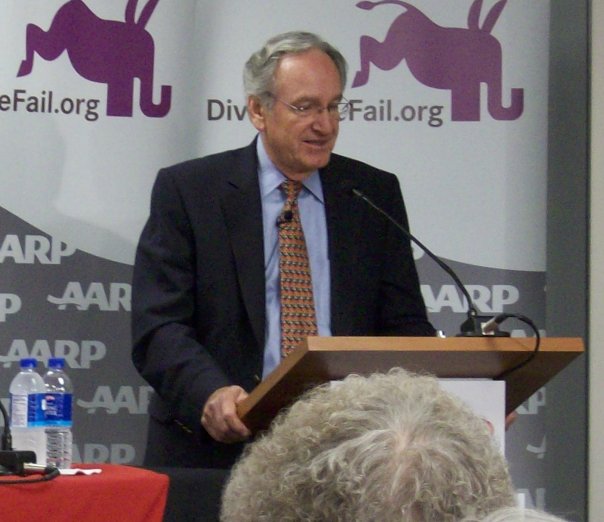
Harkin Attends National Forum on Health Reform in North Liberty, Iowa
 by Paul Deaton
Senator Tom Harkin:
“We are going to have a public option plan.”At the National Forum on Health Reform in North Liberty, Iowa on June 6, sponsored by AARP, Divided We Fail, the Johnson County Livable Community Initiative and Mediacom, Senator Tom Harkin and others said what we have known for some time, that $0.95 out of every dollar spent on health care is spent on treatments for what ails us. Less than a nickel is spent on preventing disease. In the United States, we spend more money than any industrialized nation on our health and health care and the vast majority of our dollars are spent on what is appropriately called “sick care.”
There is tremendous impetus in Washington to get health reform and health care reform done this year. The trouble is that these legislative initiatives have as many legs as a millipede and will leave footprints on us all. Former labor secretary Robert Reich recently said, “The concrete is being mixed and about to be poured. And after it's poured and hardens, universal health care will be with us for years to come in whatever form it now takes.” According to the Iowa City Press-Citizen:
think we have a critical mass to get this done this year,” he said to
about 200 people …..The attempts for health care reform in the early
1990s failed because “we didn't have the critical mass,” he said. “We
just didn't have it.” Harkin said based on discussion from Friday, “we
are going to have a public option plan.” Although
some have expressed interest in a state-by-state public option plan,
“I'm adamant that it's got to be a national plan” to have the value of
a large pool, he said.
Now, more than ever, is the time for progressives to get involved in the legislative process, give voice to our concerns and work to influence the outcomes. From the perspective of public health policy, my concerns are three:
The truth is that diabetes, cardio-respiratory disease, obesity and other chronic conditions, are driving the high health care costs in our country. Once diagnosed, each of these diseases is treatable and is being treated to the tune of big dollars to pharmaceutical companies and health care operations. The way to reform the current practices has more to do with behavior modification to prevent these chronic conditions than legislative initiatives. The remedy is as familiar as our parents’ voice: eat less and better food and exercise more.
In addition, a more holistic approach to health, one that includes consolidated medical records, mental health parity, oral health and a view toward treating the whole person, not just a specific ailment, has demonstrated health benefits. Government may play a role in reforming our approach to health. What matters more, is each of us taking ownership and responsibility for our behavior and wellness. Whatever legislation comes out of congress should support this idea.
The unseen gorilla in the room at the Gerdin Conference Center in North Liberty was the impact of farm policy on our health. Beginning with the tenure of Agriculture Secretary Earl Butz in the 1970s, farm policy has been geared towards production of food, with a substantial subsidy program designed to reward specific agri-business behaviors. The Butz philosophy was, “get big or get out” of farming, and farms have gotten bigger. Corn and soy beans comprise a higher percent of our diets today than they were in the 1950s, partly because of farm policy.
Modern food production is designed to take virtually inedible field crops, deconstruct them and then rebuild “food products” into forms that are popular with consumers. The fact that there is public demand for “whole grains,” “omega 3,” and “heart healthy” foods drives manufacturers to modify the ingredient blends of food products so they can legally be defined as such on the packaging.
What is not considered in farm policy is that processed foods contribute to the chronic conditions that are driving health care costs. I remember taking a trip to the new McDonalds restaurant as a child with my family. It had just opened and was the one of its kind in a town of 100,000 people. The food seemed exotic compared to what my mother made at home, and it was a special treat when we could afford to eat out. The trouble is that the government subsidies that create an environment for large food service outlets to provide cheap and available food, and if we can get a burger, fries and soft drink for under three bucks, we might be willing to eat more processed food at these outlets despite the risks to our health.
My proposal is to change farm policy so as to eliminate the subsidy programs for corn, soy, wheat and sugar. Perhaps the cost of processed foods would then consider the negative consequences to our health.
When we consider 47 million Americans without health insurance or access to health care, the number is staggering. In North Liberty one speaker mentioned that tens of thousands of people die in the United States each year because they don’t have access to health care. In addition, people tend to avoid treatment for chronic disease if they can’t afford it, despite the fact that preventive measures are much less expensive in the early stages of disease.
Providing access to health care is part of the Obama initiative and according to Senator Harkin, the president wants this done by October. The words “single payer” and “public option” came up repeatedly at the forum. What we need is a way to limit the influence of the powerful interests regarding health policy in Washington. If pharmaceutical companies, health insurance companies, agri-business and food manufacturers have their way, they will concoct legislation that can be called “public option.”
When we read the “Nutrition Facts” label of such legislation, it will resemble a re-mix of the same old panaceas that favor their interests. We can’t let this happen, and our recourse as citizens is to communicate our concerns to our legislative delegation and insist on a public option for access to health care that provides the advantage of scale and true competition with the powerful interests.
Senator Harkin indicated that he hopes to have his bill marked up by the July recess, so the time to act is now.
~Paul Deaton is a native Iowan living in rural Johnson County. Visit Paul's blog, BigGroveNews. E-mail Paul Deaton
 Blog For Iowa