
Iowans Are Mad As Hell And Aren't Going To Take It Anymore
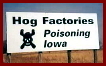 Monday may be the last opportunity to stand against terrible CAFO practices that will pollute Iowa's air and waterways. Iowans are already fighting back by hitting their local opinion pages. BFIA took an online virtual tour of Iowa newspapers' opinion pages, and this is what we discovered: Across the state, pro-environment views can be found in every paper large enough to have an opinon section. Below we've posted a small sampling.
CAFOs Create Toxic Waste Byproducts
Dee Ann Simmons Lehn expressed concern that a hog CAFO proposed near her home would threaten her quality of life and adversely affect the health of family members suffering from asthma and emphysema (March 18 letter). Her concerns are well founded.
Research by the University of Iowa found that children attending school near a CAFO had a 24.6 percent asthma rate, compared to 11.7 percent for a control school. The research also found that children raised on hog farms had a 44.1 percent asthma rate, and children raised on hog farms where antibiotics were fed subtherapeutically had a 55.8 percent asthma rate.
Other studies have found that neighbors living near a CAFO suffer from health problems, including respiratory problems, headaches, runny nose, sore throat, coughing, diarrhea, burning eyes, tension, depression, anger and fatigue.
It is not hog manure itself that causes the problems. CAFO hog manure is stored liquefied in a pit where it undergoes radical transformation. The manure begins to decompose, but because oxygen is limited in the liquid environment, decomposition is arrested, causing the manure to putrefy. During this anaerobic putrefaction of manure, over 300 volatile organic compounds (VOCs) are produced, many of which are highly toxic. If a CAFO ventilation system fails, the animals and CAFO workers can die of asphyxiation quickly. It is those same toxic VOCs that are vented to the outdoors that cause health problems for neighbors.
Living near a CAFO is not the same as visiting the county fair, or living near a farm where manure is piled and composted, or where animals deposit their manure in pastures. Manure that decomposes in the open air does not putrefy; it decomposes into carbon dioxide and humus — odorless and nontoxic end products.
I agree with Dee Ann that “If CAFOs must be built, they must be built in remote areas far away from all families and homesteads.”
We need to recognize that CAFOs are not like regular farms; they are industrial production facilities that create toxic waste byproducts which are hazardous to human health.
Francis Thicke, Fairfield, Ottumwa Courier
Manure carries a big cost, too
I
would like to thank the Register for a good March 10 editorial. Manure
might smell like money to farmers, but to the rest of Iowa it means more impaired waterways, more fish kills and more bacteria in the water.
Poor
water hygiene increases the diversity of bacteria, and virulent strains
like drug-resistant bacteria become more common. It is an
evolutionary arms race in action. We need to come to terms with nature,
less we face its wrath. We inject antibiotics into food, spread the waste on farm fields and then risk the manure/bacteria getting into waterways.
Neil Daniels, Coralville, The Des Moines Register
Protect Iowa's waterways
WALL LAKE, Iowa – It is spring again here in Iowa. Along with the arrival of the robins and other signs of spring I hope we do not experience the record-breaking levels of ammonia and other pollutants in our state waterways as happened last spring.
A major contributor to this type of runoff pollution is the application of liquid manure on frozen and snow-covered ground. The Iowa Department of Natural Resources has been working for almost a year on a rule that would restrict this practice. They considered input from livestock producers, concerned citizens and environmental groups to come up with a workable rule. Now the Iowa Legislature has effectively begun a process to undercut the DNR rule with their own legislation. The Senate and House both passed bills out of committee that would negate the DNR rule and replace it with a toothless and spineless piece of work apparently crafted by corporate agribusiness interests.
When over 400 bodies of water in our state are considered impaired, we need to address this issue in a meaningful way. Tell our legislative leaders to not allow this bill to reach the floor.
Rosie Partridge, Sioux City Journal
We loved this one, even though it isn't exactly about CAFOs.
He's a knockin'
The problem with locating whatever in the flood plain of the Mississippi seems to me to be the fact that those residents on its banks do not hold title to this river area. Ol' Man River holds this deed. Every once in a while, unannounced, he comes to inspect his property. We term this a flood. Any object squatting on his land will either move or get wet. He'll be back another day. Can't say when. Can't ya hear him knockin'?
Dallas Tuck, Keokuk, The Burlington Hawkeye
BFIA would like to
thank everyone who takes the time to write a letter to the Op-Ed
section of your local paper. It is the voice of the people.
Scroll Down for Action
 Blog For Iowa