
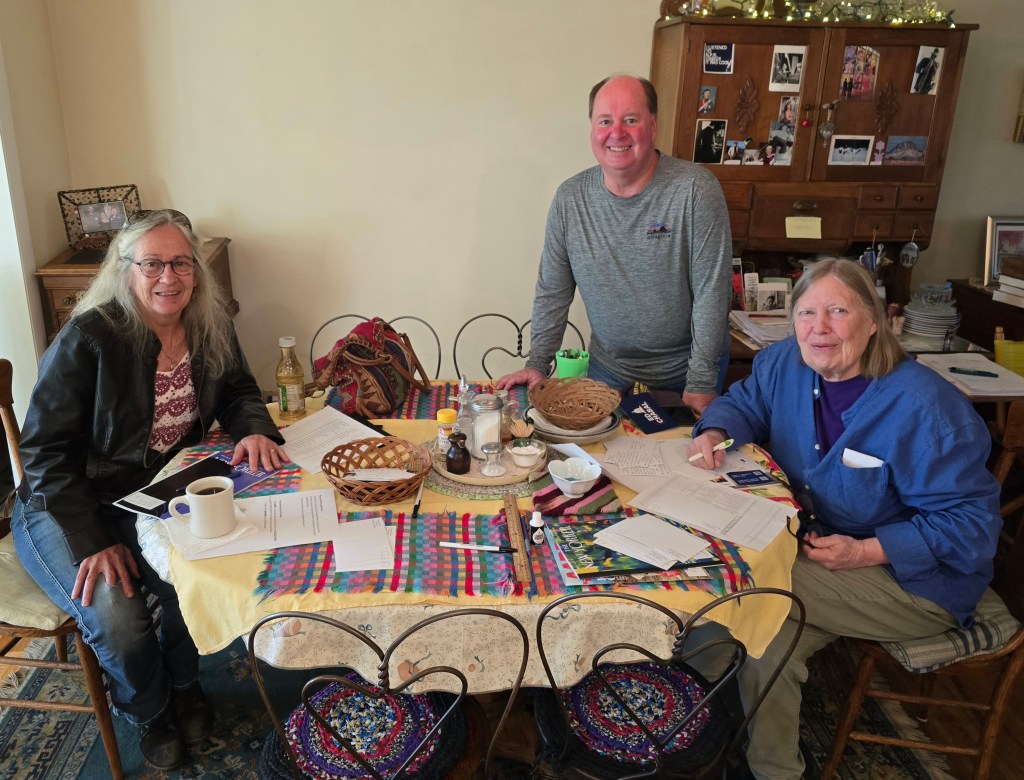
My cohort of septuagenarian and octogenarian political activist friends organized an event before the primary. (Some nonagenarians are still around, yet are taking a well-deserved break. Their work beginning with the Adlai Stevenson campaign is appreciated, they earned their spurs). We held a “meet the candidates” event for local voters, something not often done these days. All five primary candidates for county supervisor showed up to speak briefly and to shake hands and chat for a couple of hours.
In August, we fired the engines for the fall campaign to put on another meet the candidate event, which also served as our kick-off event. First Congressional District candidate Christina Bohannan was our keynote speaker. We had eight candidates in all and more than 65 attendees. It was good turnout for a small, rural city.
After kicking off the campaign we began planning and doing: we finished our third postcard party with seven people writing postcards to voters for our house and state senate candidates; planned a meet and greet event for a state representative who is not well known after redistricting; deployed a sign crew to get out the word about our candidates; and are deploying a door knocking crew to the far western part of our new state house district, where one of our members was raised. I started a special newsletter to facilitate communication, although most of our planning is done in person and via email. Phone calls? Only when we have to. Text messages? No. I would describe this as off grid organizing.
What does off grid organizing mean? Barack Obama described it as well as anyone could last night: “It was great to be back in Pennsylvania today. If this election is making you feel excited or scared or hopeful or frustrated or anything in between, don’t just sit back and hope for the best. Vote for Kamala Harris and Tim Walz. Vote for Democrats up and down the ballot who will fight for you. Then help your friends, family members, neighbors and coworkers register and make a plan to vote.”
With the demise of the coordinated campaign, we feel left on our own. The county party was able to hire a couple of organizers that work out of the First Congressional District campaign office in the county seat, yet we rely on them only when we have to. We know what we need to do and just do it. If there is a bill for advertising, we split it up and pay it. To promote our local races, we reach out directly to the state house candidates and find they are very willing to have us support them. In any case, a state house campaign is separate and different from a district wide or statewide campaign. Down ballot races are very important, so a cookie-cutter campaign doesn’t work well.
The county organizers telephone us to ask for our help. We do what we can. What hinders us, especially door knocking, is the large number of our group that have trouble moving around and are in the midst of cataract surgery, hip or knee replacement, diabetes, arthritis, or other ailments of aging. We had a conversation this week about door knocking and to a person felt it is not the kind of campaign that is needed. The number of doors a campaign knocks is no longer a meaningful metric. How deeply we penetrate social networks matters so much more. When the campaign office calls us, we politely decline.
The 2022 election cycle was my last experience door knocking and it was an eye opener. I tried to make it to every door knocking event that was in my county and my state house district. To a person, people contacted required no additional information about the election or candidates. They knew the candidates, had a plan to vote, and did it mostly on their own. If they were not going to vote, no entreaties from a stranger would change their minds. People yelled at me from behind closed doors, “Go away!” The world has changed since I re-activated in politics during the 2004 campaign.
So what do we do to get Democrats out to vote? We talk to people, in person or via the telephone. We talk to people we have known for years, and in some cases, for decades. We make sure they plan to vote. We don’t take this for granted. We ask if they need a ride to the polls. We share information and discuss issues in the campaign.These are normal conversations between rational voters. We need more of that.
Eventually my cohort and I are going to die or move to a home. Until we do, at least this campaign, we are activated.
 Blog For Iowa