
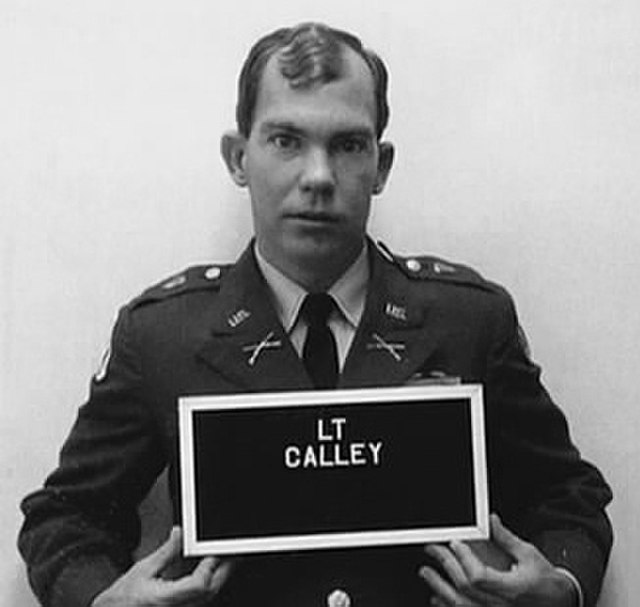
The Washington Post reported Monday that William Calley died at age 80 on April 28 in a Florida hospice. It is fitting he died in obscurity. He will not be missed.
More than anything else about the Vietnam War, the My Lai Massacre, for which he was found personally guilty of murdering 20 people, epitomized my view of what was wrong with the war. In all, U.S. estimates place the number of dead in the operation between 347 and 504 unarmed civilians, most of whom were women, children, or elderly men. My Lai had a profound influence on me, leading me to protest the war in the streets as information about it slowly became public.
I wrote about Calley in my memoir of entering the military:
The combination of willingness to serve and the end of the Vietnam war led me to seek out the Army recruiter and set aside concerns about risking my life by saying it was better for peace lovers to join the military and lead, rather than leave it to the likes of Lieutenant William Calley, the convicted war criminal who was responsible for the 1968 My Lai Massacre.
Calley was an example of what was worst about the military during the Vietnam era. The March 16, 1968, My Lai Massacre of more than 500 people, including young girls and women who were raped and mutilated before being killed, was particularly on my mind. We could do better than that. I believed the only way to address problems like My Lai was for people like me, who valued non-violent means of conflict resolution and common decency, to enter the military and do a better job of leading it. Later, in 1976, while I was stationed at Fort Benning, William Calley was locked up in the stockade.
Father’s military service played a role in my decision, as did the opportunity of youth and being single. I have no regrets in following Father’s footsteps and joining the Army. Why did I enlist? I felt the U.S. Army at the end of the Vietnam War was a despicable mess. (An Iowa Life, Unpublished Memoir of Paul Deaton)
The Washington Post story is a reasonable history of that time and Calley’s role in Vietnam. I recommend reading it here. This passage from the article rings true.
Almost from the very beginning, Mr. Calley polarized Americans who variously deemed him a war criminal or a scapegoat, a mass murderer or an inexperienced officer made to take the fall for the actions of his superiors. Defenders argued that he had been forced into a brutal conflict with an often invisible enemy, then blamed for the horrors of the war. (William Calley, Army officer and face of My Lai Massacre, is dead at 80, by Harrison Smith, Emily Langer, Brian Murphy, and Adam Bernstein. Washington Post, July 29, 2024).
While I was attending Officer Candidate School at Fort Benning in 1976, Calley was across base in the stockade. I had conversations with other officer candidates who felt Calley was a scapegoat. I maintained he was an incompetent murderer. May he burn in hell for all eternity.
 Blog For Iowa
