
Just like that, there is excitement in the air as Joe Biden endorsed Kamala Harris to be the Democratic nominee for president. It’s hard to believe it was less than a week ago. The dynamics of everything political changed. Many more people find themselves asking, “What can I do to help?” Historian and political journalist Heather Cox Richardson reported the excitement Friday morning:
People are turning out for Harris in impressive numbers. In the hours after she launched her campaign, Win With Black Women rallied 44,000 Black women on Zoom and raised $1.6 million. On Monday, around 20,000 Black men rallied to raise $1.2 million. Tonight, challenged to “answer the call,” 164,000 white women joined an event that “broke Zoom” and raised more than $2 million (UPDATE: $8.5 million) and tens of thousands of new volunteers. (Letters from an American, July 25, 2024. Heather Cox Richardson).
Thursday I took training from the Democratic National Committee in online engagement. There were so many people in the session, it load tested the applications they use. The surge of participation is palpable. It is also a good thing 100 days before the election.
What should we do to help elect Democrats?
The answer to this question is not what you may think: contact the local party and volunteer to knock doors, make phone calls, write post cards, donate money, and host events. Some campaigns need these things, yet they can become a placeholder that prevents more effective campaign work.
About door knocking. The 2022 election cycle was my last experience door knocking and it was an eye opener. I tried to make it to every door knocking event that was in my county and in my state house district. To a person, people contacted required no additional information about the election or candidates. They knew the candidates, had a plan to vote, and did it mostly on their own. If they were not going to vote, no entreaties from me would change their minds. People yelled at me from behind closed doors, “Go away!” The world has changed since I re-activated in politics during the 2004 campaign.
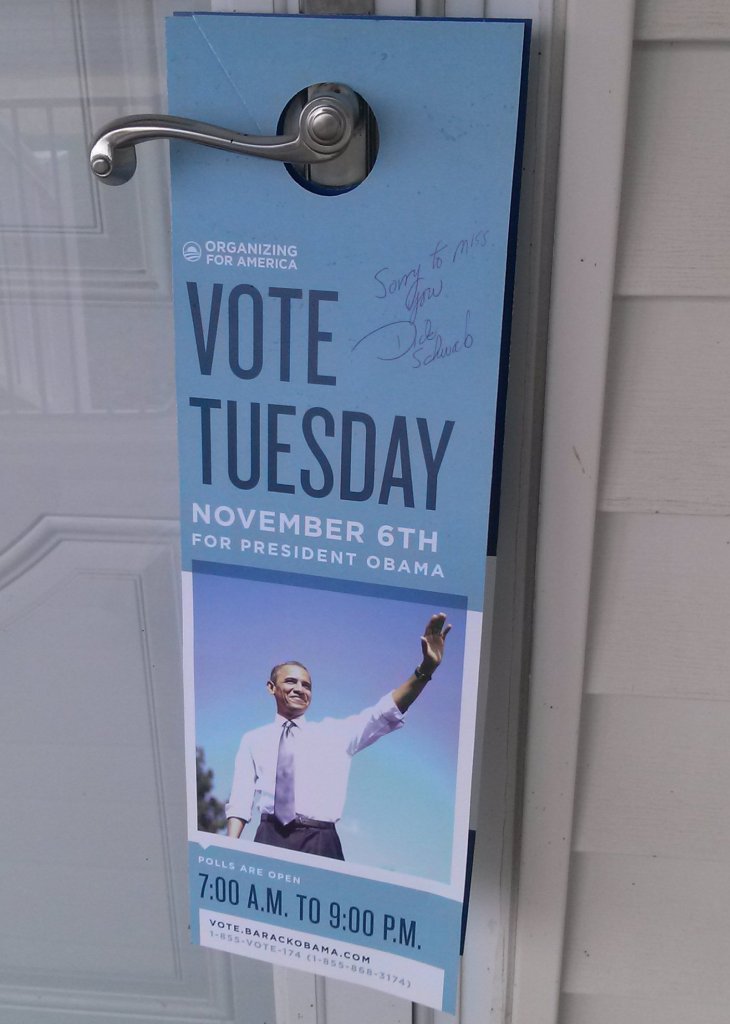
Where door knocking continues to pay dividends is when the candidate does it themself. In an Iowa state house race, this interaction is crucial. In a U.S. House District, it is impractical because of the size of the districts. The further up the ticket, the less important door knocking becomes. The most vigorous door knocking campaigns by a presidential campaign I recall were Barack Obama and Hillary Clinton. In those campaigns, especially in 2008, we contacted every voter we could think of, and phoned or door knocked until the polls closed. The takeaway from those three campaigns was if one is door knocking, a lot depends upon the database and the person writing walk lists. One only gets so much time at the door. If I were to door knock for Kamala Harris today, how would the down ballot races be handled? Voter history and existing data may not be as important in 2024 as it once was.
Door knocking is not as effective today as working our own personal networks with existing relationships with voters. In a previous post I wrote:
I was on the board of a local non-profit supporting the elderly. People would help out and we were glad for the help. Some made it very clear they didn’t want to get into discussions about politics as they knew some of us were Democrats who often wrote letters to the editor to the newspaper. We were able to do some good things with that group and we didn’t really suffer by holding off on political talk. (Don’t Talk Politics, Blog for Iowa. Paul Deaton).
What I am proposing, and what the Democratic National Committee is recommending, is to know whether people in such groups are with us on a candidate. That’s whether or not the group talks politics. In this election, with Trump on the ballot, and new restrictions on when an abortion is permissible in Iowa, we will count on a large number of voters who split the ticket. This type of canvassing is more complicated than asking a yes or no question at a stranger’s door and faithfully recording it in a database. The presumed depth of knowledge about our relationships should lend ease to how we proceed both to and from the voter identification phase.
The organizing about which I’m talking here is simple and straightforward. I’ve written before about “the way Trump campaigns used Facebook and Cambridge Analytica to scrape personal data about tens of millions of voters from the internet, and then custom targeted voters with tens of thousands of distinct daily ads designed to either persuade people to vote for Trump or not vote at all.” That is a different bag of cats than the idea of working with people you know to identify Democratic supporters and encouraging them to vote based on a personal relationship.
With a new presumptive nominee, this may be a new and needed way to canvass
 Blog For Iowa