
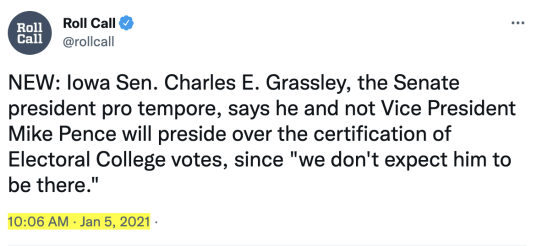
I’m posting this not so much because Grassley’s name comes up as he was next in line to sub for VP Mike Pence (another topic), but because I want as many people as possible to experience first hand just how diabolical the Republican plan to overturn the election was, and how serious they were about executing its success.
The shocking, brazen, horrifying coup plan to overturn the votes during the electoral count at the Capitol on January 6, laid out in cold blooded detail in this PDF doc is a must read.
This email between Kenneth Cheseboro and Rudy Giuliani includes the justifications they planned to use in the media, how they would avoid looking partisan, etc. It describes exactly how it was going to go down including the precise moment Pence would recuse himself, what they had instructed him to say when he recused, Grassley being in line to take over for Pence, and when they ultimately would simply refuse to abide by the Arizona court’s decision.
Here is a copy/paste of pages 2 and part of page 3 of 5 pages. Links below.
Click to access GPO-J6-DOC-Chapman004708.pdf
Unfortunately, as mentioned in my text, I lost the several-page memo I had nearly finished due to a reboot on the hotel computer. Rather than rewrite it now, and further delay, here are some quick notes on strategy.
I have not delved into the historical record (Vice President Pence’s counsel has, and seems totally up on this, and I’m sure there are many other lawyers who can add a great deal, John Yoo in particular), and am writing this with reference 3 law review articles I happen to have taken with me. which I attach as references: Kesavan. 80 N.C. L. Rev. 1653 (2002): Nagle. 104 N.C. L. Rev. 1732 (2004); and Foley, 51 Loyola U. Chi. L.J. 309 (2019).
The bottom line is I think having the President of the Senate firmly take the position that he, and he alone, is charged with the constitutional responsibility not just to open the votes, but to count them — including making Judgments about what to do if there are conflicting votes – represents the best way to ensure:
(1) that the mass media and social media platforms, and therefore the public, will focus intently on the evidence of abuses in the election and canvassing: and (2) that there will be additional scrutiny in the courts and/or state legislatures, with an eye toward determining which electoral slates are the valid ones. And it think this strategy can be carried out with surrogates of the President and Vice President, with them standing mostly above the fray, urging only that there be real scrutiny of what happened in this election, and that they’re willing to live with the result as long as there is a serious look, especially by the state legislatures, at what happened there, to ensure it will never happen again.
I think having the President of the Senate use the defensible claim that he is in charge of counting the votes as leverage to obtain that needed scrutiny would be worthwhile even if it couldn’t ultimately prevent the election of Biden and Harris. The Republicans used this argument in 1877 as leverage, and with it managed to get an election commission created which elected Hayes. Republicans should use ii again.
Here is a chronology of how things could play out, if there is a serious effort to employ the argument that the President of the Senate counts the votes.
Jan 3-5, and perhaps before then
Committees of the Senate hold hearings detailing widespread violations of law, and fraud, in the election in the states at issue. (Apparently Ron Johnson already has one planned for this week.) Idea would be to buttress the substantive basis for the President of the Senate later refusing to count votes from those States, absent more needed scrutiny.
Also, there is a hearing in the Senate Judiciary Committee exploring the constitutional question of how the votes must be counted, with at least two highly qualified legal scholars concluding that the President of the Senate is solely responsible for counting the votes, and that the Electoral Count Act is unconstitutional in dictating limits on debate and dictating who wins electoral votes when there are 2 competing slates and the House and Senate disagree.
Jan. 6. The House and Senate assemble for the opening and counting of the votes.
The theme that the counting of the votes will proceed on a strict textual, originalist basis proceeds when Vice President Pence steps up to the podium, to cause the first break with the procedures set out in the Electoral Count Act.
The Electoral Count Act states that House and Senate shall meet in the House on Jan. 6 at 1 p.m., “and the President of the Senate shall be their presiding officer.”
The Vice President announces that he will not serve as presiding officer, for two reasons. First, Congress cannot, by statute, impose duties on either the President or Vice President beyond those set out in the Constitution. For example, Congress could not by statute require the President to throw out the first ball on opening day of the baseball season. Likewise, the Vice President’s duties are precisely set out in the Constitution, and Congress may not add to them. See Kesavan at 1700-01, note 213.
Two, even if Congress can mandate that a Vice President, in general, must preside over the electoral count, Pence takes the position that he should not, and cannot, in this instance, preside, because he has a conflict of interest, as one of the candidates for election. See id. at 1698-99. Thus, one of the Senators or Representatives should be selected to serve as the presiding officer Id. at 1700.
Note that Pence so far has only indicated that he will not serve as presiding officer, based on a constitutional objection to Congress imposing extra duties on the Vice President.
It is a separate matter whether he will have a role in the joint session itself. Because the Vice President clearly serves as the President of the Senate, and the Twelfth Amendment states that in the joint session, “[t]he President of the Senate shall, in the presence of the Senate and House of Representatives, open all the certificates and the votes shall then be counted.”
So by the constitutional test, he should perform that role, unless he has a constitutionally valid reason not to. After a presiding officer is selected, he or she will then ask Vice President Pence to open the envelopes, starting with Alabama.
At this point, the Vice President will recuse himself, on the basis that as a candidate for election himself, and given that there is dispute about the electoral votes of some of the States, and especially given that it might well be the responsibility of the President of the Senate to actually count the votes, he has a conflict of interest, and he feels he cannot participate in the proceeding — just as Vice President Humphrey recused himself in the January, 1969, electoral vote count. See Kesavan at 1702 n.219. And just as the Vice President, who presides during impeachment trials, does not preside during an impeachment trial of the President.
At this point, the Vice President will have emphasized the need for focus on plain language and adherence to the Constitution, by rejecting the role of presiding officer imposed by the Electoral Count Act. He will also have made clear that he and the President are not going to be involved in counting the votes concerning their own election, which is why he feels bound to recuse himself on conflict-of-interest grounds, just as a Democrat did previously.
Of course, politically this will insulate him and the President from what will happen next.
For it is much easier for someone acting as President of the Senate to defend the prerogatives of the office if he has no conflict of interest (other than, of course, a patisan interest, which is unavoidable).
In the absence of the Vice President, the president pro tempore acts as the President of the Senate, and thus is the one with the sole power and responsibility to play that role in the joint session. So regardless of whether it is Chuck Grassley or another senior Republican who agrees to take on the role of defending the constitutional prerogatives of the President of the Senate, whoever it is then proceeds to open and count first Alabama, and then Alaska, at which point Trump and Pence are leading 12-0.
He then opens the two envelopes from Arizona, and announces that he cannot and will not, at least as of that date, count any electoral votes from Arizona because there are two slates of votes, and it is clear that the Arizona courts did not give a full and fair opportunity for review of election irregularities, in violation of due process.
Jack Wilenchik has filed an excellent cert. petition to that effect, pointing out that the Arizona courts simply rubber stamped the election results in their rush to meet the Dec. 8 “safe harbor” date which, in this context, is irrelevant, and which is contained in an unconstitutional statute. So we are lucky that Arizona will be the first contested state in the electoral count.
Unless by then the Supreme Court has taken that case and rejected it on the merits, the President of the Senate can make his own judgment that the Arizona proceedings violated due process, so he won’t count the votes in Biden’s column.
But, reprising the theme of modesty, and making clear that he is not using the power of his position to throw the election to Trump and Pence, he refuses to count Arizona in the Trump-Pence column. He says that if Arizona wants to be represented in the electoral count, either it has to rerun the election, or engage in adequate judicial review, or have its legislature appoint electors.
After Jan. 6
 Blog For Iowa