
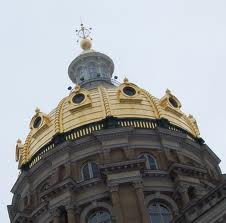
Iowa State Capitol
Gender Disparity in State Houses
There is still much work to be done if women are to achieve overall gender equity in representative democracy leadership.
House Minority Leader Mark Smith put out an e-newsletter that announced a remarkable statistic. For the 2015 legislative session, 49% of the House Democratic caucus was composed of women, making it one of the most gender-balanced state bodies in the nation.
But this is a narrow statistic, and though twenty-one of the forty-three Democrats in the Iowa House are women, only six of fifty-six Republican state house representatives are women (11%).
The numbers of women in the Iowa Senate are much worse. While six of twenty-six Democratic Senators are women (23%), just one out of twenty-four Senate Republicans are women (4%). Altogether, 22.7% of Iowa legislators are women, behind the national average of 24.4%. Right now there are thirty-four women who have gaveled in for the 2015 session of the Iowa legislature, one behind the record high of thirty-five women who served in the 2009 and 2014 sessions.
Iowa Democrats seem to do a better job of selecting women to be in its caucus leadership. Democrat Pam Jochum is the Senate President, and two of the four assistant majority leaders and three committee chairs are women. The only female Republican senator, Amy St. Clair, while not selected as a leader in her caucus, is a minority chair on the Education Committee.
In the Republican controlled House, only one woman is in leadership, Majority Leader Linda Upmeyer, and three Republican women are Committee Chairs. Eight Democratic women serve as ranking members of committees.
How do women fare in other states?
According to the National Conference on State Legislatures, approximately 1,785 women will serve in the 50 state legislatures in the 2015 legislative session, essentially no change from the proportion in the 2014 sessions. Iowa ranks ahead of seventeen states, but behind thirty-two states.
Nebraska has the fewest women in raw numbers with only ten women elected to its legislature. Since this is the only state with non-partisan elections, one wonders if women would have better or worse chances if associated with a party? Of the 1,785 women serving this year in state legislatures, 1073 are Democrats, 698 are Republicans, four are third party, and ten are those “non-partisan” Nebraskans.
Louisiana has the lowest percentage rate with only 12.5% of its legislators who are women, followed closely by Oklahoma with 12.8%.
Colorado has the highest rate with 42% of its legislators who are women, followed by Vermont with 41.1%. New Hampshire leads the way with one hundred twenty-two women in its extraordinarily large legislature.
Illinois is 31% female, Minnesota is 33%, Missouri is 24.4%, Wisconsin is 25%, and South Dakota is 21%.
The strangest part of all these numbers, however, is that when women run for office, they actually do quite well. According to Political Parity:
“Conventional wisdom often holds that women candidates have a more difficult path to elected office than their male counterparts. However, recent studies of the performance of women candidates demonstrate that they fare the same as, if not better than, men in similar races. The greatest issue in increasing the ranks of women to elected office is the significant lack of female candidates.”
Since voters seem to have no problem electing women, both parties, as well as non-partisans need to do a much better job of recruiting women to run for office.
Tracy Leone
Organizer
Iowa Federation of Labor
 Blog For Iowa