

Local Farm
Some of us are not over replacing James Harlan with Norman Borlaug in the National Statuary Hall. Give me a Free Soiler, abolitionist and friend of Abraham Lincoln over agriculture’s “greatest spokesperson” to represent the State of Iowa any day. Borlaug is recognized for “a series of research, and development, and technology transfer initiatives, occurring between the 1940s and the late 1960s, that increased agricultural production worldwide, particularly in the developing world, beginning most markedly in the late 1960s.” The reverence showed Borlaug may be okay to an extent, but in addition to being the father of the Green Revolution, he shares parentage of so-called industrial agriculture which runs against Iowa common sense.
There is substantial debate over how to feed the growing global population.
“Unfortunately the debate over how to address the global food challenge has become polarized, pitting conventional agriculture and global commerce against local food systems and organic farms,” wrote Jonathan Foley in a National Geographic article titled, “A Five Step Plan to Feed the World.”
“The arguments can be fierce, and like our politics, we seem to be getting more divided rather than finding common ground,” Foley continued. “Those who favor conventional agriculture talk about how modern mechanization, irrigation, fertilizers, and improved genetics can increase yields to help meet demand. And they’re right. Meanwhile proponents of local and organic farms counter that the world’s small farmers could increase yields plenty—and help themselves out of poverty—by adopting techniques that improve fertility without synthetic fertilizers and pesticides. They’re right too.”
Iowa farmer George Naylor was quick to set the record straight after Foley’s article. “Without serious assessment and commitment, the five steps to feed the world serve as a smokescreen for full speed ahead, corporate profitability dictating our lives based on turning Mother Nature into money,” Naylor wrote.
Both articles are worth reading, and there is more.
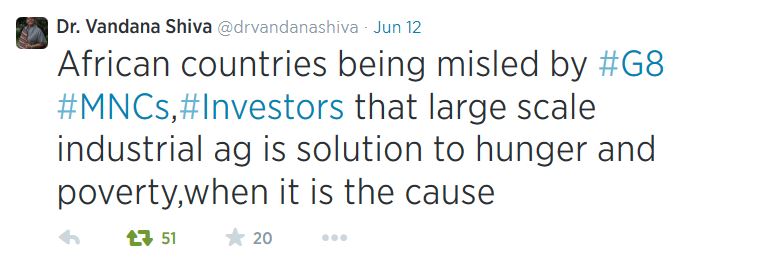
Dr. Vandana Shiva is an environmental activist and anti-globalization author who last Thursday publicized the work of the Alliance for Food Sovereignty in Africa in a series of case studies. These examples of alternatives to industrial agriculture went almost unnoticed in the corporate media, and are worth a look. Dr. Shiva has been denounced by Monsanto and others:
 In 1970, as a freshman at the University of Iowa, I suggested that organic farming was a better alternative to row cropping in an engineering class. I was reviled by the sons of row croppers who said corn and soybeans wouldn’t survive without pesticides. Since then, I have learned a lot about organic growing and local food systems, and have been particularly influenced by the story of Cuba after the former Soviet Union stopped oil imports used in industrial agriculture there. If readers haven’t seen The Power of Community, the 53:06 minute film is a good explanation of what is possible with a local food system. A sustainable, local food system has tremendous capacity to feed the world without the environmental issues created with conventional agriculture.
Some of us may have heard Dr. Shiva calling for a global food revolution. The question is was anyone listening?
 Blog For Iowa