
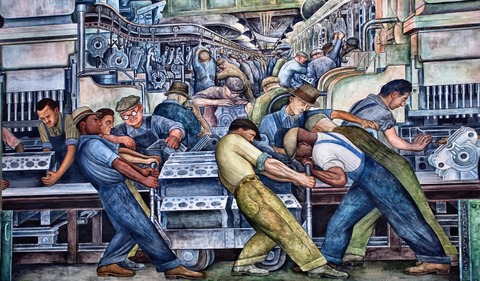
When Detroit became the largest U.S. city to declare bankruptcy last year, it triggered a process by which all the city’s assets would be thrown out on the lawn like a foreclosed home whose contents would be pilfered through by neighbors and strangers alike for their potential value.
And as the objects that made the house a home are reassessed in this new shameful context, what was once considered essential – priceless, in fact – is now valued at pennies on the dollar to expedite the financial settlement so everyone can quickly move on.
Such is the context for the extraordinarily painful negotiations taking place in Detroit right now as the Detroit Institute of Art’s collection has become the city’s main bargaining chip for the billions of dollars in unfunded debt on pension and health benefits owed to current and future retirees. The publicly-owned collection includes Bruegel’s “The Wedding Dance,” Rodin’s “The Thinker,” a self-portrait by Van Gogh, and Diego Rivera’s masterpiece mural depicting Detroit’s since-collapsed auto industry – more than 66,000 pieces altogether.
If accomplished, this will be the largest liquidation of public art in US history, and the most recent looting of art since Iraq’s Museum was vanquished in 2003.
Stealing art during moments of crisis is nothing new. In fact it’s the norm. This was sentimentally portrayed recently in George Clooney’s film, Monuments Men, in which a troop of loveable art historians are commissioned to protect and recover stolen art from the Nazis in the waning months of WWII.
But like any good art depicting a historic event, Monuments Men should have been a commentary on the present – a kind of plea to human conscience the way Arthur Miller’s “The Crucible” was during the McCarthy Era. But it wasn’t.
Instead, Monuments Men was a pat on the back to the Good Americans for beating the Bad Nazis and Bad Russians. There was no subtext to help us understand the looting of both the public worker’s pensions and the Detroit Institute of Art’s collection taking place today by bankruptcy judges, lawyers, hedge fund managers, investment bankers.
It contained no metaphor for Kevyn Orr, Detroit’s unelected City Manager who was appointed by Michigan’s Republican Governor Rick Snyder under the state’s controversial Emergency Manager law. “Everything is on the table,” Orr has repeatedly said regarding the negotiations.
To his credit, Governor Snyder has proposed a “Grand Bargain” that would maintain the art in the museum under the management of a private foundation and prevent its liquidation. However, creditors have accused Christies Auction House of low-balling the value of the art in the $816 settlement that would monumentally underfund the pension obligations.
And the discussion of salvaging the art at the expense of workers’ pensions has caught the ire of union leaders fighting to protect workers’ pensions. “The elevation of the city’s art above our hard-earned pensions and health care is unfair, offensive and elitist,” said Jeff Pegg, president of the Detroit Firefighters Association, reading from a statement signed by four labor leaders representing the public sector workers. “We appreciate the city’s art collection. But, stated bluntly: Art is a luxury. It’s not essential, like food and health care.”
So, in steps Financial Guaranty Insurance Company last Wednesday, which has asked the bankruptcy judge to force the city to instead sell all the Detroit Institute of Arts’ property (building included) to corporate buyout firms including Catalyst Acquisitions and Bell Capital Partners.
These negotiations are completely unprecedented, so it’s easy to forget that the monetization and liquidation of public art to ensure pensioners a dignified retirement is a most sublime corruption. We are expected to believe that the only option is to sell this art to fund constitutionally protected retirements.
Perhaps the acrimony caused by these insane negotiations will bog it down in so much red tape that people come to their senses and realize this entire bankruptcy is illegal, immoral, that the sale of the art that belongs to the people of Detroit is blocked?
Perhaps Congress will propose a federal bailout for the workers’ pensions, similar to the one they passed in 2008 to bail out the very banks who are now clamoring to get their hands on their very own Van Gogh?
Or perhaps Clooney will make another movie before he heads back to Darfur that more artfully depicts a public and cultural crisis of catastrophic dimensions?

 Blog For Iowa
If these works of art are liquidated like any asset on a balance sheet, the sale would represent yet another way that wealth transfers to the richest fraction of one percent in the world. Who else could afford to buy some of these pieces? With the city in bankruptcy, this is a sticky wicket all around, and worth watching. Thanks for raising this complex issue Tracy.
LikeLike