
 Whatever Happened to Bipartisanship
by Ralph Scharnau
Partisan rancor has always been a part of our political landscape. The two major parties have fundamental disagreements about a wide range of social, economic, and foreign policy issues. A two-party system in a separation-of-powers arrangement like ours means that the parties try to turn their principles into practical choices on the great issues of the day.
Since the 2010 elections, however, we often hear about an unprecedented level of outrage over a Congress referred to as dysfunctional and Washington politics as toxic. Compromise and bipartisanship seem virtually nonexistent. Many citizens find the current level of gridlock not only frustrating but also inexcusable, and public approval ratings for Congress have reached historic lows.
Which party bears primary responsibility for this impasse? In an essay adapted from their new book, It’s Even Worse Than It Looks: How the American Constitutional System Collided With the New Politics of Extremism, co-authors Thomas E. Mann, a senior fellow at the liberal Brookings Institution, and Norman J. Ornstein, a resident scholar at the conservative American Enterprise Institute, provide an answer. They write,
“The GOP has become an insurgent outlier in American politics. It is ideologically extreme; scornful of compromise; unmoved by conventional understanding of facts, evidence and science; and dismissive of the legitimacy of its political opposition.”
During the Obama administration, Republicans often mounted vehement opposition to most presidential initiatives. They employed strategic and unyielding partisanship on such issues as fiscal matters, climate change, and health care reform. This came easily in the House where they had a clear majority. But in the Senate where Democrats held a slight majority, Republicans routinely used the filibuster, requiring a supermajority of 60 votes, to block even widely supported bills or presidential nominations.
Hopes for bipartisanship and compromise seem doomed since Senate Republican leader Mitch McConnell announced after the 2010 elections that the top priority of his party is to deny Obama a second term as President. More recently, Rep. Allen West, a Florida Republican, even made the incredibly bizarre claim that there are “78 to 81” congressional Democrats who are members of the Communist Party.
President Obama, a mediator by instinct and experience, believes that standing on party principles need not preclude finding common ground around the edges. During his first term, Obama often reached out to the Republicans in a futile attempt to reach bipartisan agreements. Although never realized, Obama’s apparent willingness to trade cuts in Social Security for deeper deficit reduction angered some Democrats as a betrayal of the party’s core philosophy.
To Republicans, however, bipartisanship means all Republicans joining a minority of Democrats to enact Republican policies. In Indiana, Richard Mourdock, a tea party Republican, became the Republican U. S. senatorial candidate by defeating long-time moderate Senator Richard Lugar. Mourdock wants to purge the Republicans Party of those who fail to embrace his brand of orthodoxy, and he defines bipartisanship as occurring when Democrats join Republicans.
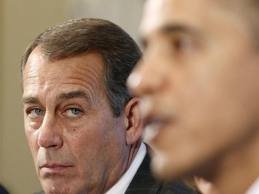
Speaker of the House John Boehner articulated a similar tactic when he stated that Republicans will do everything they can to stop or at least slow down Obama’s agenda. At the same time he noted that Republican goals would constitute the starting point for any cooperation with the President.
Washington is no longer a place for cooperative problem solving. While Democrats usually do not veer outside the bounds of normal robust politics, Republicans have emerged as an obstructionist party without a positive agenda.
Vigorous debate between political parties is an essential component of American democracy. But the current poisonous partisanship in politics impedes progress on issues of vital importance to the nation. And for this we can mostly thank the Republican Party.
Ralph Scharnau teaches U. S. history at Northeast Iowa Community College, Peosta. He holds a Ph.D. from Northern Illinois University. His publications include articles on labor history in Iowa and Dubuque. Scharnau, a peace and justice activist, writes monthly op-ed columns for the Dubuque Telegraph Herald.
 Blog For Iowa
I enjoyed your opinion piece, Ralph.
LikeLike