
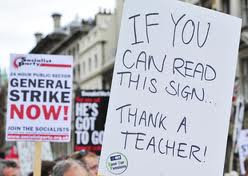
 Teachers Fight For Way Of Life
22,000 members of the Chicago teachers union voted to strike
For several years now, heavy-handed centralized management of the Chicago Public School system – by a CEO nonetheless, not even a superintendent – have alienated parents, community organizations, students, teachers and support staff.
The days of Harold Washington’s democratic reforms establishing neighborhood control through local school councils are long gone, and onerous federal mandates from No Child Left Behind have tied funding to standardized tests and teachers to filling out endless paperwork rather than practice the art of teaching. The Board of Education, still a democratically elected organization in Iowa, is now appointed by the Mayor himself and not directly beholden to the voters of Chicago.
This management style, where performance measures distract anyone from understanding Thoreau’s writing or pondering on the unfolding mystery of DNA, has produced dozens of local school closures. It’s diverted more funds into charter schools that have proven no better at educating children, but better at shifting funding from school workers salaries and into creating profits for charter school managers.
It’s sent children on busses and trains to schools outside their community without producing measurable improvements. The CPS remains quite exceptional, however, at producing high school dropouts at a consistent rate of 50%. A mere 6% of them get a bachelor’s degree. Oh, it has also succeeded in opening five new military academies.
So it’s not surprising – even in a post Walker-Wisconsin World – that more than 90% of teachers voted to authorize a strike last week in the Chicago Public School District.
Mind you, the threshold for authorizing a strike was recently raised by the Mayor’s Democratic friends in Springfield to be more than 75%, not the simple majority still required at all other school districts in the state. This difficult threshold not only counts those who voted, but the entire organized workforce. Imagine if corporate boards or the legislators in Springfield had to operate based on these hefty measures.
But the teachers, led by a grassroots activist coalition CORE that was elected just two years ago reaches across the district, use the old-fashioned organization model to build support. They effectively communicated with other teachers, parents and communities the majority of whom are also upset at the closure of local schools and libraries.
To counter this strategy, the Chicago School District CEO for the first time ever is using robocalls to reach out to parents– traditionally a stalwart of electoral politics not public sector negotiating. Democrats for Education Reform is paying for the costs of the calls rather than the district itself. Don’t be fooled by this Astroturf school reform group. Despite the positive liberal sounding name, Democrats for Education Reform is actually a for-profit charter school advocacy group run by hedge fund managers and other people in the financial industry.
Stay tuned as this drama unfolds. Chicago teachers haven’t actually gone on strike since 1987. But with Chicago’s rich history of progressive education reforms (John Dewey & Jane Adams) let’s hope that this community-based activism results in truly democratic reforms instead of the corporate model that has failed two decades of Chicago school children.

 Blog For Iowa