
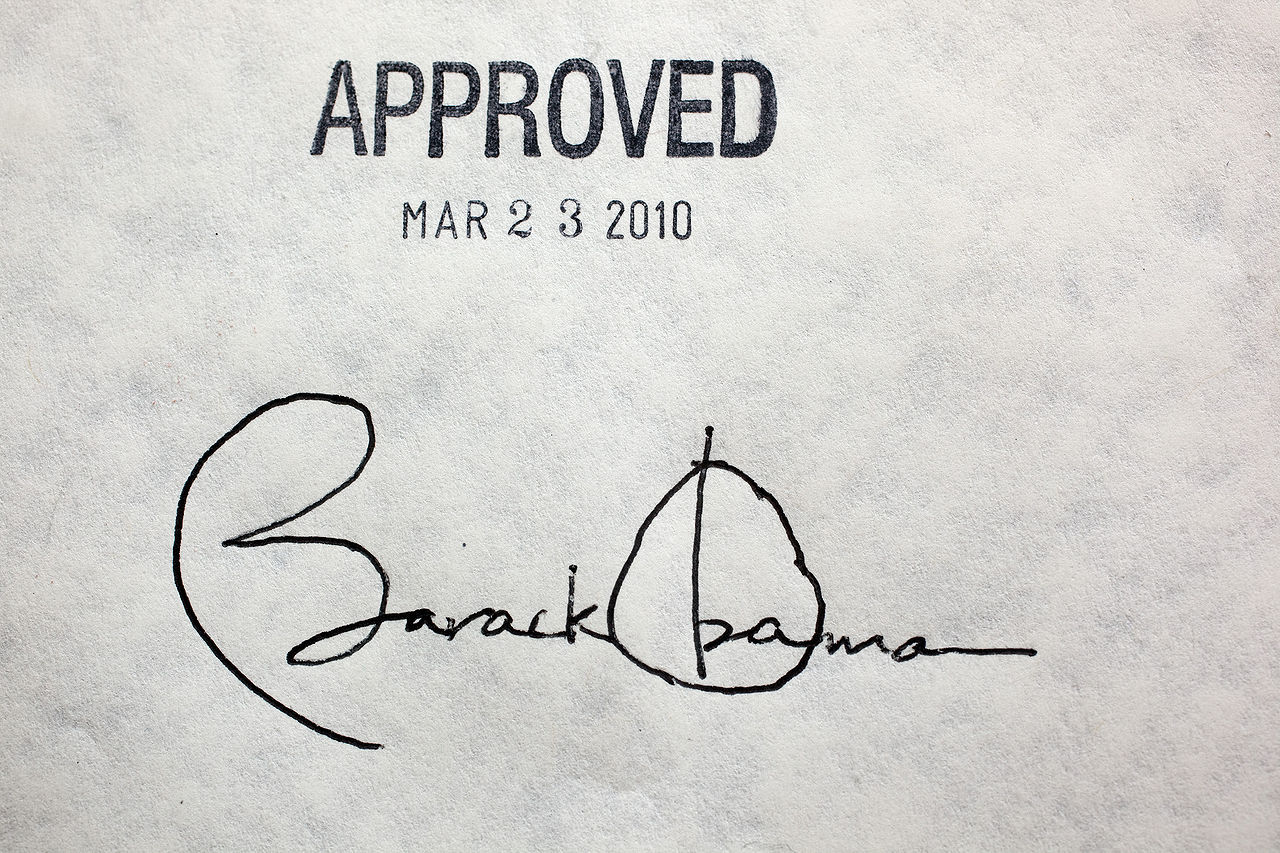
Affordable Care Act Signature
by Ralph Scharnau
The Supreme Court has agreed to rule on the constitutionality of the 2010 Affordable Care Act (ACA). This act is the most sweeping piece of domestic legislation since the passage of Medicare in 1965.
ACA requires everyone, healthy as well as sick, to buy insurance or face a penalty, while aiding those for whom this is a financial hardship. This system is already working in Massachusetts where it passed with the support of Governor Mitt Romney in 2006.
Under ACA, those who have good health benefits from employers can keep them. The act is aimed at Americans who fall through the cracks, either going without coverage or relying on the miserably malfunctioning individual “non-group” insurance. The issue becomes more urgent because fewer and fewer jobs come with health benefits, and, at the same time, employment-based coverage continues to decline.
Although not without flaws, the Affordable Care Act improves our health care system. It extends coverage to approximately 30 million uninsured people, and it expands Medicare to about 15 million low-income people. It prohibits the insurance industry from: refusing coverage to those with pre-existing conditions, ending coverage for the sick, discriminating against women, and putting annual and lifetime payment limits on overall coverage. Seniors get help with high drug costs, small businesses get tax credits for providing coverage, and children can stay on their parents’ plans until age 26. The legislation also launches a variety of public initiatives to prevent disease and encourage healthy behavior which will cut health care costs.
A vitriolic debate has erupted over this landmark health care law and the limits of federal power. At the center of the legal controversy over the act is the so-called “individual mandate.” Upholding the mandate would simply mean that the “healthcare market” which virtually everyone participates in would not allow free-riders and that Congress has the power to regulate that market. The individual mandate imposes an affirmative duty to buy health insurance. Other federal laws impose similar duties, such as paying taxes, registering for the draft, and providing safe workplaces. The mandate is irrelevant to the 80 percent of non-elderly Americans who already have insurance, either through their employers, government programs, or purchased on their own.
The individual insurance requirement that the court is reviewing isn’t the first federal mandate involving health care. There’s a Medicare payroll tax on workers and employers and a requirement that hospitals provide free emergency services to indigents.
The court decision, expected in June, will affect the way virtually every American receives and pays for health care. The justices’ decision will become a significant part of this year’s presidential and congressional election campaigns.
It is unclear what the court will do in the end, whether it will let the law stand, strike the whole thing down, or invalidate only the mandate. Lee Epstein, a political scientist and lecturer at the University of Southern California Gould School of Law, stated, “The political science side of me,” sees a 5-4 decision to strike the law while “the law professor side of me” sees it 6 to 3 to uphold. If the court invalidates the mandate, the law risks losing funding from a larger pool of premium payers necessary to provide coverage to newly insured individuals.
It should be remembered that our federal government has the judicially affirmed power under our Constitution to use public revenues to provide a needed public service such as education, national security, retirement insurance, or health care. We really need health care reform that simply extends Medicare and Medicaid coverage to all who want and need it while allowing others to opt out for private insurance coverage.
Ralph Scharnau teaches U. S. history at Northeast Iowa Community College, Peosta. He holds a Ph.D. from Northern Illinois University. His publications include articles on labor history in Iowa and Dubuque. Scharnau, a peace and justice activist, writes monthly op-ed columns for the Dubuque Telegraph Herald.
 Blog For Iowa