
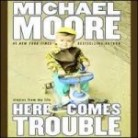
 Some say Here Comes Trouble: Stories From My Life is Michael Moore’s best work. Full disclosure: I’m a big Michael Moore fan. I’ve read all of his books and have seen all of his movies. Picking a favorite is like trying to pick a favorite child or Beatles song. Roger and Me, Bowling for Columbine, Fahrenheit 9/11, Sicko – they are all great. My favorite thing in Sicko was the inclusion of Don’t Be Shy, from the movie Harold and Maude. It was the perfect choice for the closing song. And there’s a special place in my heart for one of Moore’s earlier books, Stupid White Men…And Other Sorry Excuses For The State Of The Nation – absolutely hilarious and it made some very good points. Probably a bit ahead of its time though.
Here Comes Trouble is different from his other work – it is more personal and autobiographical. It’s simply stories from his life that shaped him. But it is also political.
There is the chapter where he is a kid on a family vacation in Washington DC and during a visit to the capitol somehow gets separated from his mother and finds himself on an elevator with Bobby Kennedy who waited with him until his mother was found. Moore thinks of this encounter later when he hears the news that Kennedy was assassinated.
There is a chapter about the time he and his teen-age buddies, worried about their draft number getting lower with each passing year during the Viet Nam war, made a reconnaissance trip to Canada to see how difficult it would be to cross over just in case they needed to.
In this book you’ll find out how it happened that Moore was one of the youngest persons to hold public office when he ran for the school board while he was still in high school and won.
And did you know that he spent a year in the seminary before he decided not to become a priest? I won’t even go there. You just have to read it yourself.
Before reading HCT, I assumed that Michael Moore was a guy who basically just hung out until he reached adulthood and then started making documentaries, probably had a degree in filmmaking or something like that. Not true. He’s been an activist, exposing and standing up to abuse and corruption basically his whole life. He includes in the book an account of a time he failed to speak up when he witnessed abuse and his deep regret over it.
He started a school newspaper when he was in the 4th grade. Long before Moore ever made a movie, he ran an alternative newspaper called the Flint Voice, later the Michigan Voice. (You’ll have to read the book to learn what the singer Harry Chapin had to do with this). For about a decade, the paper did what newspapers should do – exposed corruption without apology and without backing down.
“The Flint voice was a true muckraking paper that didn’t care who it pissed off. We did not do cover stories on the “Ten Best Ice Cream Places in Town” or “Twenty Day Trips You’ll Want to Take.” Our journalism was hard-hitting and relentless. We did sting operations on establishments that would not hire black employees. We chronicled how General Motors was taking tax abatement money and using it to build factories in Mexico. One night, we caught them literally dismantling an entire GM assembly line, loading it on a train, and sending it off to be shipped to a place called China….the plan by GM to destroy Flint [was] a story that only we would cover in the late ’70s and early ’80s.”
The police once raided his printing office, sparking a sequence of events that ended up with Michael Moore being asked to testify before Congress, (to which he replied, “I’m not really good at that sort of thing”) and a law being passed that would protect newsrooms from police raids.
One chapter describes a time when Moore accompanied a Jewish friend to Bitburg, Germany, when President Reagan made an official visit to lay wreaths on the graves of Nazis. His friend had lost family members in the holocaust and the chapter describes how they somehow made it past layers of security and successfully staged a personal protest. It was one of the most sad and poignant parts of the book.
The chapter Parnassus, reads like a mini-spy thriller, and is the book’s most disturbing chapter:
“In 1986, I was witness to a murder plot. I was there, in the room, when those in charge hatched their plan to kill the American Middle Class. It took place in a penthouse of an exclusive Acapulco resort, in a private gathering organized by top officials in the Reagan administration. I snuck in and I saw it, I heard it all, and I got out alive so I could tell a story that, unfortunately, no one at the time wanted to hear or believe. ‘The death of the middle class? Planned by our own government? HA HA HA HA HA HA!!'”
This chapter tells the story of how Moore went undercover long enough to pose as a businessman (in a seersucker suit) at a posh private meeting in Mexico, billed as a 3-day conference to “assist American businesses and help them grow.” He found out about it purely by chance, having come across this ad in a business publication:
“EXPO MAQUILA ’86”
PRESENTED BY
UNITED STATES DEPT. OF COMMERCE
AND
THE AMERICAN CHAMBER OF COMMERCE IN MEXICO
DISCOVER HOW TO USE MEXICO TO BETTER YOUR BUSINESS
‘MOVING PRODUCTION HERE SAVES JOBS AT HOME’
BY INVITATION ONLY CONTACT USDOC
“I had been talking to the people in Ralph Nader’s office about coming to Washington to do some work for them. They had two dozen public interest projects going, including a magazine called the Multinational Monitor that did pretty much what its name implied. I told them about this crazy conference happening in Mexico, that it had to be some sort of joke, because why would our own Commerce Department be helping to eliminate jobs here in the U.S. and move them to Mexico? ‘The Reagan administration,’ said John Richard, Nader’s chief of staff. ‘They’ve been on a mission to do this since they took office.'”
More from this chapter:
“… the chairman of General Motors, a man by the name of Roger Smith, had recently said that ‘moving to Mexico is a matter of survival.’ I thought about this and wondered what planet was this guy on? Survival? In the previous year, 1985, GM had posted a profit just shy of four billion dollars. In the year before that, they broke their all-time record with a profit of $4.5 billion. They were the number one corporation in the world. And yet they were constantly talking about how they were “struggling” to survive. It was all a con game to somehow convince the public that if they didn’t move some of their production to Mexico, they might go under – and then the economy would collapse with them. It was a Big Lie, but at least the Reagan administration bought it and was here selling it. They were selling it because Reagan, the former union leader, wanted to crush unions. He won the presidency by getting a lot of white union workers to vote for him. Appealing to their fears – of Iranian hostage takers, of black people, of the government – he rode a wave that would eventually drown the very people who put him into office.”
The rest of the chapter is both riveting and horrifying. If you’re standing in the bookstore browsing and you only have time to read one chapter, read this one. You will want to join the Occupy movement.
The book is packed with many more fascinating and shocking stories of Moore’s more-or-less accidental stumblings into the darker side of American business, government and society that I won’t share because you should really read the book. But he has an amazing talent of making absurd things seem as absurd as they in fact are, without using satire, just through an honest look.
Oh, and I almost forgot. John Lennon called him on the phone once. You’ll just have to read about it.
Here Comes Trouble is an autobiography. It is not his usual commentary on a particular issue like guns or the health insurance industry, but it is commentary on just about all things American. It’s about us as much as it’s about him.
In Here Comes Trouble, Michael Moore entertainingly schools us in patriotism, love of country, standing up for your fellow humans, and last but not least authenticity, a quality that seems to be largely extinct. The personal stories are touching, moving, inspirational. You see why and how Michael Moore became the person that he is – a true artistic genius and a great American hero.
 Blog For Iowa
Pingback: Book review: HERE COMES TROUBLE: Stories From My Life, by Michael Moore – Taipei Times